Anthony Edwards
Anthony Edwards scored 43 points in Game 6 against the Denver Nuggets on May 18, 2024, the same night the Timberwolves closed out the reigning champions and punched their ticket to the Western Conference Finals. He was 22 years old. He went 15-of-24 from the field, 5-of-9 from three, and played with the kind of zero-hesitation force that was starting to make “can he be the best player in the league” a real question rather than a lazy projection. Minnesota hadn’t reached a conference finals since Kevin Garnett’s last great run in 2004. Twenty years between visits. Edwards ended that.
He’s known as Ant-Man. The nickname came from his initials, A.E., filtered through the Marvel character, and it fits in exactly the way good nicknames fit: small in stature relative to what he does to the people guarding him. At 6’4” and 225 pounds he plays with a physicality that looks like it belongs on a different body. He doesn’t use his size as a crutch. He goes through contact looking for it.
Atlanta, a grandmother, and Holy Spirit Prep
Anthony Edwards was born August 5, 2001, in Atlanta, Georgia. His mother Yvette raised him alongside his grandmother, who became his primary caretaker after Yvette died when Anthony was 14. His grandmother got him to every practice, every game, every early-morning session. He has spoken about her in interviews across multiple media outlets as the person who shaped his competitive drive more than any coach. He’s not wrong to say it.
Shop Anthony Edwards jersey
As an Amazon Associate we earn from qualifying purchases.
He played high school basketball at Holy Spirit Prep in Atlanta, a small private school on Atlanta’s northwest side. By his junior year he was a consensus five-star recruit, ranked among the top three players in the 2019 class by every major recruiting service. He committed to the University of Georgia.
Georgia (2019-20)
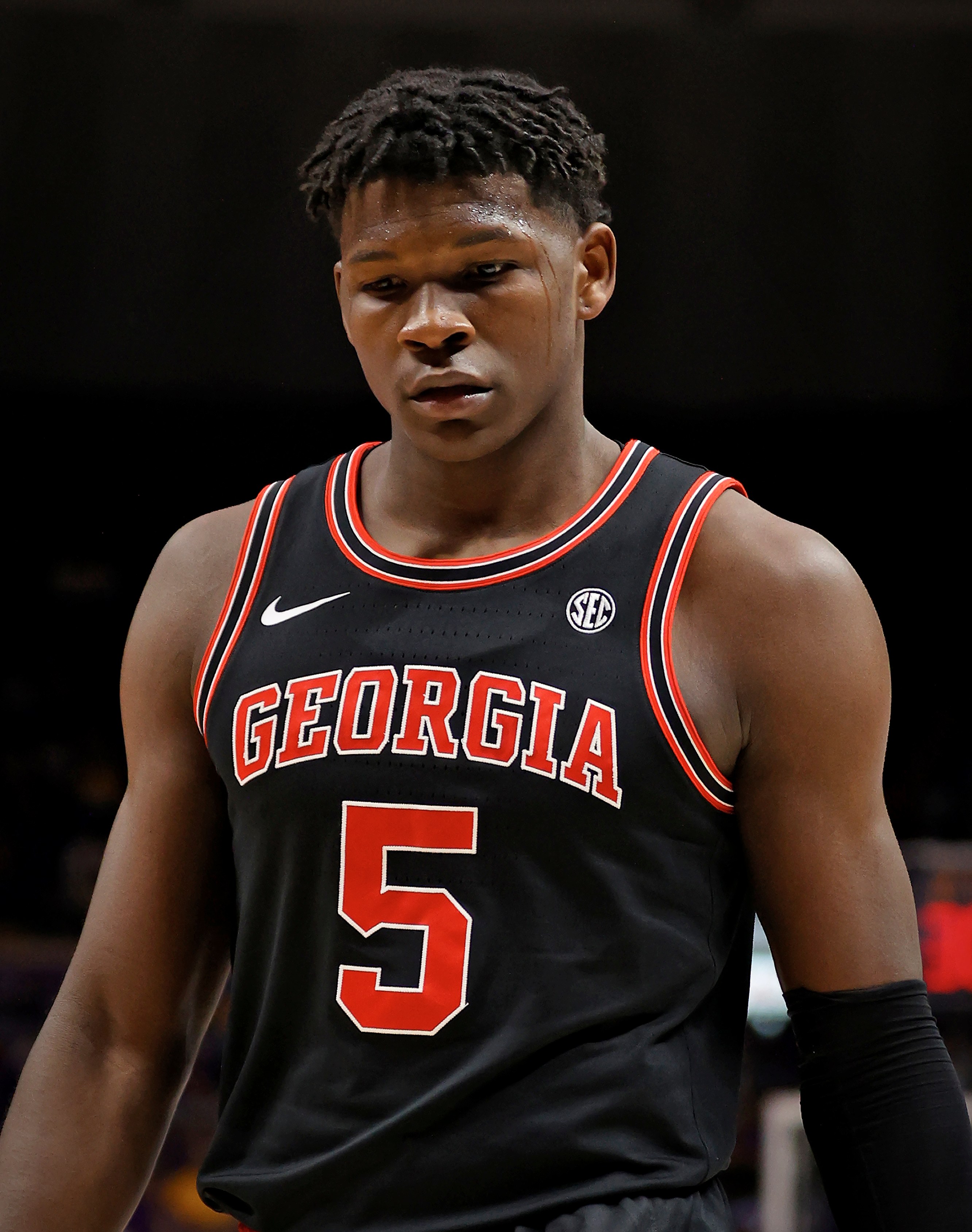
Edwards spent one season with the Bulldogs and made the most of it. He averaged 19.1 points and 5.2 rebounds per game under head coach Tom Crean, shot 40.2 percent from three on a high volume, and was named SEC Freshman of the Year. The season ended without an NCAA Tournament because COVID-19 shut down college sports in March 2020, right when Georgia was building momentum into the tournament. Edwards declared for the draft anyway. There was nothing left to prove.
His Georgia tape looked different from what scouts usually see out of one-and-done prospects. He got to his spots against SEC-level athletes without hesitation. His handle, his first step, and his straight-line burst were already NBA-ready. The question coming out of the draft process was attitude: scouts debated whether his body language in early team interviews suggested a player who was genuinely hungry or one who understood that he’d be fine regardless. His own performance answered that, eventually.
The 2020 NBA Draft and arrival in Minnesota
The Timberwolves held the No. 1 overall pick in the 2020 NBA Draft and took Edwards on November 18, 2020, at the ESPN Wide World of Sports Complex in Orlando. He was 19. Minnesota had the pick via the lottery, a result of finishing 19-45 in the 2019-20 season. They had debated, publicly and internally, between Edwards and LaMelo Ball and James Wiseman. General manager Gersson Rosas chose Edwards and has said repeatedly since that it was not a close call.
His rookie year (2020-21) produced 19.3 points and 4.7 rebounds per game, the best rookie scoring average by a Timberwolves player in franchise history. He finished second in Rookie of the Year voting to LaMelo Ball, who went third overall and produced an arguably more decorated individual season for Charlotte. The debate between the two is still running. It probably always will be.
The Finch years: building toward something
Chris Finch took over as Timberwolves head coach in February 2021 and has been the architect of the offensive system Edwards operates in. Finch’s system creates natural pick-and-roll actions for Edwards on the perimeter, maximizes his pull-up three-point game, and uses his downhill speed to generate layup opportunities and foul-line trips that keep defenses honest.
The 2021-22 Timberwolves went 46-36 and reached the playoffs for the first time since 2018. Edwards averaged 21.3 points a game and showed the defensive intensity that his rookie year had only hinted at. The 2022-23 season brought his first All-Star selection and a per-game line of 24.6 points, 5.8 rebounds, and 4.4 assists. He was 21. By every comparable development curve in recent NBA history, he was ahead of schedule.
Karl-Anthony Towns was his backcourt and frontcourt partner through most of those years. The two had a complicated dynamic, at times combustible, but on the court they were genuinely complementary: Towns at the five creating shooting gravity that defenses had to account for, Edwards in the mid-range and at the rim punishing anything that tried to sag. Rudy Gobert arrived via trade in July 2022 and the Timberwolves became a legitimate defensive team for the first time in roughly a decade.
The 2023-24 breakthrough
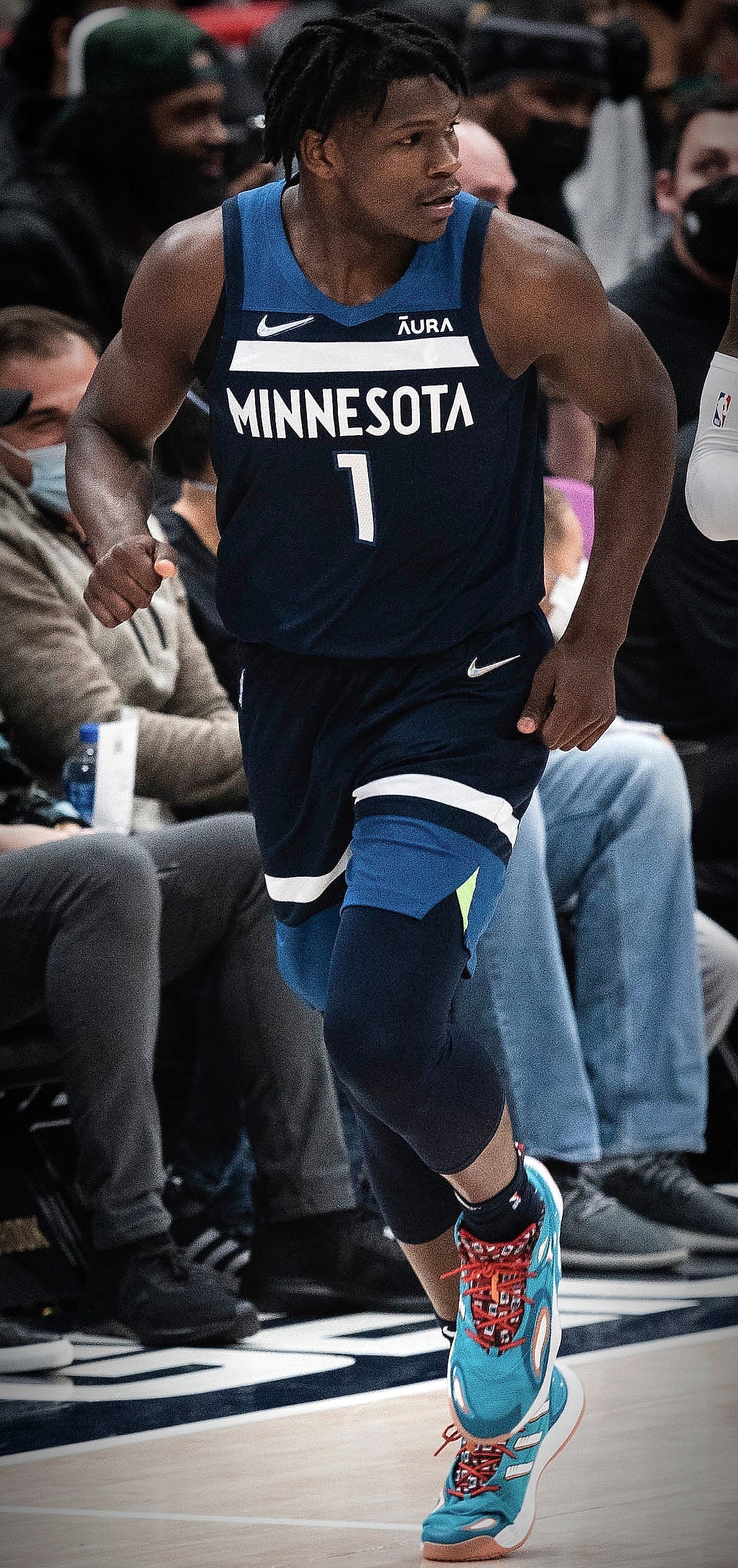
The 2023-24 regular season was the year Edwards crossed from promising star to proven one. He averaged 25.9 points, 5.4 rebounds, and 5.1 assists per game. He shot 35.7 percent from three on 7.9 attempts a game, a volume-and-accuracy combination that put him firmly in the conversation with the top perimeter scorers in the NBA. He was selected to his second consecutive All-Star Game.
But the playoffs were the real verdict.
Minnesota entered the postseason as the fifth seed. They beat Phoenix in the first round 4-0 behind Edwards averaging 29.5 points a game. The second round was the one the NBA had been building toward: a rematch of the Nuggets, the defending champions, led by Nikola Jokic.
Minnesota won in five. Edwards went for 27.0 points a game in the series, including that 43-point Game 6 blowout that ended Denver’s reign. He played physically, defensively, and without any visible deference to the team he was eliminating. Jokic was the three-time MVP. Edwards didn’t care.
The Western Conference Finals against the Dallas Mavericks were different. Luka Doncic and Kyrie Irving controlled the series tempo and Dallas won 4-1. Edwards averaged 27.1 points across the full playoffs, his best sustained scoring run to that point, but Minnesota’s offensive margin wasn’t enough against Dallas’s superior ball movement in the late games of the series. He was 22 years old. First conference finals. He’ll be back.
2024-25 and 2025-26
Edwards entered the 2024-25 season as one of the five or six most marketable players in the NBA, with Nike’s marketing infrastructure behind him and a reputation built on two years of playoff performances that genuinely moved the needle. The Timberwolves’ roster shifted; Karl-Anthony Towns was traded to the New York Knicks in September 2024 in a deal that brought Julius Randle and Donte DiVincenzo to Minnesota. The league understood immediately that the Timberwolves were now officially Edwards’s team, full stop.
His per-game averages through 2024-25 continued to reflect the growth curve. The three-point shooting, always the question, solidified. His pull-up game became something opposing defenses had to game-plan for specifically, not incidentally.
The 2025-26 season is his age-24 campaign. The Timberwolves are built to win now. Edwards has not been in an NBA Finals. That’s the only box left unchecked that matters.
How he plays

Edwards is a downhill scorer with a quick-twitch first step that creates separation before most defenders can load up to guard it. His catch-and-shoot three-point percentage has improved every season. His pull-up off the pick-and-roll is the primary weapon, a shot he gets to at any spot on the floor because his handle is good enough to change speeds and lose a defender in the time it takes them to get set.
He’s an above-average defender when engaged, which he is more consistently than his early-career reputation suggested. His lateral quickness, combined with the 225-pound frame, makes him a natural switch candidate on either wing. Finch has used that in late-game defensive assignments, putting Edwards on the opposing team’s primary creator in crunch time.
The comparison that comes up most often is Dwyane Wade, and it’s apt for the physical game. Both players have the attacking-style, contact-absorbing nature to their offense. Edwards is a better three-point shooter than Wade ever was, which matters enormously in the modern game. He’s not as creative a passer as Wade was at the same age. Different strengths, same irresistible going-to-the-basket quality.
The simpler comparison, which some Timberwolves people have started saying out loud, is that he plays the game the way someone who never worried about being stopped would play it. His confidence is not performed. It shows up in Game 6 of the second round against the defending champs when most players tighten up, and it looks exactly the same as it does in November.
Gear
Grab a card blaster to build out your Ant-Man collection.
Panini NBA card blaster on Amazon →
Sources
- Basketball-Reference: Anthony Edwards.
- The Athletic, coverage of the 2024 Timberwolves playoff run, including the Denver series and Western Conference Finals vs. Dallas. See The Athletic Minnesota Timberwolves.
Shop Jerseys & Fan Gear at Fanatics
As a Fanatics affiliate, we may earn a commission from qualifying purchases.
Shop on Amazon
As an Amazon Associate, we earn from qualifying purchases.
Shop Sneakers & Gear at JD Sports
We may earn a commission from qualifying purchases on JD Sports.