Golden State Warriors
The Golden State Warriors are one of the three founding franchises still operating in the NBA. They trace their history to the 1946 Philadelphia Warriors of the Basketball Association of America, won the BAA’s first championship in 1947, stayed in Philadelphia until 1962, moved to San Francisco that year, took the “Golden State” branding in 1971 when the team split home games between Oakland and San Diego, and have played in the San Francisco Bay Area continuously since. The franchise’s seven championships divide cleanly by era: three in the first three decades (1947, 1956, 1975), four in the modern Curry-Thompson-Green dynasty (2015, 2017, 2018, 2022). The forty-year gap between 1975 and 2015 is the longest championship drought of any “Original Eight” BAA franchise, and it is the context that makes the 2015–2022 run one of the two or three most-analyzed dynasties of the modern era.
Philadelphia, 1946–1962
The Philadelphia Warriors were among the eleven founding BAA franchises, established at the Commodore Hotel meeting in New York on June 6, 1946. Peter Tyrell and the Philadelphia sports-owner group assembled the franchise; Eddie Gottlieb was hired as head coach. Joe Fulks, acquired in the BAA’s 1946 “territorial” pre-draft, was the league’s first scoring star at 23.2 points per game in the 1946–47 season.
The 1946–47 Warriors won the first BAA championship in five games over the Chicago Stags. It is the earliest championship still recognized as a title in NBA history after the 1949 BAA-NBL merger that produced the current NBA. Fulks was the Finals scoring leader. The franchise would not win another title until Wilt Chamberlain arrived twelve years later.
Shop Golden State Warriors merchandise
As an Amazon Associate we earn from qualifying purchases.
Chamberlain, a Philadelphia native and Overbrook High School graduate, signed with the Warriors in 1959 after a year with the Harlem Globetrotters under the NBA’s then-extant territorial-rights rule. The 1959–60 Warriors won 49 games; Chamberlain averaged 37.6 points and 27.0 rebounds and was both Rookie of the Year and MVP, still the only player to win both in the same season. The 1960–61 team lost in the Eastern Division Finals.
On March 2, 1962, Chamberlain scored 100 points in a 169–147 win over the New York Knicks at the Hershey Sports Arena in Hershey, Pennsylvania. It is still the single-game scoring record in NBA history. The 1961–62 Warriors, 49–31, were the last Warriors team to play in Philadelphia.
San Francisco, 1962, and the second championship
Owner Franklin Mieuli purchased the Warriors in 1962 and moved the franchise to San Francisco in June 1962, ten years ahead of the Lakers’ Los Angeles move and the single event that brought the NBA to the West Coast. The San Francisco Warriors played their first two seasons at the Cow Palace in Daly City. They reached the NBA Finals in 1964 and 1967, losing both times to the Boston Celtics. Chamberlain was traded to Philadelphia in January 1965 in exchange for cash, Connie Dierking, Paul Neumann, and Lee Shaffer.
The “Golden State” rebranding, and Rick Barry’s 1975 title
The franchise took the “Golden State Warriors” name in 1971, during a season in which the team was splitting home games between the Oakland Coliseum Arena and the San Diego Sports Arena. The Golden State name was chosen to reflect the full-state regional branding rather than the city-specific “San Francisco” or “Oakland” naming. Home games consolidated in Oakland in 1972, and the team played all subsequent home games at the Oakland Coliseum Arena (later Oracle Arena) through the 2018–19 season.
The 1974–75 Warriors, coached by Al Attles and led by Rick Barry (who had played for the ABA’s Oakland Oaks from 1968 to 1972 before returning to the NBA via the San Francisco franchise), swept the Washington Bullets 4–0 in the 1975 NBA Finals. It was the single most-unexpected championship of the 1970s. Barry was Finals MVP. The 1974–75 team had finished 48–34 in the regular season and entered the Finals as nine-point underdogs.
The forty-year rebuild
Between 1975 and 2015 the Warriors made the playoffs thirteen times and advanced past the first round only three times. They reached the conference finals once (1976, lost to the Phoenix Suns in seven). The 1988–89 team was a 43-win first-round playoff exit. The 1991–92 team, coached by Don Nelson with Chris Mullin, Mitch Richmond, and Tim Hardaway (the “Run TMC” nickname), reached the second round.
The 2006–07 “We Believe” Warriors, an 8-seed coached by Don Nelson (in his second stint), upset the top-seeded Dallas Mavericks 4–2 in the first round in what remains the single most-celebrated non-championship playoff upset in franchise history. Baron Davis’s dunk over Andrei Kirilenko in the second round (a loss to the Utah Jazz) is the most-replayed Warriors non-championship moment.
The Joe Lacob and Peter Guber ownership group purchased the franchise from Chris Cohan in July 2010 for $450 million, the largest sale price for an NBA franchise at the time. Lacob, a venture-capital partner at Kleiner Perkins, had publicly stated on the day of the sale that the Warriors would win an NBA championship within five years. He made the target.
The Mark Jackson years (2011–2014)
Mark Jackson was hired as head coach in June 2011. His three-year tenure (2011–2014) produced two playoff teams, including a 51-win 2013–14 season, and rebuilt the roster that Steve Kerr would eventually inherit. Curry, drafted seventh overall in 2009, was still in the early injury-affected phase of his career during the Jackson years. Klay Thompson was drafted 11th overall in 2011. Draymond Green was a 2012 second-round pick (35th overall). By 2014, the three core pieces of the dynasty were in place, though the team had not yet reached a conference final.
Jackson was fired in May 2014 despite a 51-win season, a move that was controversial at the time and has been re-litigated repeatedly in subsequent commentary. Lacob’s stated reason was that the Warriors needed a coach more inclined to modern offensive spacing. Kerr, who had never coached a professional team, was hired two weeks later.
The 2015 championship, the 73-9 season, and the Kerr era
The 2014–15 Warriors, in Kerr’s first season, went 67–15. Curry won his first regular-season MVP. The team beat the LeBron-led Cleveland Cavaliers in six games in the 2015 NBA Finals. Andre Iguodala was Finals MVP.
The 2015–16 Warriors finished 73–9, the best regular-season record in NBA history (breaking the 1995–96 Bulls’ 72–10 mark). Curry won his second MVP on a unanimous vote. The Warriors lost the 2016 Finals to Cleveland in seven games, the only Finals of the dynasty they did not win. The series ended with Kyrie Irving’s three over Curry with 53 seconds left in Game 7.
In July 2016 the Warriors signed Kevin Durant as a free agent from Oklahoma City. Durant had averaged 28.2 points during the 2015–16 season. The signing was possible because of the one-time $24 million salary-cap spike from the new national-TV revenue package that offseason.
The Durant-era Warriors won championships in 2017 (over Cleveland 4–1) and 2018 (over Cleveland 4–0). Durant was Finals MVP both years. The 2018–19 team reached the Finals a fifth consecutive year and lost 4–2 to the Toronto Raptors, a series defined by Durant’s Achilles tear in Game 5 and Klay Thompson’s ACL tear in Game 6.
The 2022 championship
Durant left in free agency in July 2019 for Brooklyn. Thompson missed the 2019–20 season recovering from his ACL tear and the 2020–21 season with a torn Achilles. The 2019–20 and 2020–21 Warriors missed the playoffs. The rebuild focused on retaining the Curry-Thompson-Green core, drafting James Wiseman second overall in 2020 (a pick widely considered a miss) and Jonathan Kuminga seventh in 2021, and signing Andrew Wiggins via the 2020 trade for D’Angelo Russell.
The 2021–22 Warriors went 53–29 and beat the Boston Celtics in six games in the 2022 NBA Finals. Curry averaged 31.2 points per game in the series and was Finals MVP, the one piece of the award shelf that had eluded him. The 2022 championship, the fourth of the dynasty, closed the eight-year competitive window that began with the 2015 ring. The rise of that dynasty is traced in Marcus Thompson II’s Golden: The Miraculous Rise of Steph Curry (Touchstone, 2017), and its internal tensions in Ethan Sherwood Strauss’s The Victory Machine (PublicAffairs, 2020).
Arenas and the Chase Center move
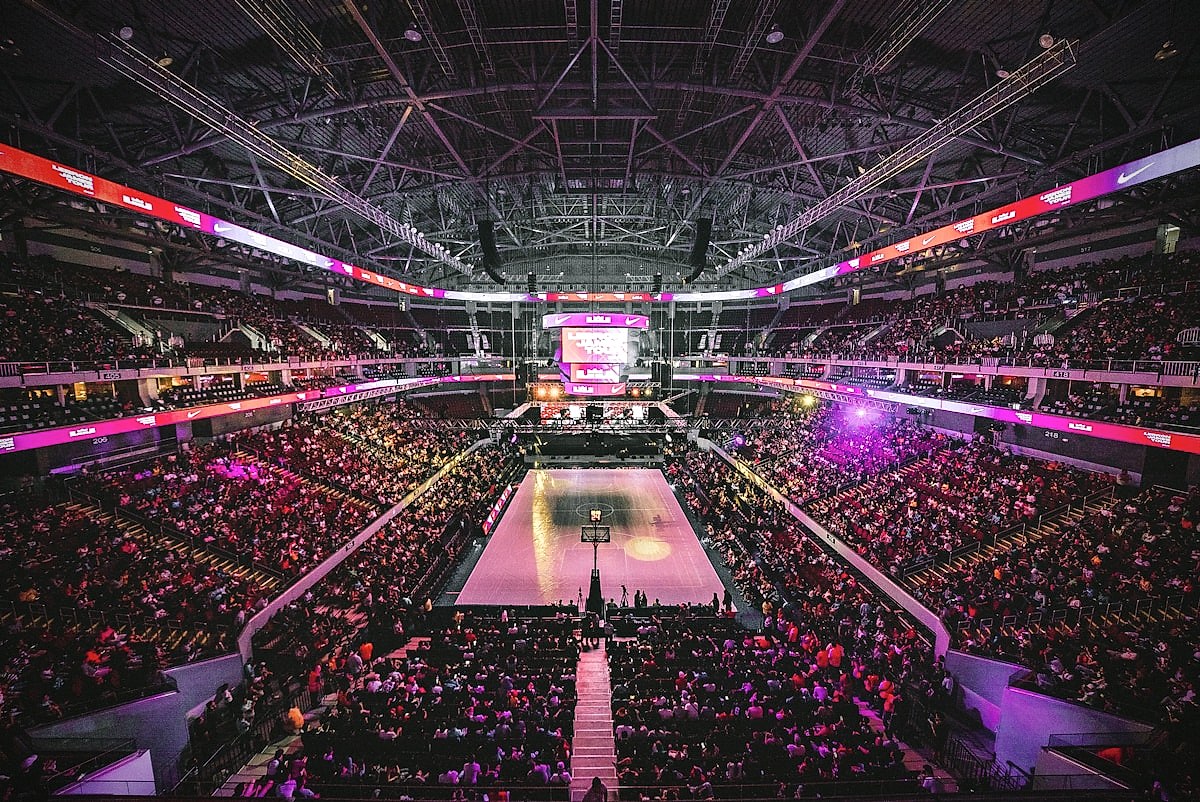
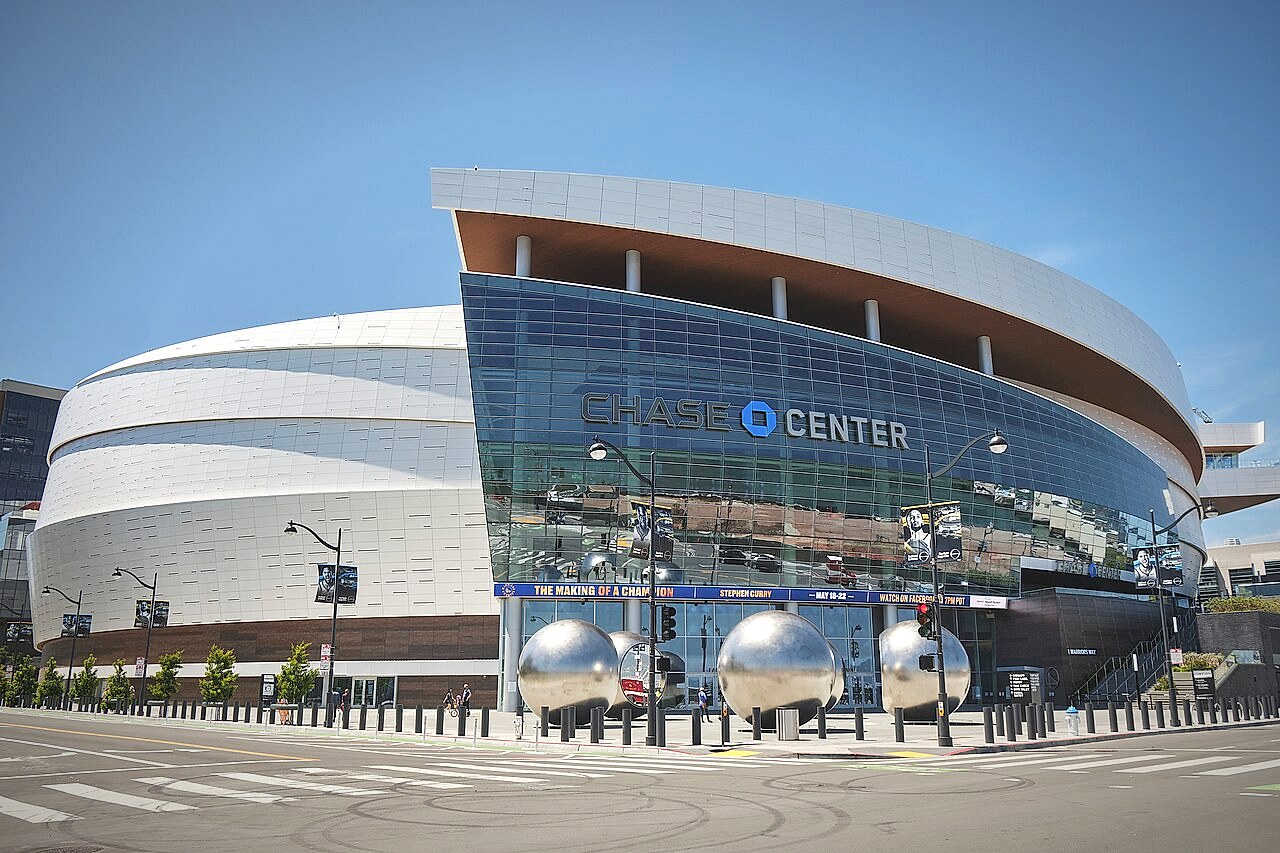
The Warriors played at the Philadelphia Arena and the Philadelphia Civic Center from 1946 to 1962, at the Cow Palace from 1962 to 1964, at the San Francisco Civic Auditorium from 1964 to 1966, at the Oakland Coliseum Arena (later Oracle Arena) from 1966 to 2019, and at Chase Center in San Francisco since September 2019. The Chase Center move was controversial among Oakland fans; Oracle Arena had hosted three championship banner-raisings (2015, 2017, 2018) before the move. The 2022 championship banner was raised at Chase Center in October 2022. The 2022 banner is the only one of the franchise’s seven that has hung at Chase Center from the start.
Chase Center, privately financed at $1.4 billion, was the first privately-financed arena in the NBA since Madison Square Garden in 1968. It has a capacity of 18,064.
The Curry-Thompson-Green era, extended
Curry turned 37 in March 2025 and has re-signed with the Warriors through the 2026–27 season. Thompson signed with the Dallas Mavericks in July 2024 after thirteen seasons with Golden State. Green re-signed in 2023 through 2026–27. The 2023–24 Warriors missed the playoffs in the play-in tournament. The 2024–25 team, with Thompson gone and Curry in what the front office has publicly characterized as a championship-window-last-ride, has rebuilt around Jonathan Kuminga and Kevon Looney.
Retired numbers and the Oracle-era legacy
The Warriors have retired six jersey numbers:
- Wilt Chamberlain (13)
- Alvin Attles (16)
- Nate Thurmond (42)
- Rick Barry (24)
- Chris Mullin (17)
- Tom Meschery (14)
Curry’s number 30, Thompson’s number 11, and Green’s number 23 are presumed to be retired upon the players’ retirements. Kerr’s jersey number has not been retired.
Sources
- Basketball-Reference, Golden State Warriors franchise page (regular-season and playoff records)
- Marcus Thompson II, Golden: The Miraculous Rise of Steph Curry (Touchstone, 2017)
- Ethan Sherwood Strauss, The Victory Machine: The Making and Unmaking of the Warriors Dynasty (PublicAffairs, 2020)
- Tim Kawakami, various The Athletic columns on the Warriors, 2015–2024
- NBA Finals box scores: 1947, 1956, 1975, 2015, 2016, 2017, 2018, 2019, 2022 (Basketball-Reference)
- Golden State Warriors media guides, 2014–15 through 2024–25
- Joe Lacob / Peter Guber ownership transition records (July 2010, purchase at $450 million)
- Chase Center opening records, September 2019 (privately financed $1.4 billion venue)
Shop Official Golden State Warriors Gear at Fanatics
As a Fanatics affiliate, we may earn a commission from qualifying purchases.
Shop on Amazon
As an Amazon Associate, we earn from qualifying purchases.
Shop NBA Gear at JD Sports
We may earn a commission from qualifying purchases on JD Sports.