Boston Celtics
The Boston Celtics have won eighteen NBA championships, the most in league history. They won eleven of those eighteen between 1957 and 1969, a thirteen-year stretch that included eight consecutive championships from 1959 through 1966. No franchise in the four major American professional leagues has matched that concentration of titles. The architect of the run was Red Auerbach, the head coach from 1950 to 1966 and general manager for most of the franchise’s next three decades. The on-floor architect was Bill Russell. The rest of the franchise’s history, including the Larry Bird 1980s, the 2008 championship with Garnett and Pierce and Allen, and the 2024 title under Joe Mazzulla, runs along the same organizational DNA that Auerbach and Walter Brown installed in the 1950s.
The 1946 founding, and Walter Brown’s early-years loss
The Celtics were one of the eleven founding members of the Basketball Association of America, established June 6, 1946 at the Commodore Hotel in New York. Boston’s franchise was owned by Walter A. Brown, who also owned the Boston Bruins of the NHL. Brown chose the “Celtics” name over the suggestions of his publicity staff, which had favored “Unicorns” and “Whirlwinds,” in homage to the Original Celtics of 1914 New York and to Boston’s Irish-American population.
The franchise’s first four seasons (1946–47 through 1949–50) produced a combined 65–139 record. The BAA merged with the National Basketball League in June 1949 to form the NBA. Brown, by most accounts, was losing money on the franchise at a rate of $50,000 a year and considered closing the team in 1950. Then he hired Red Auerbach.
Shop Boston Celtics merchandise
As an Amazon Associate we earn from qualifying purchases.
Red Auerbach, the 1950 hiring, and the Cousy era
Auerbach arrived in the fall of 1950 after short stints as head coach of the Washington Capitols and the Tri-Cities Blackhawks. His first Celtics move, which he has described in multiple interviews as the most consequential of his career, was the acquisition of Bob Cousy in the dispersal draft of the folded Chicago Stags. Auerbach had publicly said before the draft that he did not want Cousy; he wanted a center. Privately, per John Feinstein’s interviews with Auerbach in Let Me Tell You a Story (2004), he took Cousy on the gamble that Cousy’s Holy Cross résumé and creative passing would translate. It did.
The 1950s Celtics, with Cousy at point guard, Bill Sharman at shooting guard, and Ed Macauley at center, were a high-scoring team that could not defend. They won division titles but not championships, losing three consecutive conference finals between 1954 and 1956. Auerbach’s decision to trade Macauley and Cliff Hagan to the St. Louis Hawks for the draft rights to Bill Russell in April 1956 was the one move that changed the franchise’s competitive identity. Russell arrived in December 1956 after winning Olympic gold in Melbourne.
The Russell dynasty (1957–1969)
The 1956–57 Celtics won the championship in seven games over St. Louis, a series remembered for Cousy’s scoring and the decisive double-overtime Game 7 at Boston Garden. It was the franchise’s first. It was Russell’s first. Ten more followed in twelve years.
- 1957 (over St. Louis 4–3)
- 1959 (over Minneapolis 4–0; the only four-game sweep of the run)
- 1960 (over St. Louis 4–3)
- 1961 (over St. Louis 4–1)
- 1962 (over Lakers 4–3)
- 1963 (over Lakers 4–2)
- 1964 (over San Francisco Warriors 4–1)
- 1965 (over Lakers 4–1)
- 1966 (over Lakers 4–3)
- 1968 (over Lakers 4–2)
- 1969 (over Lakers 4–3)
The 1958 team lost the Finals to the St. Louis Hawks in six games; the 1967 team lost the Eastern Division finals to the Philadelphia 76ers in five. Those two seasons are the only blemishes in the Russell era. Auerbach retired from coaching after the 1966 championship and promoted Russell to player-coach. Russell became the first Black head coach in any major American professional sport. The 1968 and 1969 championships were Russell’s as head coach.
The Celtics have retired Russell’s jersey number (6) and the league retired it across the NBA following his death in 2022.
The post-Russell transition (1969–1974)
Russell retired in 1969. Sam Jones retired the same year. The 1969–70 Celtics finished 34–48, their first losing season since the 1950–51 year under Auerbach. The rebuild, led by new head coach Tom Heinsohn, came fast. The 1971 NBA Draft produced John Havlicek’s backcourt partner Jo Jo White. The 1970 fifth-overall pick Dave Cowens, a 6’8” Florida State center of a type the league had not seen, became Rookie of the Year in 1971 and MVP in 1973.
The 1974 Celtics, with Havlicek, Cowens, White, and Paul Silas, won the championship in seven games over Milwaukee. Havlicek was Finals MVP. The 1976 Celtics won a second championship in six games over the Phoenix Suns; Game 5 of that series, a triple-overtime Boston Garden win, is widely considered the greatest single game of the 1970s.
The Larry Bird era and the 1980s Big Three
Red Auerbach, then general manager, drafted Larry Bird sixth overall in 1978 even though Bird had announced he would stay at Indiana State for his senior year. The pick used the NBA’s then-extant junior-eligibility provision (a loophole closed after the 1979 draft). Bird signed with Boston in September 1979 on a five-year, $3.25 million contract, the largest rookie contract in American professional sports history at the time.
The 1979–80 Celtics improved from 29 wins to 61, a 32-win season-over-season improvement. Bird was Rookie of the Year. In the summer of 1980, Auerbach traded the first and thirteenth overall picks in the 1980 draft to the Golden State Warriors for Robert Parish and the third pick, which he used on Kevin McHale. The trade is widely regarded as the most consequential single draft-day transaction in NBA history.
The Celtics, built around Bird-McHale-Parish up front and Dennis Johnson at point guard, won championships in 1981 (over Houston 4–2), 1984 (over the Lakers 4–3), and 1986 (over Houston 4–2). Bird was Finals MVP in 1984 and 1986, and three-time regular-season MVP (1984, 1985, 1986).
The 1985–86 team, at 67–15, is ranked by most retrospective lists among the three or four best regular-season rosters in league history. The Bird era ended on a congenital back injury. Bird retired in August 1992 after the 1992 Olympic Dream Team gold. McHale retired in 1993. Parish played through 1997, mostly in Charlotte and Chicago.
The lost years, 1993–2007
The Celtics missed the playoffs in six of seven seasons between 1993 and 1999. Reggie Lewis, the 27-year-old All-Star point guard who had been drafted in 1987 and was widely expected to lead the next Boston era, died of sudden cardiac arrest during a July 27, 1993 off-season practice at Brandeis University. Lewis’s number 35 was retired and hangs at TD Garden. The death is the single most-consequential injury or health event in post-Bird Celtics history; the roster plan he was supposed to anchor was replaced by a 1994–97 rebuild under Rick Pitino’s general-management tenure.
Paul Pierce was drafted in 1998 out of Kansas, tenth overall. He carried the franchise for the next decade through mixed results: two conference finals appearances (2002 and 2008) separated by four losing seasons. The 2006–07 Celtics went 24–58, the franchise’s worst season since 1946.
The 2008 championship, and the return of Big Three-era branding
In the summer of 2007, general manager Danny Ainge acquired Ray Allen from Seattle (for Delonte West, Wally Szczerbiak, and the draft rights to Jeff Green) and Kevin Garnett from Minnesota (for Al Jefferson, Theo Ratliff, Gerald Green, Ryan Gomes, Sebastian Telfair, two first-round picks, and a draft pick swap). The moves, announced in July and August, produced the most-anticipated offseason roster transformation in the league’s decade.
The 2007–08 Celtics went 66–16. They won the 2008 NBA Finals over the Lakers in six games. Pierce was Finals MVP. Head coach Doc Rivers, hired in 2004, won his first championship. The 2008 title was the first time in franchise history a Boston team had gone from losing record to championship in a single offseason.
The Garnett-Pierce-Allen-Rondo core produced four more playoff runs (reached the 2010 Finals, lost to the Lakers in seven), until Allen’s July 2012 free-agent departure to Miami and the June 2013 trade that sent Garnett and Pierce to the Brooklyn Nets for a package of first-round draft picks that would fuel the Jayson Tatum era.
The Brad Stevens rebuild, and the Jayson Tatum era
Brad Stevens was hired as head coach in July 2013 after six seasons at Butler. The Stevens Celtics missed the playoffs only once in his nine seasons. The 2017 trade for Kyrie Irving, the 2017 draft pick that became Jayson Tatum (third overall), and the 2019 draft pick that became Jaylen Brown (third overall, 2016) built the roster that would eventually win the 2024 championship.
Stevens became team president in June 2021. Ime Udoka was hired as head coach, reached the 2022 Finals (losing to Golden State in six), and was suspended for the 2022–23 season over a workplace violation in September 2022. Joe Mazzulla was promoted from top assistant to head coach. Mazzulla, at 34 years old, was the third-youngest head coach in modern NBA history at his hiring.
The 2023–24 Celtics went 64–18 and won the 2024 NBA Finals over the Dallas Mavericks 4–1. Jaylen Brown was Finals MVP. Tatum was Eastern Conference MVP. The championship was the franchise’s eighteenth, pushing the Celtics past the Lakers’ seventeen for sole possession of the all-time NBA title lead.
Arenas and the parquet floor
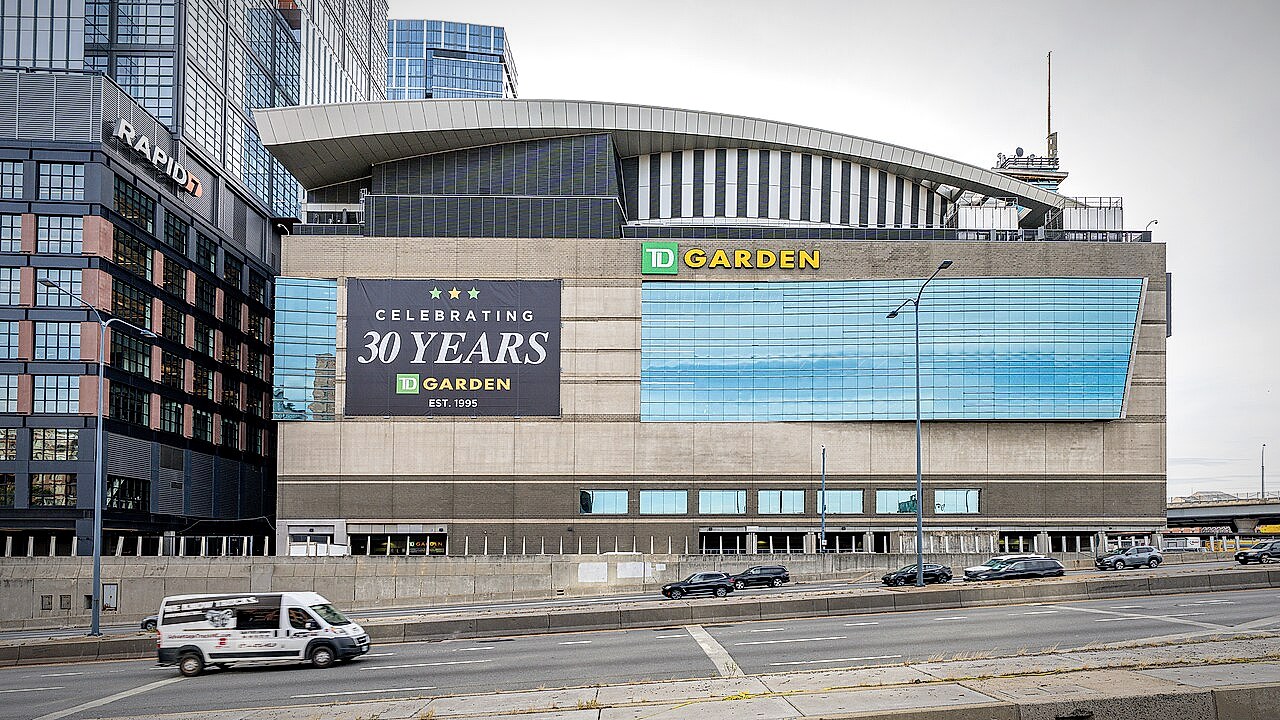
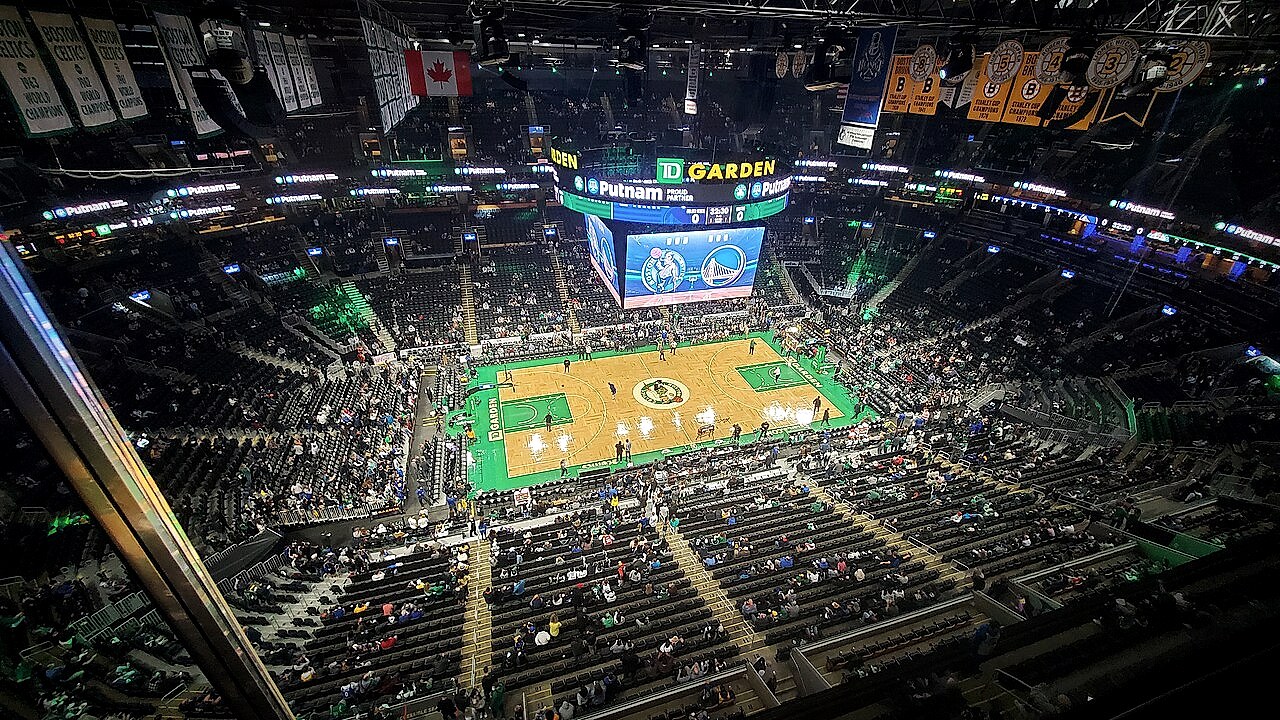
The Celtics played at the Boston Arena from 1946 to 1947 and at the Boston Garden from 1947 to 1995. The Boston Garden’s parquet floor, installed in 1946 and made from reclaimed lumber in an oak-on-red-oak herringbone pattern because of postwar wood shortages, became the visual signature of the building and the franchise. The original floor was disassembled after the Garden’s closure in 1995; a section of it is displayed in the TD Garden lobby. The current floor at TD Garden (opened 1995, renamed to TD Banknorth Garden in 2005, TD Garden since 2009) is a newer parquet using the same herringbone pattern.
Retired numbers
Twenty-three jersey numbers have been retired to the TD Garden rafters, the most of any NBA franchise:
- Bill Russell (6)
- John Havlicek (17)
- Larry Bird (33)
- Paul Pierce (34)
- Kevin Garnett (5)
- Kevin McHale (32)
- Robert Parish (00)
- Bob Cousy (14)
- Bill Sharman (21)
- Sam Jones (24)
- K.C. Jones (25)
- Tom Heinsohn (15)
- Tommy Heinsohn (coach banner)
- Dave Cowens (18)
- Don Nelson (19)
- Ed Macauley (22)
- Frank Ramsey (23)
- Dennis Johnson (3)
- Jo Jo White (10)
- Jim Loscutoff (Loscy banner)
- Reggie Lewis (35)
- Red Auerbach (2, the only non-player retired number)
- Cedric Maxwell (31)
The 2 is Red Auerbach’s, retired in 1985 as an honor for his 1950–1966 head-coaching tenure and his continued general-management role. No number has been retired since Cedric Maxwell in 2003, which is a deliberate franchise policy: ownership and front office have been explicit that the standard requires both championship contribution and multi-year on-roster tenure. Rajon Rondo and Doc Rivers are the two names most mentioned in forward-looking retirement discussion.
Sources
- Basketball-Reference, Boston Celtics franchise page (regular-season record, playoff results, championship chronology)
- Red Auerbach and John Feinstein, Let Me Tell You a Story: A Lifetime in the Game (Little, Brown, 2004)
- Dan Shaughnessy, Wish It Lasted Forever: Life with the Larry Bird Celtics (Scribner, 2021)
- Bob Ryan and Dick Raphael, The Boston Celtics: The History, Legends, and Images of America’s Most Celebrated Team (Addison-Wesley, 1989, with subsequent editions)
- Boston Celtics media guides, 2007–08 through 2024–25 (roster transactions, championship chronology)
- NBA Finals box scores: 1957, 1959–66, 1968–69, 1974, 1976, 1981, 1984, 1986, 2008, 2010, 2024 (Basketball-Reference)
- Celtics retired-number ceremony records
- Reggie Lewis memorial records, Brandeis University (July 27, 1993)
Shop Official Boston Celtics Gear at Fanatics
As a Fanatics affiliate, we may earn a commission from qualifying purchases.
Shop on Amazon
As an Amazon Associate, we earn from qualifying purchases.
Shop NBA Gear at JD Sports
We may earn a commission from qualifying purchases on JD Sports.