Vancouver Grizzlies
The Vancouver Grizzlies were a Canadian NBA franchise that existed for six seasons, won 101 games, lost 359, and moved to Memphis in July 2001. They were one of two NBA expansion teams admitted in 1995 (the other being the Toronto Raptors). They drafted Bryant Reeves with the sixth pick of the 1995 NBA Draft, paid him $61 million in 1997, and watched him eat his way out of the league by 2001. They drafted Steve Francis second overall in 1999 and watched him refuse to report. They drafted Pau Gasol third overall in 2001 in what would prove to be the franchise’s last act in Vancouver, then loaded his rights onto a moving truck headed for Tennessee.
It was the most chaotic six-year run by any NBA franchise in the modern era. It was also, by every account from anyone who lived through it in the city, one of the most beloved bad sports teams in Canadian history.
The expansion
The NBA’s 1995 expansion put franchises in Toronto and Vancouver, Canada’s two biggest English-speaking markets. The reasoning at the time, articulated by then-commissioner David Stern, was that the league’s broadcast partners (TBS and NBC, plus the Canadian rights deal with TSN) had identified Canadian basketball viewership as the fastest-growing demographic outside the United States. Both Canadian markets had successful NHL teams, established arena infrastructure, and the kind of corporate-sponsorship base the NBA wanted.
Shop Vancouver Grizzlies merchandise
As an Amazon Associate we earn from qualifying purchases.
Vancouver’s ownership group was led by Arthur Griffiths, who already owned the Vancouver Canucks NHL team. Griffiths had built the new General Motors Place arena (renamed Rogers Arena in 2010) in downtown Vancouver in 1995 specifically to anchor both franchises. The Grizzlies played their home games on the same hardwood floor the Canucks rolled their ice over.
The team’s first general manager, Stu Jackson, had been a Knicks assistant coach. The first head coach, Brian Winters, had played 11 NBA seasons in the 1970s with the Lakers and Bucks. The first owner had no basketball-operations experience at all.
The Bryant Reeves draft
The Grizzlies and Raptors held a special pre-draft coin flip for the 1995 NBA Draft. Toronto won and took Damon Stoudamire seventh overall (Vancouver picked sixth). The first five picks were Joe Smith, Antonio McDyess, Jerry Stackhouse, Rasheed Wallace, and Kevin Garnett. Vancouver, with the sixth pick, took Bryant “Big Country” Reeves out of Oklahoma State.
Reeves was a 7’0”, 290-pound center from Gans, Oklahoma, a town of about 350 people. His nickname “Big Country” had been earned at Oklahoma State because of his rural Oklahoma background; teammates joked he had grown up on a literal cattle ranch (which he had). He had led Oklahoma State to the 1995 Final Four. He had averaged 21 points and 10 rebounds his senior year. He was, by every standard 1995 scouting metric, a defensible top-ten pick.
He was also already showing signs of the back problems that would end his career. The Cowboys’ team trainer at Oklahoma State had documented two herniated lumbar discs in his junior year. Vancouver’s medical staff cleared him anyway.
Six seasons of structural disadvantage
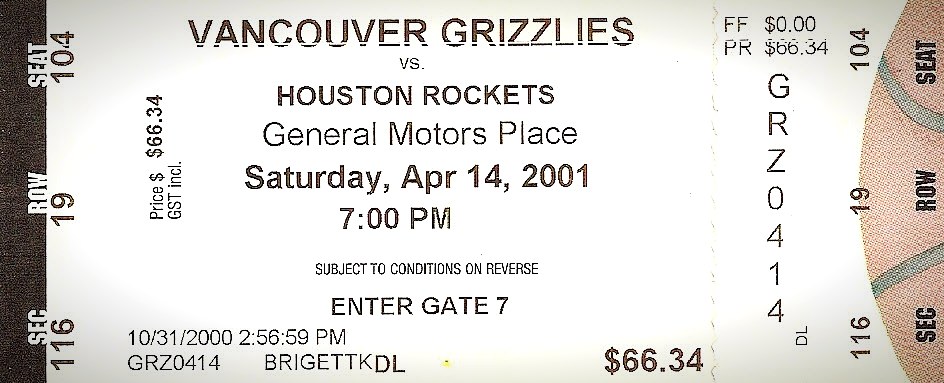
The Grizzlies finished 15-67 their first season (1995-96), which was actually better than the second-year mark of 14-68. The 1996-97 season set a then-NBA record for losses (65), since broken by the Sixers’ Process tanking. The franchise won fewer than 25 games in five of its six seasons. The one season they cracked 25 was the lockout-shortened 1998-99 (8 wins in 50 games extrapolates to 13 in 82).
The structural problems went beyond the on-court product. The Canadian dollar averaged roughly 70 cents on the U.S. dollar across the late 1990s. Player salaries were paid in U.S. dollars; arena revenues came in Canadian dollars. The exchange-rate gap meant the Grizzlies’ effective payroll was always 30 percent below the league average even when their nominal payroll was roughly average. Canadian provincial and federal income taxes were also higher than U.S. state taxes, which made Vancouver an unattractive free-agent destination.
Steve Nash, born in Victoria, British Columbia, was on track to be the franchise-defining free-agent target in 2000. The Grizzlies had been tracking him since his 1996 draft. Nash signed with the Dallas Mavericks instead. Vancouver’s front office told the Vancouver Sun that summer that they could not match Dallas’s offer because of the after-tax math.
The Steve Francis revolt
The 1999 NBA Draft was the chance to reset. The Grizzlies had the second pick. Elton Brand went first to Chicago. Vancouver took Steve Francis, the dynamic Maryland point guard who had been the consensus second-best player on most boards.
Francis refused to report. He made the announcement publicly on draft night. He cited Vancouver’s distance from his East Coast home, his discomfort with playing in Canada, and what he called “religious reasons” (which he never elaborated on). The Grizzlies tried for two months to convince him to honor the contract. He refused.
On August 27, 1999, Vancouver traded Francis (along with Tony Massenburg) to the Houston Rockets for an eight-player return centered on Othella Harrington, Antoine Carr, Brent Price, Michael Dickerson, and two future first-round picks. Francis went on to win co-Rookie of the Year (with Elton Brand) and made three All-Star teams in Houston. Vancouver got a player package whose best pieces produced about half of Francis’s career value.
The Francis refusal is, in basketball-historical writing, one of the three or four most damaging single-player decisions a struggling franchise has ever absorbed.
The Pau Gasol pick and the move to Memphis
The 2001 NBA Draft was the last act in Vancouver. The Grizzlies had the third pick. Atlanta took Pau Gasol with the third pick on Vancouver’s behalf, on a pre-arranged trade that sent Shareef Abdur-Rahim to Atlanta. Vancouver’s intention was for Gasol to be the franchise’s foundation in 2001-02 and beyond.
The franchise never played him in Vancouver. On July 4, 2001 (a date that earned the move a permanent Canadian sense of cultural sting), the NBA Board of Governors approved the relocation of the Grizzlies to Memphis. Owner Michael Heisley, who had bought the team from John McCaw Jr. in early 2000 and had pledged publicly at the time of purchase that he would keep the team in Vancouver, cited the persistent currency gap and a growing $40 million annual operating loss. Gasol won the 2001-02 NBA Rookie of the Year as a Memphis Grizzly. He never stepped on the floor at GM Place.
Vancouver after the Grizzlies
The Vancouver basketball market did not return to NBA professional play. The city’s basketball energy migrated to BC Lions football, the Vancouver Canucks (whose Cup runs in 2011 and 2024 dominate civic memory), and the Vancouver Bandits of the Canadian Elite Basketball League (founded 2018). The CEBL is a small regional summer league. There has been no serious NBA-return discussion since approximately 2010.
The Memphis franchise has, in the years since the move, won zero championships. The Vancouver Grizzlies are 25 years removed from their last game and zero years removed from being the NBA’s most-frequently-debated “what could have been” franchise. The closest the city has come to NBA basketball since 2001 is occasional preseason games at Rogers Arena (Toronto Raptors hosted Sacramento there in October 2017; the Lakers hosted the Warriors there in October 2024).
The 2026 view
If the Grizzlies had stayed, the franchise would, in any plausible alternate history, have been the team that drafted Pau Gasol and built around him for the better part of the 2000s. Gasol’s 2008 trade to the Lakers (in real history, from Memphis) would have happened either in Vancouver or, if the franchise had been stable, possibly not at all. The 2010s Grizzlies of Marc Gasol, Mike Conley, Zach Randolph, and Tony Allen (Grit and Grind) would have been Vancouver’s. The franchise’s post-2020 rebuild around Ja Morant would have been Vancouver’s.
None of that happened. The Grizzlies’ six-year Vancouver run produced no playoff appearances, no Rookie of the Year winners, no All-Stars from drafts the franchise made (Mike Bibby was traded to Sacramento before he made All-Star teams), and no championship banners.
It did produce a teal-and-bronze color scheme that the Memphis franchise still uses to this day. It produced Big Country Reeves and the brief Mike Bibby–Shareef Abdur-Rahim–Bryant Reeves nucleus that the team’s marketing department called “Beasts of the East” (a campaign that was, on its face, geographically incorrect; Vancouver was in the Western Conference). It produced, by some Canadian basketball historians’ arguments, the cultural moment that turned Toronto from a basketball town that didn’t take itself seriously into one that, by the 2019 NBA championship parade, did.
The Vancouver Grizzlies are the most-loved bad NBA franchise of the last forty years. They are also the only NBA team to leave Canada and not come back. Bill Simmons devotes a chapter to the franchise in The Book of Basketball (Random House, 2009), which remains the most-read lay history of the league’s expansion follies.
Sources
- Basketball-Reference: Vancouver Grizzlies franchise pages (1995-96 through 2000-01).
- Vancouver Sun, archive coverage of the franchise across 1995-2001.
- ESPN, coverage of the July 2001 move to Memphis.
- The Globe and Mail, retrospective on the Grizzlies’ Vancouver years (June 2016).
- Bill Simmons, The Book of Basketball (Random House, 2009), Vancouver Grizzlies chapter.
Shop NBA Gear at Fanatics
As a Fanatics affiliate, we may earn a commission from qualifying purchases.
Shop on Amazon
As an Amazon Associate, we earn from qualifying purchases.
Shop NBA Gear at JD Sports
We may earn a commission from qualifying purchases on JD Sports.
Sources
- Basketball-Reference: Vancouver Grizzlies franchise (1995-96 through 2000-01)
- Vancouver Sun archive coverage of the franchise across 1995-2001
- ESPN coverage of the July 2001 move to Memphis
- Bill Simmons, The Book of Basketball (Random House, 2009), Vancouver Grizzlies chapter
- The Globe and Mail retrospective on the Grizzlies' Vancouver years (June 2016)