Kevin Garnett
Kevin Garnett is the most intense basketball player of the last forty years. The statement is subjective on its face and objective on its record. He is the player who, at 6’11”, checked smaller guards at the point of attack; who threw elbows at teammates in practice; who screamed at his own teammates in huddles and at opposing team employees in arena hallways and at himself after missed shots; and who, at the moment his Celtics won the 2008 NBA Finals, stood at mid-court at TD Banknorth Garden (now TD Garden), pointed to the sky, and shouted “Anything is possible!” into Michele Tafoya’s ESPN microphone. He is the 2004 NBA Most Valuable Player. He is the 2008 Defensive Player of the Year. He is a fifteen-time All-Star and a nine-time All-NBA selection. He won a championship in 2008. He is the first player drafted directly out of high school since 1975. His 21-season career is tied with Dirk Nowitzki and Kobe Bryant for the longest in NBA history, and his career per-game line of 17.8 points, 10.0 rebounds, and 3.7 assists, across 1,462 games, is the only 17-10-3 career average produced by a player who spent at least ten years at power forward.

Greenville, Mauldin, and Farragut (1976–1995)
He was born May 19, 1976 in Greenville, South Carolina. His mother, Shirley Garnett, was a hair stylist. His biological father, O’Lewis McCullough, was out of the family by the time Kevin was born. His mother married Ernest Irby, a carpenter, around 1977, and Irby helped raise him. The family lived in the Mauldin section of Greenville County. His mother divorced Irby in his teenage years, and the family’s economic situation tightened. He has documented the childhood in his own 2022 memoir KG: A to Z (Triumph Books, 2022), co-authored with David Ritz.
He attended Mauldin High School through his junior year and was a high-level recruit by the summer of 1994. On May 5, 1995, his senior year, a fight broke out in a hallway at Mauldin High that involved several African-American students (including one of Kevin’s teammates) and several white students. No charges were pressed against Garnett specifically; he was not even at the scene of the initial altercation. But in the aftermath, five students were arrested under the state’s then-active “lynching” statute (the same statute that was used to prosecute the 1993 Allen Iverson bowling-alley case). Garnett, afraid of being pulled into prosecution, transferred to Farragut Career Academy on Chicago’s West Side for his senior year. Farragut head coach Wolf Nelson ran a basketball-first curriculum that the Garnett family had been introduced to by Kevin’s AAU coach. He moved in with his godparents and played his senior season there.
Shop Kevin Garnett jersey
As an Amazon Associate we earn from qualifying purchases.
At Farragut he averaged 25.2 points, 17.9 rebounds, 6.7 assists, and 6.5 blocks and was the USA Today National High School Player of the Year. Farragut went 28-2. Coaches across the country (Indiana, Kentucky, North Carolina, Michigan) were actively recruiting. Garnett had committed, informally, to Michigan for the 1995-96 season. On April 4, 1995, after a week of academic deliberation and after the SAT-score uncertainty around his eligibility (he had been a nontraditional test-taker throughout his Mauldin years), he declared for the 1995 NBA Draft. He was the first player to do so straight out of high school since Bill Willoughby in 1975. At the time it was considered a radical decision. It was also one that would reshape the league.
The 1995 draft and the Minnesota years (1995–2007)
The Minnesota Timberwolves held the fifth overall pick. They had gone 21-61 the previous season and were in a six-year rebuild under a succession of coaches and general managers. On June 28, 1995, they selected Kevin Garnett fifth overall. Behind him in that draft were Joe Smith, Antonio McDyess, Jerry Stackhouse, Rasheed Wallace, and, at 20th, Kobe Bryant.
He averaged 10.4 points as a rookie off the bench. He moved into the starting lineup that December. By his third year (1997-98) he was averaging 18.5 points and 9.6 rebounds, was a first-team All-NBA selection, and was making the annual All-Star appearance that would become consecutive for ten years. In the summer of 1997, at age 21, he signed a six-year, $126 million extension with the Timberwolves that was the largest contract in NBA history to that point. The deal, specifically, was the catalyst for the 1998-99 NBA lockout, which the league used to negotiate the maximum-contract system still in place today. Almost every subsequent NBA contract is set against the reference point of the Kevin Garnett 1997 extension.
The Timberwolves made the playoffs in eight consecutive seasons (1996-97 through 2003-04) and, at his 2004 peak, reached the Western Conference Finals, which remains the single deepest playoff run in Minnesota Timberwolves history. He averaged 24.2 points, 13.9 rebounds, and 5.0 assists in 2003-04, won the regular-season MVP with 120 of 123 first-place votes (the most unanimous MVP vote since Shaq in 2000; see our Shaquille O’Neal biography), and led Minnesota to 58 wins, the franchise’s best regular-season record. The 2004 WCF series against the Los Angeles Lakers went six games; the Timberwolves, playing without Sam Cassell (who had strained his hip) for most of the series, lost 4-2. It was as close as Minnesota has ever come to a Finals.
The post-2004 Timberwolves never made the playoffs again with Garnett. Personnel turnover, poor drafting, and a gradual decline in supporting-cast quality meant that his final three Minnesota seasons were spent on teams that missed the postseason. By the summer of 2007, both he and general manager Kevin McHale agreed a trade was the only path forward.
The 2007 Boston trade and the 2008 championship
On July 31, 2007, the Boston Celtics acquired Garnett from the Timberwolves in what was, at the time, the largest trade in terms of player count in Celtics history. The deal sent Al Jefferson, Ryan Gomes, Gerald Green, Theo Ratliff, Sebastian Telfair, two first-round picks, and cash to Minnesota. Boston had acquired Ray Allen from Seattle five weeks earlier and already had Paul Pierce. The trio was announced at the TD Banknorth Garden in early August 2007.
The 2007-08 Celtics went 66-16, the best single-season improvement in NBA history to that point (from 24-58 the previous year). Garnett won Defensive Player of the Year on the strength of his perimeter-to-post versatility and his ability to defend all five positions when the offensive sets required a switch. The team beat Atlanta in seven, Cleveland in seven, and Detroit in six on the way to the 2008 Finals, which was a rematch of the 1984-85-87 Celtics-Lakers rivalry in a generation that had grown up on those series.
Boston beat the Los Angeles Lakers 4-2. In Game 6 at TD Banknorth Garden on June 17, 2008, the Celtics won 131-92, the most lopsided clinching-game result in Finals history since 1965. Garnett posted 26 points, 14 rebounds, 4 steals, and 3 blocks. Paul Pierce won the Finals MVP (detail on the 2008 vote-reconsideration argument is on our Every NBA Finals MVP page). As the confetti dropped, ESPN sideline reporter Michele Tafoya found Garnett at mid-court. He shouted, looking directly into the camera:
Anything is possible!
It was, by multiple measures, the most-replayed post-championship interview of the 2000s decade. Garnett was 32. He had been in the NBA for thirteen years. He had been in the playoffs for twelve of them. He had never won a playoff series until the 2008 run. The championship closed the only real gap in his career résumé.
The later Celtics years, Brooklyn, and the return to Minnesota (2008–2016)
The 2008-09 Celtics were 62-20 and the defending champions. Garnett tore a tendon in his right knee in February 2009 and missed the playoffs. Without him, Boston lost in the second round. He returned for 2009-10, Boston reached the Finals, and the Lakers beat them 4-3 in a seven-game series that ended the Big Three’s championship window. He made one more deep run with Boston (a 2012 Eastern Conference Finals loss to the LeBron James Miami Heat).
On June 28, 2013, Boston traded Garnett and Paul Pierce to the Brooklyn Nets in a seven-player deal that also returned three unprotected first-round picks (in 2014, 2016, and 2018) to the Celtics. The picks became Marcus Smart, Jaylen Brown, and Collin Sexton, which is now remembered as the single most lopsided trade in modern NBA history. Garnett played 1.5 seasons in Brooklyn. On February 19, 2015 he was traded back to the Minnesota Timberwolves for Thaddeus Young, a full-circle return to the franchise where his career had started. He played 38 games for Minnesota in the 2015-16 season as a mentor to Karl-Anthony Towns and Andrew Wiggins. He announced his retirement on September 23, 2016. He was 40.
Hall of Fame, jersey retirements, and legacy
He was inducted into the Naismith Memorial Basketball Hall of Fame on May 15, 2021 (the ceremony had been postponed from 2020 due to the pandemic), alongside Kobe Bryant and Tim Duncan. His presenter was Ray Allen.
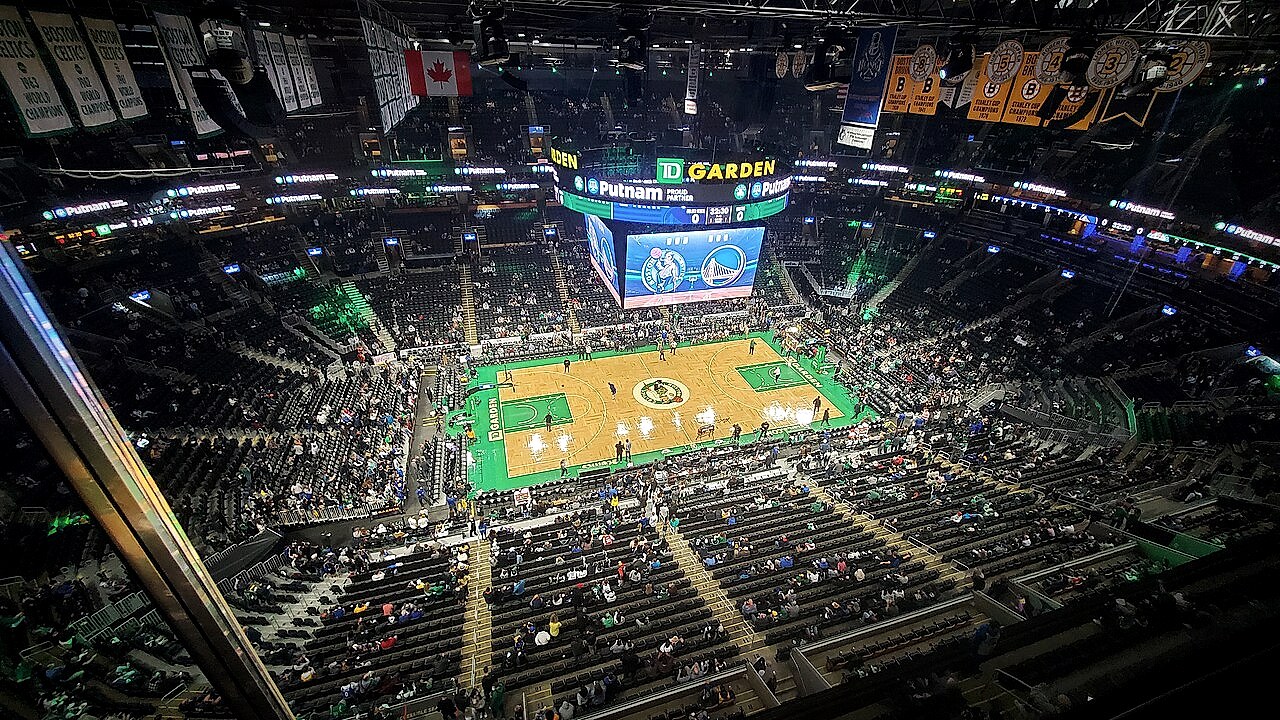
The Minnesota Timberwolves retired his #21 on April 11, 2022 at Target Center, with Karl-Anthony Towns, Kevin McHale, Ray Allen, and Paul Pierce in attendance. The Boston Celtics retired his #5 on March 13, 2022 at TD Garden. He is one of only four players (alongside Tim Duncan, Shaquille O’Neal, and Kareem Abdul-Jabbar) to have had his jersey retired by two different franchises.
Legacy
The single cleanest statement about Garnett is that he was the most versatile defender of his era and, with Tim Duncan, one of the two players who defined the “four who plays five” archetype that the modern NBA has since rebuilt its defensive schemes around. His peak Minnesota years (2001-2006) included five All-NBA First Team selections, four Defensive Player of the Year votes in which he finished top five, and a 2004 MVP that is generally retrospectively ranked as the second-most undervalued MVP performance of the 2000s (the first being LeBron James’s 2009 MVP). His career total of 26,071 points, 14,662 rebounds, 5,445 assists, 2,037 steals, and 2,037 blocks places him, by total win shares, in the top ten all-time.
The cultural legacy is a separate category. His approach to the game (on-court trash talking that carried over to the tunnel, pregame rituals that included him head-butting the basket stanchion, his well-documented refusal to speak to any opposing player during games) has been studied in sports-psychology dissertations and, more informally, imitated by every high-intensity player to enter the league since 1997. He is credited, along with Kobe Bryant, as one of the two players whose public persona most aggressively pushed the notion that “basketball as competitive warfare” was a valid stylistic choice. The “Big Ticket” nickname, coined by Boston Globe reporter Jackie MacMullan in 2007 and referring both to his height and to his trade-deadline-ticket status at the time, has since become the brand name he uses for his various post-career ventures: his KG Certified podcast on Showtime, his coaching-and-development work with Minnesota youth basketball programs, and his ownership stake in multiple youth-basketball academies through his Kids on the Run Foundation.
The Athletic’s 2022 NBA 75 ranking placed Garnett at 14th, which is consistent with most retrospective rankings that emphasize defensive value. Bill Simmons’s The Book of Basketball ranks him 15th. The consensus is that he is a top-fifteen player of all time. The argument about him is whether he is more properly the 14th-best or the 20th-best, and even the 20th-best rating would put him inside the lowest 1% of all players who have played professional basketball in any major league.
Sources
The Mauldin / Farragut biography is drawn from Kevin Garnett’s 2022 memoir KG: A to Z (Simon & Schuster, co-authored with David Ritz) and from Jack McCallum’s November 1996 Sports Illustrated feature “The Kid.” The 1997 extension and its role in the 1998-99 lockout is documented in Marc Stein’s 2010 retrospective at ESPN. The 2004 MVP vote count is from the NBA’s official 2003-04 Kia Most Valuable Player press release. The 2008 Finals game-by-game and Game 6 detail are from the NBA.com 2008 Finals archive. The 2013 Brooklyn trade details (including the three-pick return that became Smart, Brown, and Sexton) are from Brian Windhorst’s ESPN reporting of the trade. The jersey-retirement ceremonies are from the NBA’s official broadcast archive.
Shop Jerseys & Fan Gear at Fanatics
As a Fanatics affiliate, we may earn a commission from qualifying purchases.
Shop on Amazon
As an Amazon Associate, we earn from qualifying purchases.
Shop Sneakers & Gear at JD Sports
We may earn a commission from qualifying purchases on JD Sports.