Dirk Nowitzki
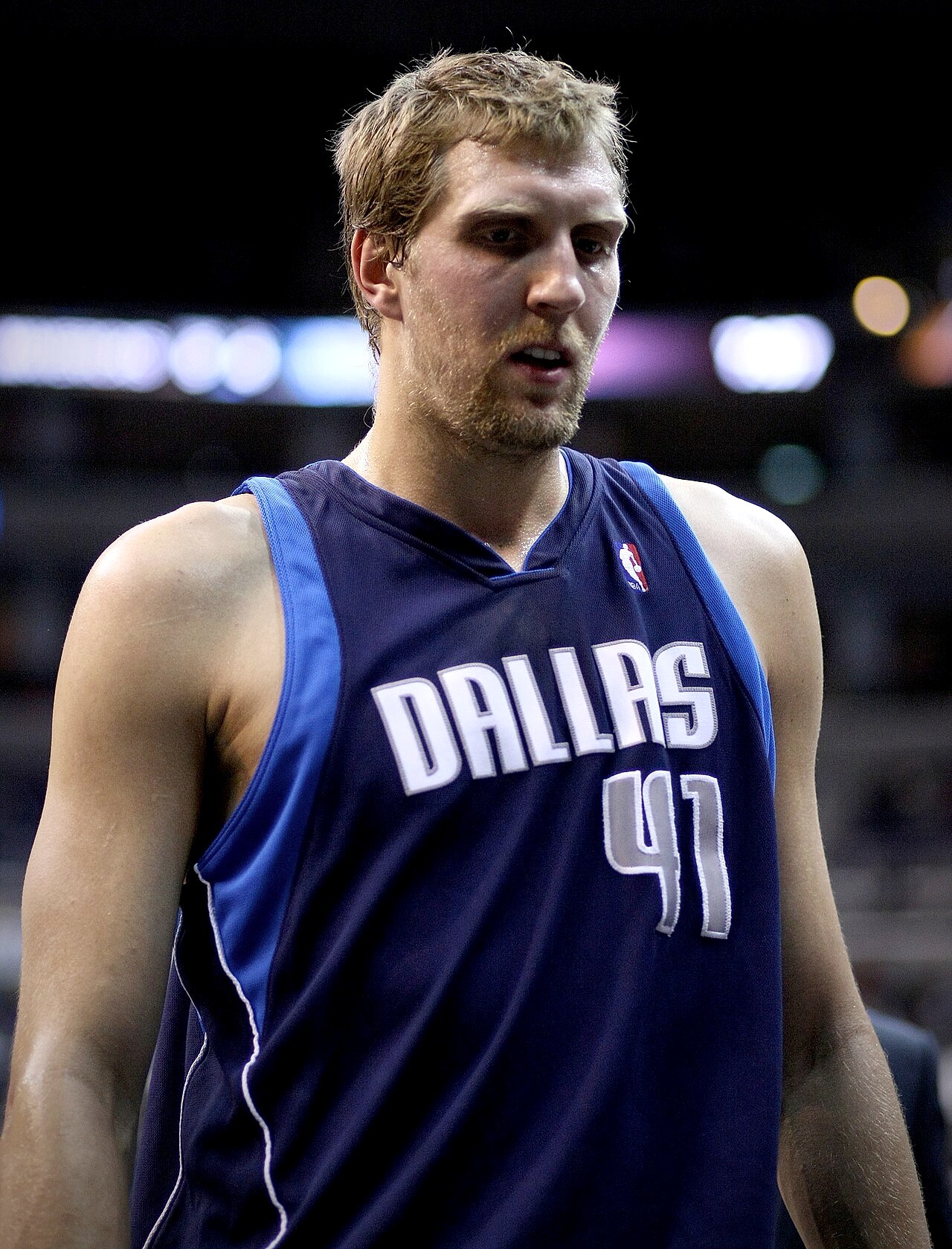
Dirk Nowitzki is the greatest European basketball player who has ever lived. The argument against that sentence is that Luka Dončić or Nikola Jokić will eventually surpass him, not that anyone before him has. He is the 2007 Most Valuable Player, the 2011 Finals MVP, a fourteen-time All-Star, a twelve-time All-NBA selection, a 50-40-90 club member, a Hall of Famer, and the sixth-highest scorer in NBA history at 31,560 career points. He played all 21 of his seasons for the Dallas Mavericks, which is tied with Kobe Bryant and Udonis Haslem for the longest single-team career in league history (Haslem’s contract deals did not always run a full NBA season, so the cleanest version of the record is Nowitzki and Bryant at 21). He was coached in his youth by a German economist and former national-team player named Holger Geschwindner, who, among other things, banned him from weight training until he was 25 and required him to learn the saxophone as a condition of his basketball development. He won the 2011 NBA Finals over LeBron James, Dwyane Wade, and Chris Bosh in one of the most iconic underdog runs of the past twenty-five years. His one-legged fadeaway is the single most-copied post-move of the 2010s NBA, by every wing who has attempted one, including Kevin Durant, Kawhi Leonard, Paul George, and LeBron James.
Würzburg and the family
He was born June 19, 1978 in Würzburg, a Bavarian university town in what was still West Germany. His father Jörg-Werner Nowitzki was a professional handball player who represented West Germany in international competition. His mother Helga was a professional basketball player who represented the German national team. His older sister Silke went on to work in marketing for the NBA.
He was 5’10” at age 11 and grew to 6’11” by 16. He played handball (the dominant sport in Germany) and tennis before picking up basketball in 1991 after watching the 1992 U.S. Olympic Dream Team in Barcelona. (He was 14 during the Barcelona Games and has said Charles Barkley’s physicality in that tournament was what drew him to basketball specifically.) He wore #14 through his DJK Würzburg years in tribute to Barkley.
Shop Dirk Nowitzki jersey
As an Amazon Associate we earn from qualifying purchases.
Holger Geschwindner
At 15, during a local-league game at the Basketball Center Würzburg, Nowitzki caught the attention of Holger Geschwindner, a former West Germany national-team player who had studied physics at the University of Munich and had become one of Germany’s oddest basketball coaches. Geschwindner’s training philosophy, documented in Thomas Pletzinger’s 2019 book The Great Nowitzki and in Wright Thompson’s definitive 2011 ESPN longform, rested on three rules. First, no weight training until the player’s body has matured, because weight training before skeletal maturity calcifies motion patterns. Second, no tactical drills, because tactical drills substitute for judgment. Third, non-basketball activities (music, literature, travel) are required, because a one-dimensional player is not an interesting basketball player.
Geschwindner made Nowitzki practice six hours a day. He made him read Schiller and Goethe. He made him learn the saxophone, which Nowitzki played (badly, by his own admission) through the 2000s. The relationship lasted through Nowitzki’s entire career. Geschwindner flew from Germany to Dallas for most of the playoff years to watch practices.
DJK Würzburg and the Nike Hoop Summit
At 16 he joined DJK Würzburg in Germany’s second-tier basketball league as a forward, not a center, which was Geschwindner’s deliberate positional choice. He averaged 28.2 points per game in 1997-98, led DJK to promotion into the top-tier Basketball Bundesliga, and was named German Basketballer of the Year.
In April 1998 he played in the Nike Hoop Summit in San Antonio, a showcase game between the USA under-19 team (which included Rashard Lewis and Al Harrington) and a World Select Team. Nowitzki scored 33 points and grabbed 14 rebounds. Every NBA team with a first-round pick watched the tape. Dallas Mavericks general manager Don Nelson personally flew to Würzburg within two weeks to watch him practice.
The 1998 draft
On June 24, 1998, the Milwaukee Bucks took Nowitzki with the 9th overall pick in the NBA Draft. The Bucks traded him immediately to the Dallas Mavericks for Robert “Tractor” Traylor, the Michigan power forward Milwaukee had drafted at six. Tractor Traylor played six NBA seasons, averaged 4.8 points, and died of a heart attack in Puerto Rico in 2011 at 34. The Milwaukee-Dallas deal of June 24, 1998 is, by any reasonable reading of the record, the most one-sided trade in NBA draft-night history.
Don Nelson had also acquired Steve Nash that same day in a separate deal with Phoenix. The 1998-99 rookie-season Mavericks, with a 20-year-old Nowitzki averaging 8.2 points and Nash playing backup point guard, were 19-31 in a lockout-shortened year. Dallas fans booed Nowitzki at Reunion Arena for most of his rookie year. He called his parents weekly to tell them he was going home.
The Nash-Finley-Nowitzki Big Three (1999–2004)
Mark Cuban bought the Mavericks in January 2000. He inherited a team that had 50-win upside and a front office (Nelson, Michael Finley, Nash, Nowitzki, and a young Juwan Howard) that had been assembled to produce a title. By 2000-01 the Mavericks were a 53-win playoff team. By 2002-03 they were a 60-win team that reached the Western Conference Finals before a torn ligament in Nowitzki’s left knee, caused by a Manu Ginóbili collision in Game 3 against San Antonio, ended the series. Dallas lost in six.
The Phoenix Suns signed Steve Nash as a free agent in the summer of 2004 after Mark Cuban declined to match the six-year $63 million offer sheet. Nash won the 2004-05 and 2005-06 MVP awards for Phoenix. Cuban has publicly called the decision not to match the offer the single worst judgment of his ownership tenure.
2006 Finals and the disappointment
The 2005-06 Mavericks were 60-22. Nowitzki averaged 26.6 points on 48% shooting, 40.6% from three, and 90.1% from the line. They beat Memphis, San Antonio, and Phoenix in the West, leading Phoenix 3-1 in the Conference Finals and holding off a Steve Nash-led comeback. The Finals against Miami opened with two Dallas blowouts at home. Then Dwyane Wade averaged 34.7 points for the remaining four games and Miami won in six. It remains, by one common measurement, the second-worst 2-0 lead collapse in NBA Finals history (the worst being the 2016 Warriors losing to Cleveland from 3-1).
2007: the MVP
The 2006-07 Mavericks won 67 games, a franchise record. Nowitzki averaged 24.6 points, 8.9 rebounds, and 3.4 assists. He shot .502 from the field, .416 from three, and .904 from the line, joining the 50-40-90 club. He won the MVP ahead of Steve Nash (who was bidding for a third straight) and Kobe Bryant, becoming the first European player to win the award. The 67-win Mavericks entered the playoffs as the No. 1 seed in the West. They lost in the first round to the 8-seed Golden State Warriors in six games, a Don Nelson-coached upset that remains one of the biggest first-round upsets in league history. The MVP trophy was presented to Nowitzki five days after the elimination. He has described the 2007 playoff exit, on multiple occasions, as the most painful basketball experience of his life.
2011: the championship
The 2010-11 Mavericks were not the West’s best team. They had Jason Kidd (37 years old), Jason Terry, Shawn Marion, J.J. Barea, a late-career Peja Stojaković, and the midseason acquisition of Tyson Chandler at center, who Rick Carlisle would later call the hinge that unlocked the championship. They went 57-25, entered the playoffs as a three seed, and ran the table. They swept the two-seed Lakers in the second round in a series in which Nowitzki posted 32 points a game.
In Game 1 of the Western Conference Finals against Oklahoma City, Nowitzki hit 12 straight free throws in the fourth quarter to set an NBA postseason single-game record of 24 consecutive makes. He scored 48 on 12-of-15 shooting in that game. Dallas won the series in five.
The Finals against Miami were the LeBron-Wade-Bosh Big Three’s first season together. The Heat won Game 1. In Game 2, trailing by 15 with 7:14 left, the Mavericks went on a 22-5 run, capped by Nowitzki’s driving left-handed layup over Chris Bosh with 3.6 seconds left. Miami led 2-1. In Game 4, with a 101°F fever and a torn tendon in his left middle finger, Nowitzki scored 10 of Dallas’s final 12 points in the fourth quarter, including a game-winning floater. The Mavericks won Game 4 by 3. In Game 6, on June 12, 2011, Nowitzki, shooting 1-of-12 in the first half, scored 10 points in the fourth quarter. Dallas won 105-95. He was Finals MVP with an average line of 26.0, 9.7, and 2.0.
He walked off the floor before the final horn and cried in the tunnel. Mark Cuban’s postgame interview with the ABC broadcast team referred to Nowitzki as “the best player I’ve ever been around in any sport.” Twenty minutes later, on the podium, Nowitzki accepted the Finals MVP and said his first words were to his mother: “Mom, I won.”
Later years and retirement (2012–2019)
Post-championship, the Mavericks did not make a conference final again in his career. The team went through year-to-year competitive cycles. Nowitzki averaged 20 a game through 2015, 18 a game through 2017, and 12 a game through his final two seasons. He became, in 2018-19, the first player in league history to play 21 seasons with a single franchise (surpassing Kobe Bryant’s 20).
On April 9, 2019, in his final home game at American Airlines Center, against the Phoenix Suns, he scored 30 points. At halftime Larry Bird, Charles Barkley, Shawn Kemp, Scottie Pippen, and Detlef Schrempf each walked out to the floor to speak. Nowitzki’s ten-minute farewell address began with the words “I’m glad we lost the first one so I could keep being a Maverick.” His final NBA game was one day later, on April 10, 2019, a 20-point, 10-rebound double-double in a road loss at San Antonio.

Hall of Fame and legacy
He was inducted into the Naismith Memorial Basketball Hall of Fame on August 12, 2023, alongside Dwyane Wade, Pau Gasol, and Tony Parker. Charles Barkley, who had been Nowitzki’s childhood reason for wearing #14, presented him. The speech Nowitzki delivered (17 minutes, in English, with two German sentences at the end for his parents watching from Würzburg) was rated by The Athletic’s ranking of every modern Hall of Fame speech as the fourth-most moving induction address in the 2020s.
The career numbers are 31,560 points, 11,489 rebounds, 3,651 assists. He is sixth in career points. His .471/.380/.879 shooting splits are, for a player of his size, without historical precedent. He is the all-time Mavericks leader in every major counting stat. The Mavericks retired his #41 on January 5, 2022. The German men’s national team retired his #14 in September 2022. (In both cases, the retirement happened while he was still on the payroll as a special advisor to the franchise.)
The one-legged fadeaway is the single-signature legacy contribution. He developed it with Geschwindner in the mid-2000s as an answer to the increased emphasis on help defense that the rule changes of 2001-04 had produced. The mechanic (right-foot pivot, weight transfer onto the left leg, right leg lifted at a 45-degree angle, ball released over the left shoulder) is unguardable for the ten-tenths of a second it takes to execute. Kevin Durant, LeBron James, Kawhi Leonard, and Giannis Antetokounmpo have all said in on-record interviews that the Nowitzki one-legger is the single shot they specifically studied on tape to add to their own games. It is as influential as Hakeem Olajuwon’s Dream Shake was twenty years earlier.
At his 2023 Hall of Fame induction, Barkley said, in the introductory speech, “Dirk Nowitzki is the best European basketball player I’ve ever seen. He may be the best I ever will see.” The line got repeated on four different basketball podcasts the next morning. Nobody has seriously disagreed yet.
Gear
Read Ian Thomsen’s The Soul of Basketball for the 2011 Finals.
Sources
The Geschwindner training system detail is cited from Thomas Pletzinger’s 2019 book The Great Nowitzki (W.W. Norton English edition 2022) and Wright Thompson’s June 2011 ESPN feature. The 1998 draft-night Milwaukee-Dallas trade and the Robert Traylor context are from the NBA Draft archive and Milwaukee Journal Sentinel retrospectives. The 2011 Finals single-game narratives (Game 2 comeback, Game 4 fever, Game 6 tears) are reconstructed from the ABC broadcast archive and Brad Townsend’s Dallas Morning News 2011 championship coverage. The 2019 farewell ceremony detail is from Townsend’s April 9, 2019 piece. The 2023 Hall of Fame speech is from the official HoF ceremony broadcast.
Shop Jerseys & Fan Gear at Fanatics
As a Fanatics affiliate, we may earn a commission from qualifying purchases.
Shop on Amazon
As an Amazon Associate, we earn from qualifying purchases.
Shop Sneakers & Gear at JD Sports
We may earn a commission from qualifying purchases on JD Sports.
Sources
- Basketball-Reference: Dirk Nowitzki
- Naismith Memorial Basketball Hall of Fame: Dirk Nowitzki
- Thomas Pletzinger, The Great Nowitzki (W. W. Norton, 2019; English translation 2022)
- ESPN: "The Holger Geschwindner System" (Wright Thompson, 2011)
- The Dallas Morning News: "Dirk's Farewell" (Brad Townsend, April 9, 2019)