Kevin Durant
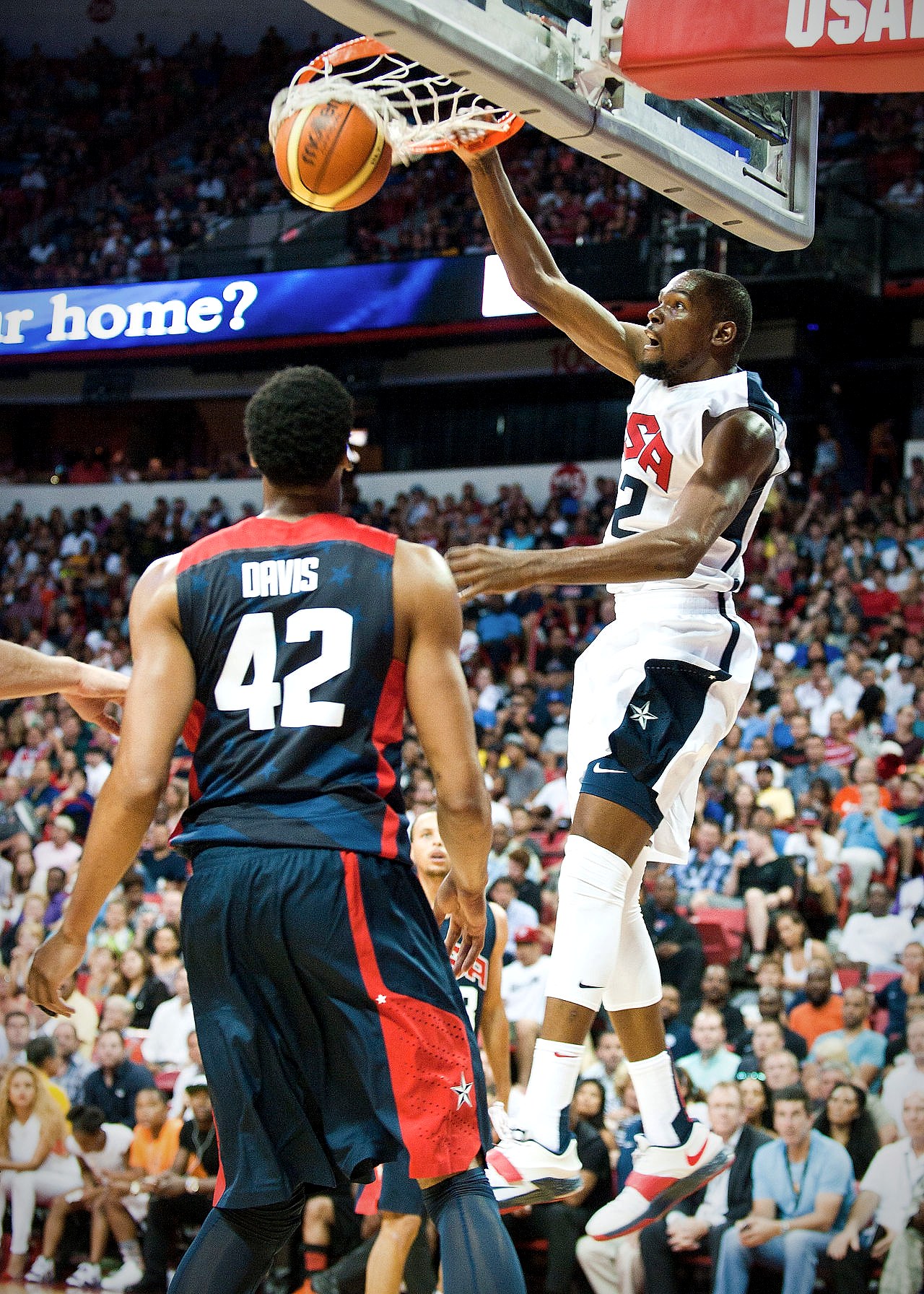
Kevin Durant is the most efficient pure scorer of the last twenty years. He has won two championships, two Finals MVPs, an MVP, four scoring titles, and enough All-Star and All-NBA selections that the comparative frame most writers use for him is no longer “best scorer of his generation” but “where he ranks among the top ten shooters and scorers in league history.” He is also, by his own word, the most fought-over individual player of the 2010s and 2020s. The 2016 free-agency choice turned into a decade of rotating headlines, and the 2025 trade that landed him in Houston was, on a strictly mechanical level, the largest single transaction the league has ever processed.
Prince George’s County and the path through private-school basketball
He was born September 29, 1988, in Washington, D.C., and raised in Prince George’s County, Maryland, by his mother, Wanda Durant, and his grandmother, Barbara Davis. His father, Wayne Pratt, was out of his life until Kevin was a teenager. He played AAU basketball with the DC Blue Devils, then the PG Jaguars, then the Prince George’s County Nike Hoop Club, alongside two teammates who would also reach the NBA: Ty Lawson and Michael Beasley.
He attended four high schools. National Christian Academy first, then Oak Hill Academy for his junior year, then a return to the D.C. area at Montrose Christian in Rockville, Maryland, for his senior year. Oak Hill was the marquee high-school program in the United States in the early 2000s; Montrose, under Stu Vetter, was a close second. Vetter’s 2005–06 Montrose team was chosen over Oak Hill because the school was closer to home and because Wanda wanted him to finish at a program where she could see most of his games in person. He was named Co-Most Valuable Player of the 2006 McDonald’s All-American Game alongside Chase Budinger.
Shop Kevin Durant jersey
As an Amazon Associate we earn from qualifying purchases.
Texas (2006–07) and the Naismith
He committed to Rick Barnes and the Texas Longhorns for one season. His statistical line that year, 25.8 points, 11.1 rebounds, and 1.9 blocks a game at nineteen years old, produced the first sophomore-eligible Naismith College Player of the Year ever awarded to a freshman. Texas lost to USC in the second round of the 2007 NCAA Tournament. He declared for the draft two weeks later.
The 2007 Draft, Seattle, and the move to Oklahoma City
The 2007 NBA Draft is remembered by both the Portland and Seattle front offices as the one neither of them ever finished debating. Portland, holding the No. 1 overall pick, selected Greg Oden, a center from Ohio State who Kevin Pritchard’s Blazers front office had graded as a generational interior defender. Seattle, at No. 2, took Durant. Within eighteen months Oden had missed an entire NBA season to microfracture surgery, and within five years the Portland decision was one of the most-cited what-ifs in draft history. He won Rookie of the Year in 2007–08 as a Seattle SuperSonic.
In the summer of 2008 the franchise relocated to Oklahoma City and was renamed the Thunder, a move that is still disputed in Seattle and that is discussed in detail on our Seattle SuperSonics franchise page. Durant spent his entire first decade in OKC.
The Oklahoma City Thunder years (2008–2016)
Oklahoma City was the most talented young team the NBA produced between Kobe’s Lakers and Curry’s Warriors. In 2011–12 the Thunder reached the Finals with Durant, Russell Westbrook, James Harden, and Serge Ibaka in their starting five; LeBron James’ Miami Heat beat them in five games. Harden was traded to Houston that October, a move the Thunder front office has since acknowledged, on background and in Sam Presti’s rare public remarks, as one they miscalculated by reading as a contract-mathematics problem rather than a contention-window problem.
Durant won the regular-season MVP in 2013–14 (32.0 points, 7.4 rebounds, 5.5 assists a game) and delivered the acceptance speech that has become the most-quoted single MVP acceptance in league history, with the famous ending “You the real MVP” directed at his mother sitting in the front row. The Thunder reached the 2016 Western Conference Finals leading the Warriors 3–1 and lost the next three games. It is the loss that reshaped the rest of his career.
The Warriors decision (July 4, 2016)
On the Fourth of July, 2016, he announced on The Players’ Tribune that he was signing with the Golden State Warriors, the team that had just eliminated him from the playoffs. The two-year deal with a player option (approximately $54 million) was structured to preserve his cap flexibility. The decision was received in most of the basketball press as the defining super-team move of the decade, and in Oklahoma City as something closer to a betrayal. The jersey-burning in Bricktown was the photographed equivalent of the 2010 Cleveland jersey burnings after The Decision, with one difference: OKC had not been a contender of LeBron’s stature at the time of his 2010 departure. The Thunder were a sixty-win team that had been up 3–1.
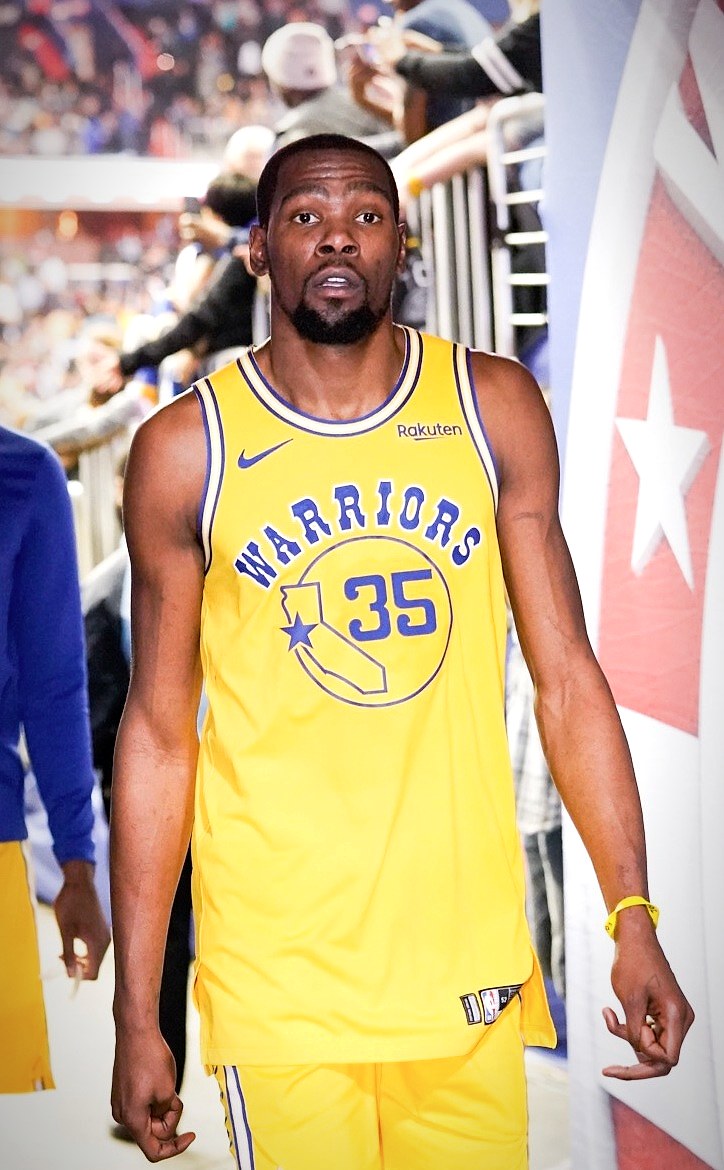
Golden State (2016–2019): two championships, two Finals MVPs
In his first Warriors season, Golden State won a record-setting sixteen playoff games and lost one, with Durant averaging 35.2 points a game across the 2017 Finals sweep of Cleveland. He was Finals MVP. The following Finals (2018), also against Cleveland, also a sweep, he averaged 28.8 points a game and won the Finals MVP again. Only Michael Jordan, Magic Johnson, Kareem Abdul-Jabbar, Tim Duncan, Shaquille O’Neal, LeBron James, and Hakeem Olajuwon have more than one Finals MVP. Durant’s two are as dominant statistically as any pair the list has produced.
The 2019 Finals ended his Warriors run. He injured his right calf in the second round against Houston, missed nine playoff games, and returned in Game 5 of the Finals against Toronto. Early in the second quarter he ruptured his right Achilles tendon on a non-contact move near midcourt. He signed with the Brooklyn Nets as a free agent two weeks later.
Brooklyn (2019–2023): the Big Three that did not hold
In Brooklyn he paired with Kyrie Irving and, after a February 2021 trade, James Harden. The three played 16 games together as a starting unit. The team’s second-round 2021 playoff exit to Milwaukee, in a seven-game series decided by an overtime Game 7 in which Durant’s size-fourteen foot was very obviously on the three-point line on a game-winning attempt, is one of the great individual-performance-and-still-lost playoff series in recent memory. Harden was traded to Philadelphia in February 2022; Irving’s status was a rotating question through the 2021–22 and 2022–23 seasons; and on February 9, 2023, Durant was traded to the Phoenix Suns for Mikal Bridges, Cameron Johnson, and a package of first-round picks.
Phoenix (2023–2025)
Two and a half seasons in Phoenix produced one playoff series win and a steady drumbeat of coaching changes and roster adjustments. Phoenix finished the 2024–25 season 36–46, missed the play-in, and by the June 2025 draft was openly discussing a full teardown.
The 2025 trade to Houston, the largest in NBA history
On June 22, 2025, the Rockets acquired Durant from the Suns as the centerpiece of a trade that ultimately involved seven teams, 13 players, six future first-round picks, a second-round pick swap, and the No. 10 pick in the 2025 draft. The league office required three days to process the paperwork. Houston sent Dillon Brooks, Jalen Green, and the picks to Phoenix; Phoenix sent Durant’s $54 million expiring contract to Houston along with rerouted assets; every other team in the chain took on a secondary role. It is, by the count of both ESPN and The Ringer, the largest NBA trade in recorded league history. The Rockets entered the 2025–26 season as the No. 2 seed in the Western Conference and an immediate title contender.
Team USA and the Olympic scoring record
He has won four Olympic gold medals with the United States (2012, 2016, 2020, 2024), more than any American men’s basketball player in history, and in the 2024 Paris tournament he passed Carmelo Anthony and Lisa Leslie to become the all-time leading scorer in Olympic basketball across both tournaments, a record that at his current career pace will stand for at least another cycle. He is also the first player to be named to three All-Olympic teams.
Legacy
The career-shape argument about Durant is the same one as the Warriors-decision argument. Marcus Thompson II’s KD: Kevin Durant’s Relentless Pursuit to Be the Greatest (Atria, 2019) is the most reported book on the OKC-through-Warriors arc. If you count the championships, he is a two-time champion with two Finals MVPs and an MVP, which is the résumé of an inner-circle top-fifteen player. If you count the per-game efficiency (.500 from the field, .400 from three, .880 from the line for a career, the 50-40-90 club, which has only existed for eight players), he is the most efficient high-volume scorer ever to shoot a basketball. If you count the Achilles recovery, which was unprecedented for a player of his size and which he has played at an All-NBA level through, again, unprecedented, he is also one of the great medical-rehabilitation stories in league history. All three of those things are true at once. Most arguments about him are arguments about which one of them matters most.
Signature Shoes
Durant’s Nike KD line has run from the KD 1 (2007) through the KD 17. The KD 4 is the most collector-sought of the early models. Performance reviewers have consistently rated the KD 15 and KD 16 among the best guards and wings shoes of their respective years for court sensitivity and ankle support.
Gear
Read Ian Thomsen’s The Soul of Basketball.
Sources
See the linked list in the page frontmatter. The 2025 trade processing detail is cross-referenced against NBA.com’s June 22, 2025 release and ESPN’s seven-team trade walkthrough. The Montrose and Oak Hill high-school detail draws on a 2017 Washington Post long-form piece by Steve Yanda; the Olympic scoring record is from USA Basketball’s 2024 tournament summary.
Shop Jerseys & Fan Gear at Fanatics
As a Fanatics affiliate, we may earn a commission from qualifying purchases.
Shop on Amazon
As an Amazon Associate, we earn from qualifying purchases.
Shop Sneakers & Gear at JD Sports
We may earn a commission from qualifying purchases on JD Sports.