Where Is the National Basketball Hall of Fame Located?

- The short answer, and the address
- Why Springfield, of all places?
- The argument that almost sent it to New York
- 1968: the first Hall, on the Springfield College campus
- 1985: the move downtown, to the river
- 2002: the basketball-domed building on West Columbus Avenue
- What the sphere actually holds inside
- Visiting today
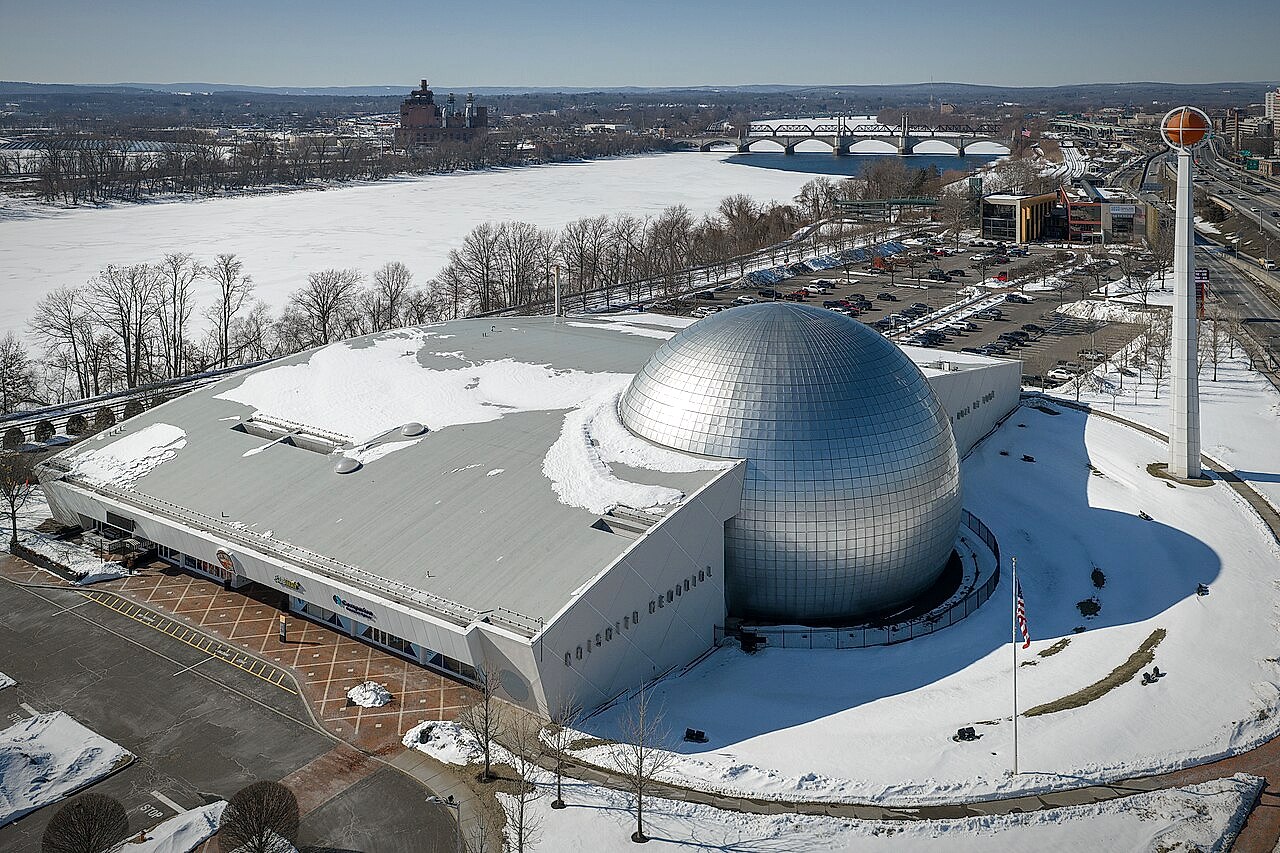
The short answer is Springfield, Massachusetts. The building address is 1000 Hall of Fame Avenue, on the east bank of the Connecticut River, a ten-minute walk from downtown and maybe two exits south of downtown on Interstate 91. You cannot miss it from the highway. The main exhibit hall is housed inside an eighty-foot silver sphere clad in a basketball-textured skin, bolted onto a low riverfront plaza; once you know what it is, it is the only thing to look at.
Springfield is not an NBA city. It is not close to one either, the nearest franchise is the Celtics, ninety minutes east on the Mass Pike, and after that you are looking at Brooklyn or Philadelphia. It is not even a mid-sized college town in the basketball sense; UConn and Syracuse are both closer than the next Division I program in Massachusetts. What Springfield has is the December 1891 gymnasium where basketball was invented, and that has been enough, for three successive iterations of the museum, to pin the sport's national shrine to the same two-block stretch of the Connecticut River. Below is the full story of how the Hall of Fame ended up here and why it has moved three times without ever leaving.
Why Springfield, of all places?
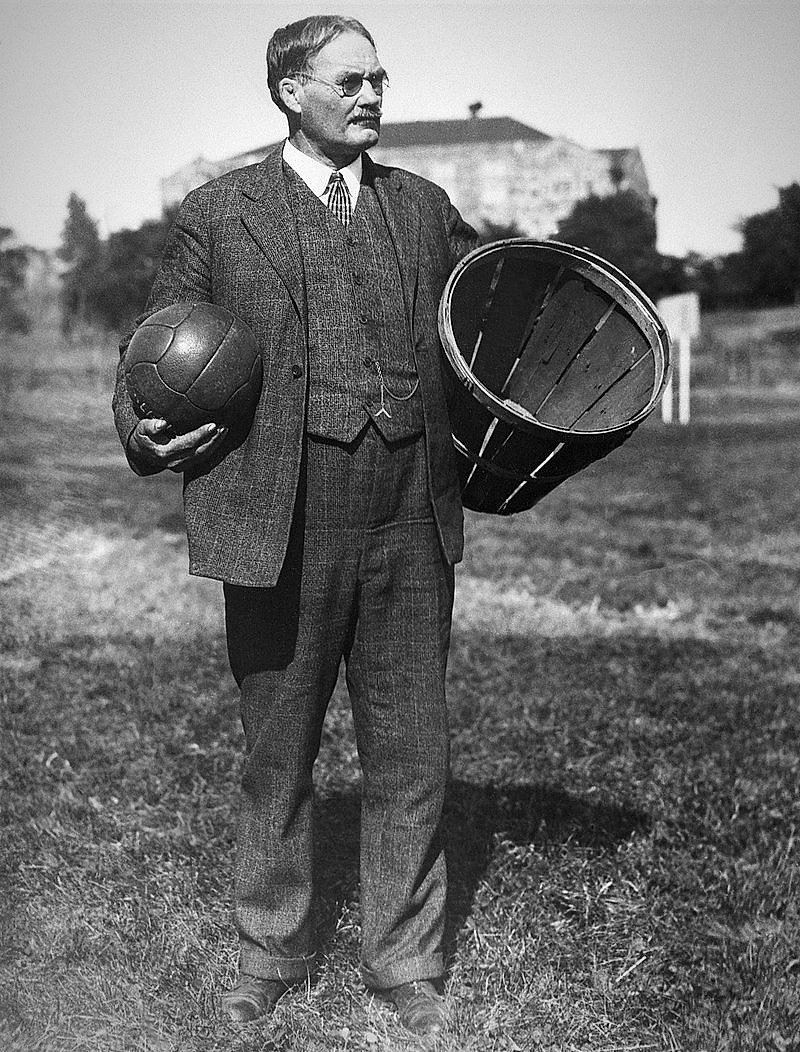
Basketball was invented at the International YMCA Training School, the institution that in 1912 became Springfield College, by a thirty-year-old Canadian physical-education instructor named James Naismith. The reason he invented it is usually told as a cartoon about restless boys and a rainy New England winter, and that is not wrong, but the real version is a bit more interesting. Naismith's boss, Luther Halsey Gulick, ran the school's physical-training department with a theological insistence on what he called "muscular Christianity" and was convinced that between the end of the football season in November and the start of baseball in April, the students under his care were losing their souls to boredom. In the fall of 1891 he gave Naismith two weeks to come up with an indoor winter game that would be vigorous enough to keep a class of eighteen-year-olds tired, safe enough not to break them on a wooden gym floor, and structured enough to survive a forty-minute class period.
Naismith wrote thirteen rules in longhand, typed them out on the afternoon of December 21, 1891, and had the building superintendent, Pop Stebbins, nail a peach basket to each balcony railing of the Armory Street gymnasium. A soccer ball was the only piece of equipment on hand; the peach baskets still had their bottoms, so every made shot required someone to climb up and fish the ball out with a stick. The first game, played the same afternoon, ended 1–0 on a single made basket by a student named William R. Chase. That is the game the Hall of Fame is, in effect, a monument to.
So when the question of a national basketball shrine arose in the 1940s and 1950s, the selection committee did not have a shortage of options, New York had MSG, Indianapolis had the Hinkle Fieldhouse of Hoosiers fame, Chicago had the Stadium, Philadelphia had the Palestra, but only Springfield had the actual gym. Naismith himself, on the record, had endorsed the idea of a museum in the city before he died in Lawrence, Kansas, in 1939, and the college trustees took the hint. Springfield College formally incorporated the Hall in 1959 and fundraised through most of the following decade.
The argument that almost sent it to New York
It is worth remembering that the decision to put the Hall in Springfield was not inevitable and was in fact resisted at the time, particularly by New York writers who, then as now, had a hard time believing any sport's capital city lay west of the Hudson. The case against Springfield ran roughly like this. The sport's commercial center had been Madison Square Garden from roughly 1934 (when Ned Irish began promoting college double-headers there) straight through the 1950s. The NBA's best-watched Finals of the early league, the great Knicks teams, the Rucker Park genealogy, and the sheer working population of basketball writers all clustered in New York. Putting the Hall of Fame two hours north in a depressed industrial city on the Connecticut River, the argument went, would treat the sport's birth as a civic trivia fact rather than a living thing.
The counter-argument was mostly a Springfield College one, backed by Naismith's own written wishes, and it won out for two reasons. First, the college owned the land and was willing to break ground without waiting for the NBA to commit capital it did not yet have. Second, the early Hall was as much a YMCA-movement artifact as a pro-league artifact, and the YMCA movement's center of gravity, such as it had one, was still Springfield. By the time the NBA became rich enough to contemplate relocating the museum to a more commercial city, the Hall had already been open in Springfield for a decade and the argument was functionally settled. The two subsequent moves, in 1985 and 2002, only tightened the connection to the place, neither of them contemplating leaving it.
1968: the first Hall, on the Springfield College campus
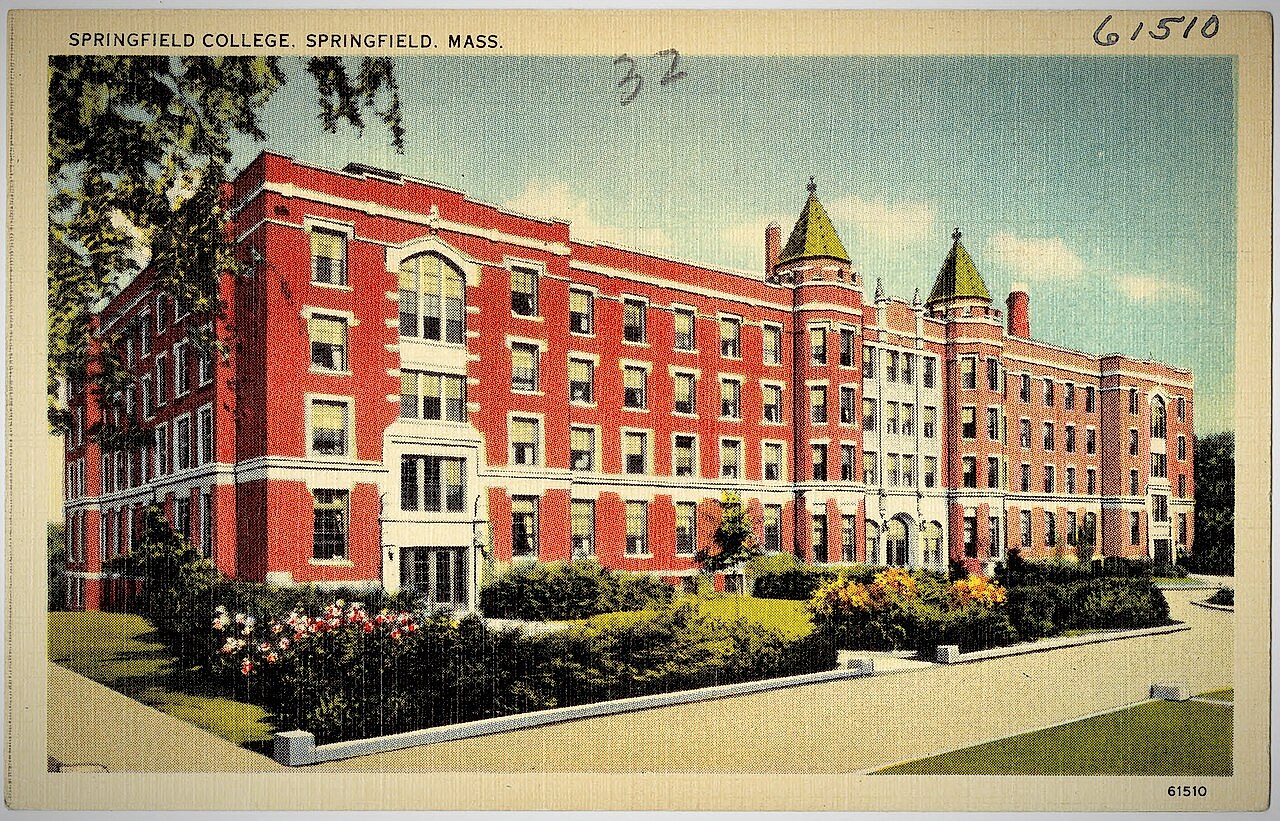
The original Naismith Memorial Basketball Hall of Fame opened on February 17, 1968, inside a single-purpose brick building on the Springfield College campus, on Alden Street. The first class had technically been enshrined in 1959, Naismith, Forrest "Phog" Allen, Luther Gulick, and a dozen others , but for nine years the Hall existed strictly on paper and in a rotating glass case on loan from the college. The physical building was modest, roughly thirteen thousand square feet, and largely a product of donated bricks and donated labor from the local YMCA network. Admission on opening weekend was a dollar.
By most accounts the 1968 building was undersized from the day it opened. Every year the induction class added four or five names; by the late 1970s the plaques were sharing floor space with the exhibits they were supposed to live alongside, and visiting sportswriters began to describe the place, not unfairly, as "cramped." The campus Hall served for seventeen seasons before the move downtown.
1985: the move downtown, to the river
The second Hall of Fame opened in 1985 on West Columbus Avenue, at the riverfront a mile west of the college. The new building was roughly fifty-three thousand square feet, four times the size of the original, and was the Hall's first stand-alone facility off the college grounds. It is the building most visitors in the late-1980s / early-1990s television era would remember, a squat brick structure with a glass atrium and a full-size practice court on the upper floor, where visitors were welcome to shoot. The annual September enshrinement ceremony moved from the gym on the college campus to nearby Symphony Hall and the riverfront plaza, where it has stayed since.
The 1985 Hall introduced two features the institution kept in every subsequent building. The first was the practice-court concept, a regulation floor, open to the public, where you could take a shot under a banner of your favorite inductee. The second was the life-size bronze statue gallery, commissioned one at a time across several decades, which eventually tracked the evolution of the game's iconography (Naismith holding a peach basket, Wilt Chamberlain towering at seven feet one, Michael Jordan mid-dunk in the 1984 warm-up jersey). Both features survived the 2002 rebuild.
2002: the basketball-domed building on West Columbus Avenue
The Hall most fans picture from television, the silver sphere, opened on September 28, 2002, on the lot immediately next to the 1985 site. It was a roughly forty-seven-million-dollar project, designed by the New York firm Gwathmey Siegel & Associates, and it replaced the 1985 facility with a purpose-built museum organized around an eighty-foot sphere clad in basketball-textured stainless steel. Charles Gwathmey, the firm's co-founder, was a committed New Yorker and an unlikely choice for the commission; by his own account in interviews at the time, he accepted the job specifically because the site's only non-negotiable program requirement was that the building be instantly recognizable from the highway. The sphere read as a basketball from I-91. That was the brief.
The 2002 move kept the Hall on the same two-block stretch of West Columbus Avenue but nearly doubled the square footage and, for the first time, produced a piece of architecture distinctive enough to function as a city-skyline element in its own right. The old 1985 building was demolished within a year. The 1968 campus building was repurposed by Springfield College for academic use and stands today under a different name, its plaque commemorating the original tenant still mounted by the front door.
What the sphere actually holds inside

Inside, the ground floor is organized around a regulation basketball court, Center Court, used for induction-week events and the occasional clinic. From Center Court a spiraling ramp carries visitors up the inside wall of the sphere, past rotating exhibits on specific players, teams, and eras, until the ramp delivers them onto the third-floor Honors Ring, a circular gallery where every inductee's plaque is mounted, chronologically, along the sphere's interior curve. The effect is unsubtle and, after a while, a little overwhelming; the inductee class is now well past four hundred names.
The remaining square footage on the perimeter of the sphere holds a broadcasting studio (used by ESPN and by New England regional sports networks for live inductee-weekend coverage), a research library with the Hall's archival collection of early rulebooks and film, a 250-seat theater that runs a rotating short-form documentary, and a gift shop that, by gift-shop standards, is remarkably restrained. The surrounding plaza, called Hall of Fame Village, contains roughly two dozen retail and dining tenants and functions as the city's de facto downtown on induction weekend every September.
Visiting today
The Hall of Fame is open year-round, closed only on Thanksgiving, Christmas, and the day between. Hours are extended across the September enshrinement weekend, when that year's inductees are formally honored at the ceremony on Center Court and then again at the companion event at Symphony Hall, a short walk across the downtown plaza. Springfield sits roughly ninety minutes by car from Boston, two hours from New York City, and a fifteen-minute drive from Bradley International Airport in Windsor Locks, Connecticut , a detail that appears in every "where is the Basketball Hall of Fame" article because the Hall's own trustees, over the years, have cited it as the practical reason the institution has never seriously contemplated another move. Easy off the interstate, fifteen minutes from a commuter airport, and already on the ground where Naismith taught the first class of eighteen-year-olds to dribble. For a sport invented in Springfield, it turns out, Springfield is not a bad place to keep the museum.
Shop on Amazon
As an Amazon Associate, we earn from qualifying purchases.
Shop Basketball Shoes & Apparel at JD Sports
We may earn a commission from qualifying purchases on JD Sports.
Sources
- Naismith Memorial Basketball Hall of Fame, official site
- Basketball-Reference, Hall of Fame index
- City of Springfield, Massachusetts, visitor information
- Gwathmey Siegel & Associates, Hall of Fame project page
- Naismith Memorial Basketball Hall of Fame (Wikipedia)
- "The Basketball Man", Bernice Larson Webb biography of James Naismith, University Press of Kansas, 1973
- Springfield Republican archives, 1968 and 1985 dedication coverage