The Invention of Basketball: December 1891 in Springfield
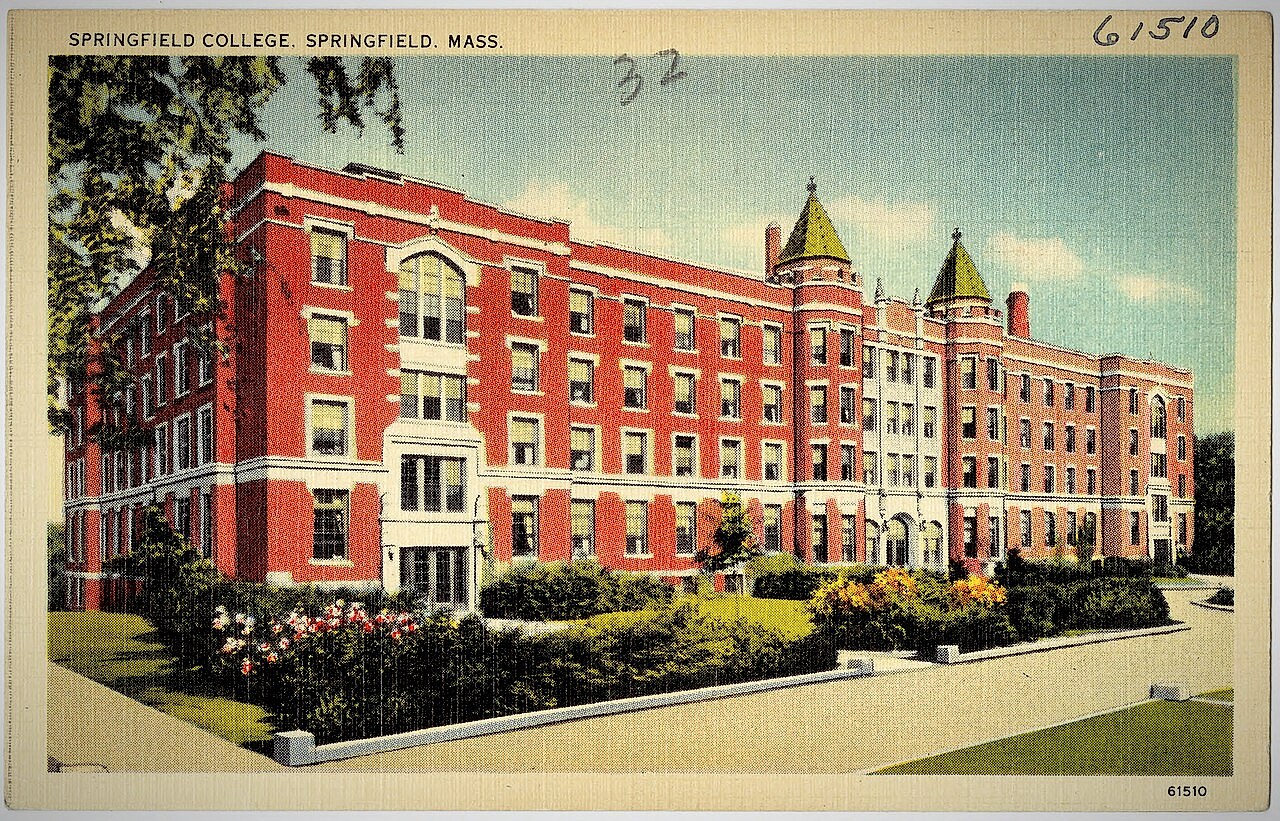
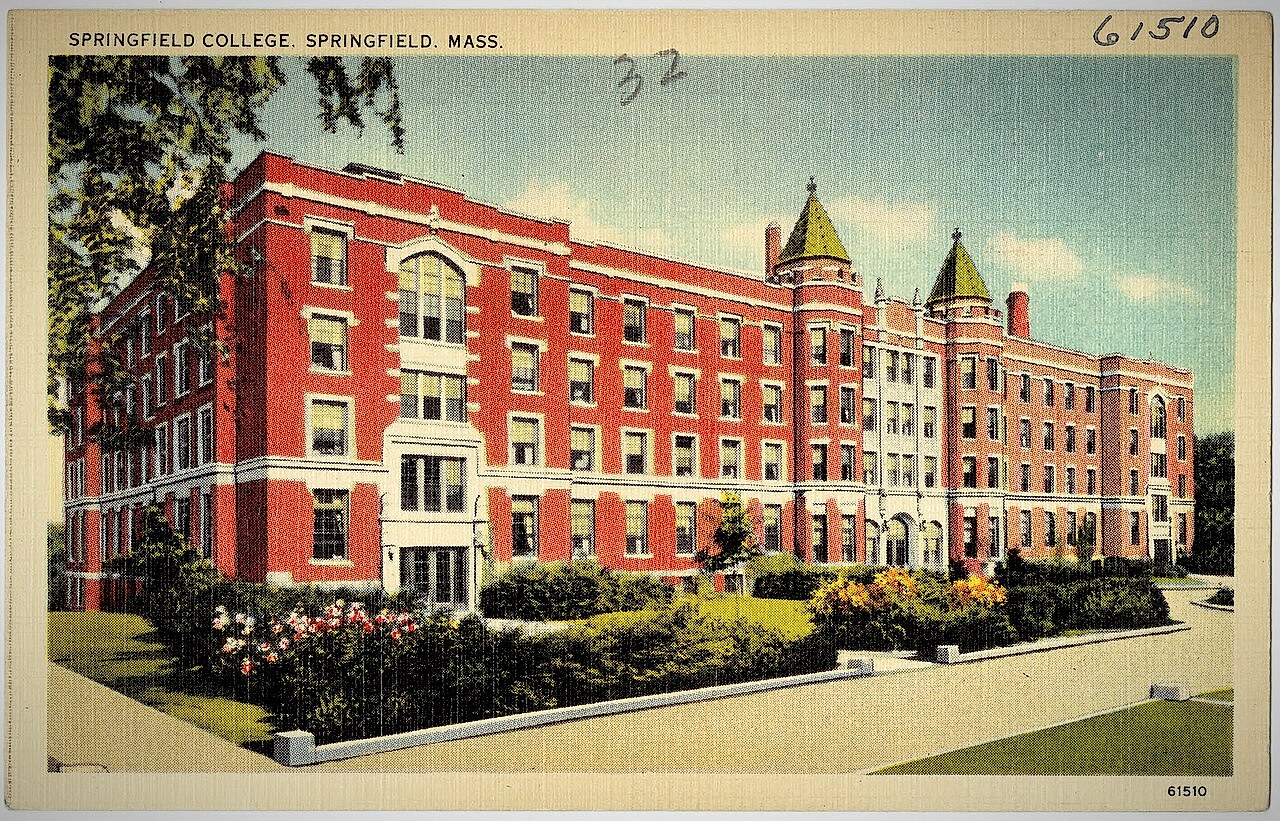
Basketball was invented in Springfield, Massachusetts, in two weeks of December 1891, by James Naismith, a thirty-year-old Canadian physical-education instructor at the International YMCA Training School. The game was built to solve a specific classroom problem: an indoor winter activity for a class of student physical-education teachers who had chewed through every existing gymnasium drill their instructors had given them. The first recorded game was played on December 21, 1891, with two peach baskets nailed to a balcony, a soccer ball, eighteen players, and thirteen rules Naismith had written on two sheets of paper and tacked to the gym wall. The final score was 1–0. The game worked. No one in the room that afternoon, including Naismith, treated the result as the invention of an international sport. The spread happened in the years immediately after.
Luther Gulick and the muscular Christianity directive
The invention started with Luther Gulick, the Training School’s head of physical education. Gulick was a Congregational minister’s son, a trained physician, and the YMCA movement’s most aggressive intellectual advocate for what he called “muscular Christianity,” a nineteenth-century American and British movement that argued Protestant churches had over-emphasized cerebral religion at the expense of the body. Gulick’s position was that physical training was not preparation for moral formation but part of it, and that American men (he wrote mostly about men) were in a state of national physical decline that the YMCA could correct through organized sport.
In the fall of 1891, Gulick had given the indoor-winter-game assignment to two previous instructors, both of whom had returned variations on existing gymnasium activities (medicine-ball games, calisthenics routines) that the class had rejected as too familiar. In late November or early December, Gulick handed the assignment to Naismith, who was a first-year faculty member teaching a section of the 1891–92 Secretarial Course. The note Gulick gave Naismith, preserved in Naismith’s own 1941 posthumously-published memoir Basketball: Its Origin and Development, was blunt: the students needed something “that would take the form of a game, with certain definite objects, and that would make an appeal to their rivalry and to their enthusiasm.”
Shop NBA Gear
As an Amazon Associate we earn from qualifying purchases.
Naismith has said that he accepted the assignment with the explicit condition that if the new game failed, the class would revert to standard calisthenics and he would take the failure on his record. Gulick agreed. The fourteen-day design window that followed is the one Naismith spent at a desk in his boarding-house room working out, against the constraints of indoor play, the specific rule set that would distinguish the new game from soccer (no running with the ball), from rugby (no roughing), and from lacrosse (no sticks).
The design logic of the rules
Naismith started from the observation that nearly every team ball sport known in 1891 involved running with the ball, and that running with a ball in a small indoor gymnasium produced predictable collisions. He eliminated running with the ball entirely. That single constraint, more than any other, defined the game. A player who caught the ball had to pass it or shoot it; he could not advance it with his feet. The ban on running with the ball is rule three of the original thirteen and is the game’s oldest continuous structural rule.
Naismith then needed a scoring objective. Goals on the floor were too easy to cluster-defend. He raised the goal to ten feet, specifically so defenders could not mass around it, and angled the opening upward so that the shot required arc and touch, not force. The combination of the horizontal pass-to-shoot constraint and the vertical ten-foot goal is the design decision that made basketball basketball. Nothing else in the original rule set is as structurally load-bearing.
The peach baskets, and the janitor Pop Stebbins
Naismith asked the Training School’s janitor, whose name was Pop Stebbins, for two square wooden boxes about eighteen inches on a side. Stebbins had no wooden boxes of that size but found two bushel-sized peach baskets in the school’s storeroom, left over from an earlier shipment of peaches from a local New England fruit supplier. Naismith accepted the peach baskets. He nailed them to the lower rail of the Armory Street gymnasium balcony. The balcony happened to be ten feet above the gymnasium floor.
The ten-foot rim height was an artifact of the balcony. It was not chosen for any specific basketball-physics reason. It is, by the unanimous accounting of Naismith’s own 1941 memoir and the surviving Training School architectural plans, the simple dimension of the gymnasium’s existing structure. Every regulation basket in the world since, at every level of play from elementary-school-sized basketballs to the NBA’s professional rim, has been set at ten feet.
The thirteen original rules
The rules, which Naismith typed on two sheets and tacked to the bulletin board on December 21, 1891, before the first game, are:
- The ball may be thrown in any direction with one or both hands.
- The ball may be batted in any direction with one or both hands, never with the fist.
- A player cannot run with the ball. The player must throw it from the spot on which he catches it, allowance to be made for a man running at good speed.
- The ball must be held in or between the hands. The arms or body must not be used for holding it.
- No shouldering, holding, pushing, tripping, or striking in any way the person of an opponent.
- A foul is striking at the ball with the fist, violation of Rules 3 and 4, and such as described in Rule 5.
- If either side makes three consecutive fouls it shall count a goal for the opponents.
- A goal shall be made when the ball is thrown or batted from the grounds into the basket and stays there.
- When the ball goes out of bounds, it shall be thrown into the field and played by the first person touching it.
- The umpire shall be judge of the men and shall note the fouls.
- The referee shall be judge of the ball and shall decide when it is in play, in bounds, and to which side it belongs.
- The time shall be two fifteen-minute halves with a five-minute rest between.
- The side making the most goals in that time shall be declared the winner.
The two sheets have a specific biography of their own. A student in Naismith’s class, Frank Mahan, kept one of them after the first game in 1892. Mahan returned it to Naismith several years later. Naismith’s grandson Ian Naismith inherited the sheets from the family. The sheets were sold at auction by Sotheby’s on December 10, 2010 for $4.3 million, then the highest price ever paid at auction for a piece of sports memorabilia. The buyer was David G. Booth, a Kansas alumnus and investment manager, who donated the rules to the University of Kansas. They are now on permanent display in a climate-controlled vault at Allen Fieldhouse.
The first game, December 21, 1891
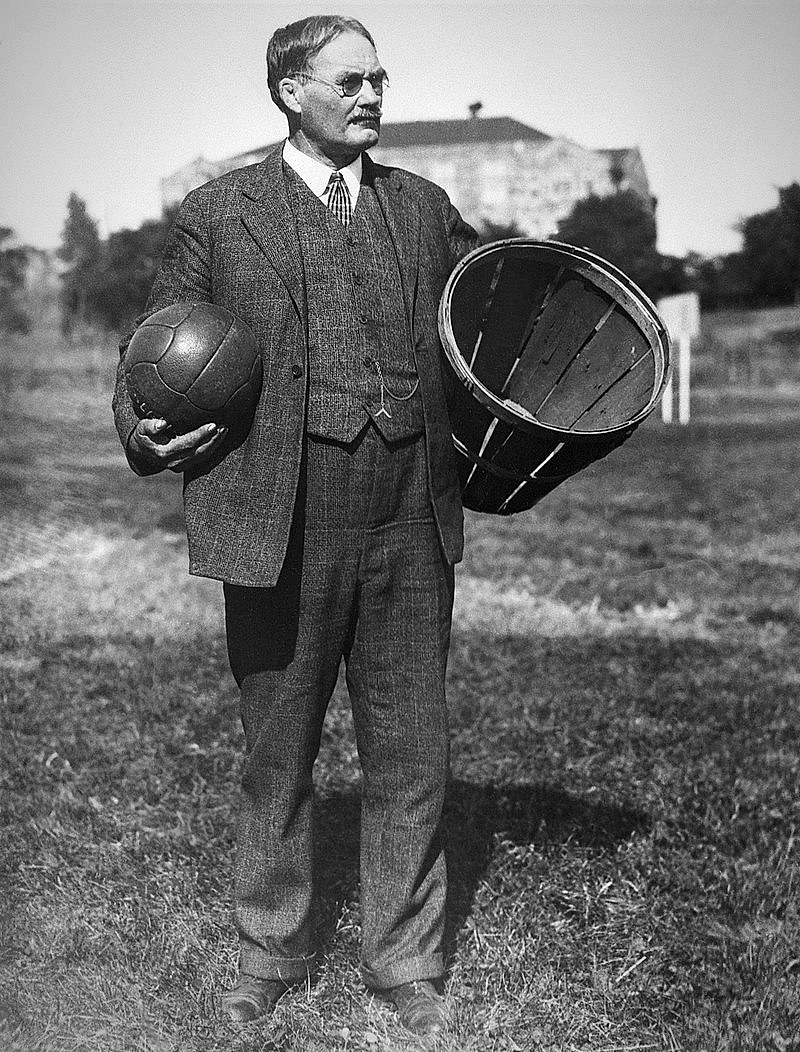
Eighteen students in Naismith’s 1891–92 Secretarial Course played the first game, nine to a side, in the Armory Street gymnasium on December 21, 1891. Naismith supervised. The ball was an Association Football (soccer ball) from the Training School’s athletic supply room. A class attendance sheet, preserved in the Springfield College archive, lists the eighteen names.
The final score was 1–0. The only made basket came late, from roughly twenty-five feet out, by William R. Chase, a student from the class. Naismith was required to use a ladder after the made basket to remove the ball from the peach basket; the ball did not fall through the bottom. The issue of retrieving the ball would lead, several years later, to the addition of a square-hole cutout at the bottom of the basket; the metal net-and-cylinder rim that every modern basketball uses descends from that post-1891 modification. The janitor-aided ladder retrieval is one of the most-repeated details about the first game.
The students finished the session, filed out of the gymnasium, and went about their afternoon. Naismith’s own reported reaction, per his 1941 memoir, was mild optimism. He wrote that “the game was a success, as far as it went, but there were two or three things about it that were obvious defects, and that needed to be changed.”
Senda Berenson and the 1892 Smith College women’s game
In March 1892, Senda Berenson, director of physical education at Smith College in Northampton, Massachusetts, introduced basketball to Smith. Berenson had corresponded with Naismith and had traveled the twenty miles south to Springfield to watch the Training School classes during the spring of 1892. She brought the rules back to Smith, modified several of them (most visibly: six players per side instead of five-or-nine, a three-zone court on which players were restricted to one zone only, no individual dribbling, a maximum of three passes per possession), and held the first formal women’s basketball game at the Smith College gymnasium on March 21, 1892.
Berenson published Basket Ball for Women in 1893, the first printed rulebook for the women’s game. The Berenson modifications governed U.S. women’s basketball in various evolved forms for roughly seventy years, until the NCAA and AAU adopted five-on-five full-court play in the late 1960s and early 1970s. The intercollegiate five-on-five standard was formalized in 1971.
The relationship between Naismith and Berenson is the most-underreported part of the 1891–92 basketball history. Naismith’s correspondence with Berenson, preserved in the Smith College Sophia Smith Collection archive, makes clear that Naismith supported the Smith introduction, approved of the Berenson modifications as valid adaptations rather than dilutions, and considered the women’s game a full-status parallel of the men’s. The later twentieth-century framing of the women’s game as a derivative or lesser parallel does not appear in any Naismith document from the 1890s.
The first competitive tournament, 1898
Basketball spread through the YMCA network across the 1890s. Within three years of the December 1891 first game, basketball was being played in YMCAs in Paris, Melbourne, and Tokyo. The first documented intercollegiate men’s game was played on February 9, 1895 between Hamline College of Minnesota and the Minnesota State School of Agriculture (Hamline won 9–3). The first recognized organized league, the National Basketball League, formed in Philadelphia in 1898 and included six teams from the Philadelphia and New Jersey YMCA area. The NBL of 1898 was not the NBA’s direct predecessor (the NBA traces to the 1946 Basketball Association of America), but it was the first organized season-long professional competition in the sport.
The 1898 NBL season included 81 games over four months. Trenton, New Jersey, won the first league title. The franchise transition from YMCA exhibition basketball to organized paid competition dates to that 1898 season.
The 1936 Olympics and Naismith’s trip to Berlin
Basketball was included in the Summer Olympic program for the first time at the 1936 Berlin Games. FIBA, the International Basketball Federation (founded 1932, headquartered in Geneva), successfully petitioned the IOC in April 1934 for the inclusion. Naismith, by then seventy-four years old and a naturalized U.S. citizen teaching at the University of Kansas, attended the 1936 Games as the IOC’s guest of honor for the new sport. He presented the gold medal to the winning U.S. team in an outdoor, rain-soaked final played on tennis courts. He died three years later, in November 1939.
The question the first game did not answer
The one rule Naismith did not write into the original thirteen was how a ball-holder could move without running. The Training School students tolerated the constraint on that December afternoon in 1891; in later practice, the inability to advance the ball in any form other than the pass produced stagnant play. The solution came from student improvisation: players began rolling the ball on the floor ahead of themselves, which counted as passing to themselves. Rolling evolved into bouncing. The bouncing rule was formalized as the dribble by the 1896–97 season. Dribbling was codified in the rulebook in 1898.
The dribble is the single largest post-1891 rule change, and it is the one most responsible for the game’s modern playing style. Without it, basketball in its 1891 form is closer to handball or water polo: a pass-only team sport. With it, the individual ball-handler becomes a narrative point of interest, which is the game we watch. Naismith himself was skeptical of the dribble for most of its first decade, concerned that it shifted the game toward individual display and away from the team-ball-movement premise he had designed. The rule prevailed anyway.
Related reading
Gear
Browse The Book of Basketball, the sport’s most comprehensive single-volume history.
The Book of Basketball on Amazon →
Sources
- James Naismith, Basketball: Its Origin and Development (Association Press, 1941)
- Luther Gulick papers, Springfield College archive (indoor-winter-game assignment correspondence, fall 1891)
- Springfield College archive, class attendance record, Secretarial Course 1891–92
- University of Kansas, Allen Fieldhouse, original thirteen rules exhibit; Sotheby’s December 10, 2010 auction record
- Senda Berenson, Basket Ball for Women (Smith College, 1893)
- Smith College Sophia Smith Collection, Naismith–Berenson correspondence (1892–1896)
- FIBA, decisions of the International Olympic Committee, Athens, April 1934 (basketball’s inclusion in the 1936 Berlin Games)
- Naismith Memorial Basketball Hall of Fame, James Naismith induction file (1959)
Shop NBA Gear at Fanatics
As a Fanatics affiliate, we may earn a commission from qualifying purchases.
Shop on Amazon
- The Invention of Basketball: December 1891 in Springfield — books ↗
- NBA history books ↗
- Basketball training gear ↗
As an Amazon Associate, we earn from qualifying purchases.
Shop Basketball Shoes & Apparel at JD Sports
We may earn a commission from qualifying purchases on JD Sports.
Sources
- Naismith Memorial Basketball Hall of Fame, James Naismith biography
- Springfield College, history of basketball
- James Naismith, "Basketball: Its Origin and Development" (Association Press, 1941)
- Senda Berenson, "Basket Ball for Women" (Smith College, 1893)
- University of Kansas, Allen Fieldhouse, original rules exhibit