How the 24-second shot clock saved the NBA
Without the 24-second shot clock, professional basketball would not exist as a major American sport. That is not hyperbole. By the early 1950s the NBA was dying. Average game scores hovered in the 70s. Teams stalled with the ball for entire quarters. The sport’s signature game (Fort Wayne Pistons 19, Minneapolis Lakers 18 on November 22, 1950) was a final score that would not have looked out of place in nineteenth-century college football. Fans booed during games. Television networks declined to broadcast. Several franchises (the Indianapolis Olympians, the Anderson Packers, the Sheboygan Red Skins) folded between 1950 and 1953.
What saved the league was a Syracuse bowling-alley owner with a notepad and a number: 24.
The stall problem
The pre-1954 NBA had no rule against holding the ball indefinitely. As long as a team kept the ball in play, they could pass it around the perimeter for as long as they wanted. The strategic implication, especially in the late game, was clear: take a lead, pass the ball, run out the clock.
Shop NBA Gear
As an Amazon Associate we earn from qualifying purchases.
The most extreme example of this strategy was the Fort Wayne Pistons’ November 22, 1950 game against the Minneapolis Lakers at the Minneapolis Auditorium. The Pistons trailed early. They decided their best chance to keep George Mikan (the league’s dominant scorer, then averaging 27.4 points per game) from beating them was to keep the ball away from him entirely. They started stalling in the second quarter. The crowd booed. Lakers head coach John Kundla pulled his defenders back to half court rather than chase the ball at midcourt. The Pistons maintained the strategy through three full quarters. The final score was Fort Wayne 19, Minneapolis 18. Mikan scored 15 of his team’s 18 points; the rest of his teammates went 1-of-18. The game is the lowest-scoring game in NBA history and remains, more than seven decades later, the structural case study every basketball historian cites for why the league needed a shot clock.
The 1953-54 NBA, the season immediately before the shot clock was adopted, averaged 79.5 points per team per game. Six teams averaged fewer than 80. Television contracts (the DuMont Network had carried selected games since 1947) were not being renewed. League attendance averaged about 3,500 per game. The Baltimore Bullets folded in November 1954. Three more franchises were openly considering folding before the 1954-55 season.
Danny Biasone
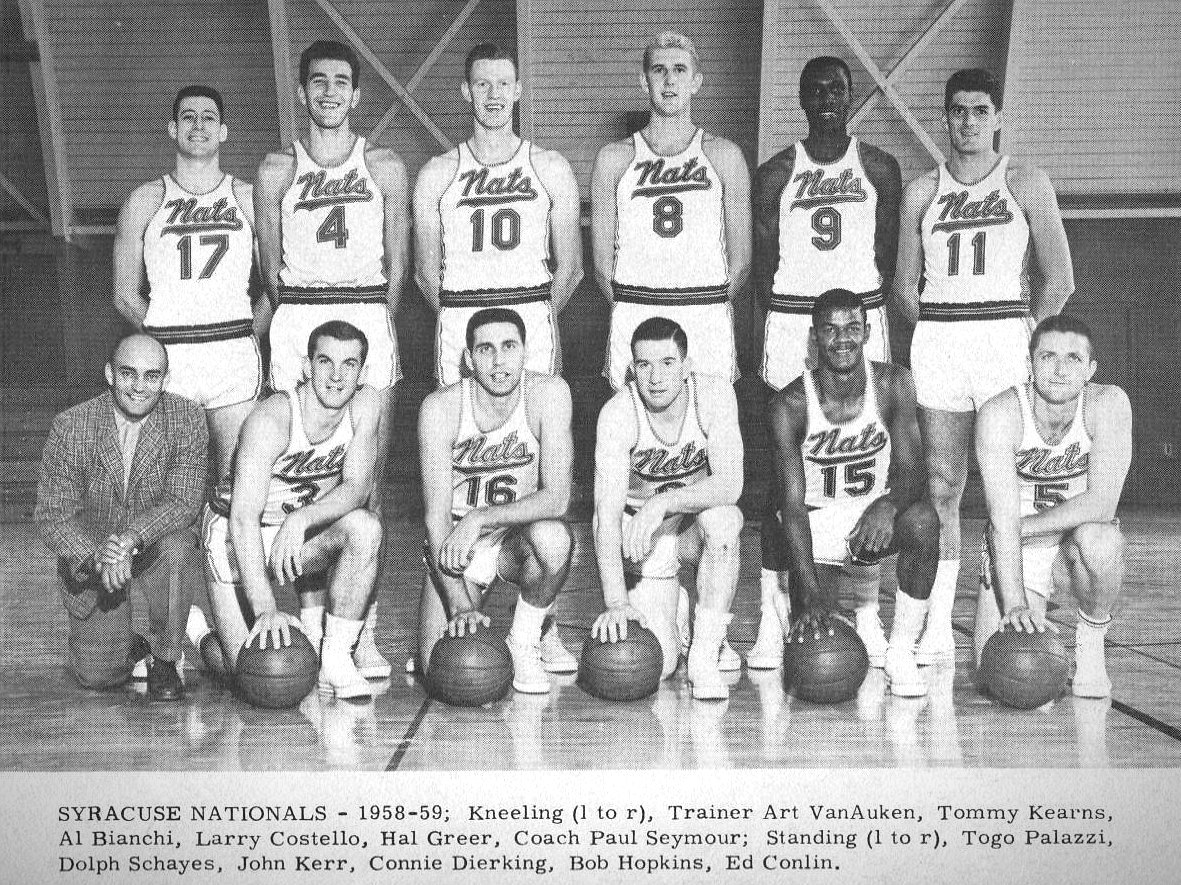
Danny Biasone owned the Syracuse Nationals. He had bought the franchise in 1946 for $5,000, having previously owned a Syracuse bowling alley. He was not, by any account from contemporaneous press, a basketball-strategy thinker. He was a small-business owner who had inherited a basketball team whose existence threatened the survival of his bowling alley because all the city’s basketball energy was going to the Nationals’ losing seasons.
Biasone had been thinking about a shot clock for several years. He had argued the case at NBA owners meetings. He had drafted variations of the rule on bar napkins. The mathematical breakthrough that finalized the 24-second number, by Biasone’s own account in a 1986 oral-history interview with Charles Salzberg for From Set Shot to Slam Dunk, came in the summer of 1953. Biasone sat down with Leo Ferris, the Nationals’ general manager, in Biasone’s bowling alley with a notepad. They calculated:
The average NBA team in 1953-54 was attempting roughly 60 field goals per game. Both teams combined were taking 120. A 48-minute game contains 2,880 seconds. 2,880 divided by 120 equals 24.
Biasone’s argument: if the shot clock was set at 24 seconds, the league’s best teams would still be able to run their full offensive sets, and the league’s stalling teams would be forced to shoot. The math worked.
He brought the proposal to the April 22, 1954 owners meeting at the Hotel Lafayette in New York City. The owners voted to adopt it. The rule went into effect for the 1954-55 season.
October 30, 1954: the first shot-clock game
The first NBA game ever played with a shot clock was the Rochester Royals at the Boston Celtics on October 30, 1954, at the Boston Garden. The Celtics won 98-95. The two teams combined to attempt 213 field goals, more than 50 above the pre-clock average. The pace was, by every contemporaneous account, immediately better. Boston Globe columnist Jerry Nason wrote the next morning that “basketball came alive last night for the first time in years.”
The 1954-55 NBA scoring average jumped from 79.5 points per team per game to 93.1. Field-goal attempts per team per game rose from 75.4 to 89.1. Attendance jumped 50% inside two seasons. Television interest returned (NBC signed a 1955 broadcasting deal that would last fifteen years). The Syracuse Nationals (Biasone’s team) won the NBA championship that very first shot-clock season, beating the Fort Wayne Pistons in seven in the Finals.
The Fort Wayne Pistons. The same franchise that had, four years earlier, scored 19 points to beat Minneapolis 19-18.
The structural effect on the sport
The shot clock did three things at once.
First, it forced offense. Teams could no longer stall. A possession had to produce a shot attempt within 24 seconds or it ended in a turnover. The strategic landscape rebuilt itself around set-piece offense (screen-and-roll combinations, pick-the-screener concepts, fast-break transition basketball as a primary scoring method). The pre-1954 era’s slow-down sets disappeared.
Second, it created the modern NBA pace. The 1955-56 Boston Celtics under Red Auerbach, with Bob Cousy at point guard, were the first team to build their entire offensive identity around shot-clock-era basketball. They averaged 106 points per game (still leading the league by 10 points over second place) and won the 1957 championship. Auerbach would later write in his autobiography that the shot clock was the single rule change that made his fast-break Celtics possible.
Third, it standardized broadcast viability. The pre-1954 NBA had not been worth televising because the games were too slow and too unpredictable in length (a stall game could run 30 minutes; a normal game could run 90). With the shot clock, every game’s pace was consistent and the television window became reliable. The 1955 NBC deal was signed within months of the rule change. The league’s revenue base became, for the first time in its eight-year existence, structurally sustainable.
The variations and the modern game
The 24-second NBA shot clock has held since 1954. The college game adopted a 45-second shot clock in 1985 (after the famous January 30, 1982 stall game between Virginia and North Carolina, in which Dean Smith’s Tar Heels held the ball against a Ralph Sampson-led Virginia team for nearly seven minutes in the first half), then dropped it to 35 seconds in 1993 and to 30 seconds in 2015. FIBA uses 24. The WNBA has used 24 from its founding in 1997.
The NBA’s shot-clock rule itself has been adjusted twice in significant ways:
1976: The corner-ball rule. A team could not call timeout on the offensive end of the floor with fewer than six seconds remaining on the shot clock. The rule was added to prevent teams from using timeouts to reset the clock on dead-ball plays.
2018: The 14-second offensive-rebound reset. Before 2018, an offensive rebound reset the shot clock to a full 24 seconds. After 2018, an offensive rebound resets the clock to 14 seconds (the back end of a normal possession). The change was designed to push pace further by limiting the value of long offensive sequences. The league’s average possessions per game rose from 99.6 in 2017-18 to 101.4 in 2018-19, a small but meaningful pace increase.
The 14-second reset is structurally consistent with what Biasone designed. He calculated 24 seconds as the back-end limit for a single offensive set. He never accounted for offensive rebounds because his math assumed each possession was a single shot attempt. The 2018 rule corrected the oversight by treating an offensive rebound as the start of a new sub-possession.
The plaque in Syracuse
Danny Biasone is enshrined in the Naismith Memorial Basketball Hall of Fame as a contributor (inducted in 2000). He died in May 1992 at age 83 in Syracuse. There is a plaque outside the Onondaga County War Memorial in downtown Syracuse, the building that was the Nationals’ home arena and the place where the original 24-second rule was first tested in 1954 preseason scrimmages, marking the location.
The plaque is small. It reads, in its first line, “Birthplace of the 24-second shot clock.” The second line reads, in effect, that without it, the NBA would not exist.
Both sentences are, by basketball-historical convention, factually correct.
Related rule histories
- The illegal-defense rule (1981 to 2001), the other major NBA structural rule change of the post-Mikan era.
Gear
Browse The Book of Basketball for how the shot clock reshaped the game.
The Book of Basketball on Amazon →
Sources
- Basketball-Reference: NBA team scoring averages, 1953-54 through 1955-56.
- New York Times, archive coverage of the April 22, 1954 NBA owners meeting at the Hotel Lafayette.
- Charles Salzberg, From Set Shot to Slam Dunk: The Glory Days of Basketball in the Words of Those Who Played It (Dutton, 1987), Biasone interview.
- Boston Globe, Jerry Nason game recap, October 31, 1954.
- Red Auerbach with Joe Fitzgerald, Red Auerbach: An Autobiography (Putnam, 1977).
- NBA.com Hall of Fame entry for Danny Biasone (inducted 2000).
Shop NBA Gear at Fanatics
As a Fanatics affiliate, we may earn a commission from qualifying purchases.
Shop on Amazon
As an Amazon Associate, we earn from qualifying purchases.
Shop Basketball Shoes & Apparel at JD Sports
We may earn a commission from qualifying purchases on JD Sports.
Sources
- Basketball-Reference: NBA team scoring averages 1953-54 through 1955-56
- Charles Salzberg, From Set Shot to Slam Dunk: The Glory Days of Basketball in the Words of Those Who Played It (Dutton, 1987), Biasone interview
- Red Auerbach with Joe Fitzgerald, Red Auerbach: An Autobiography (Putnam, 1977)
- NBA.com Hall of Fame entry for Danny Biasone (inducted 2000)
- Boston Globe archive, Jerry Nason game recap, October 31, 1954
- New York Times archive, coverage of the April 22, 1954 NBA owners meeting