George Mikan
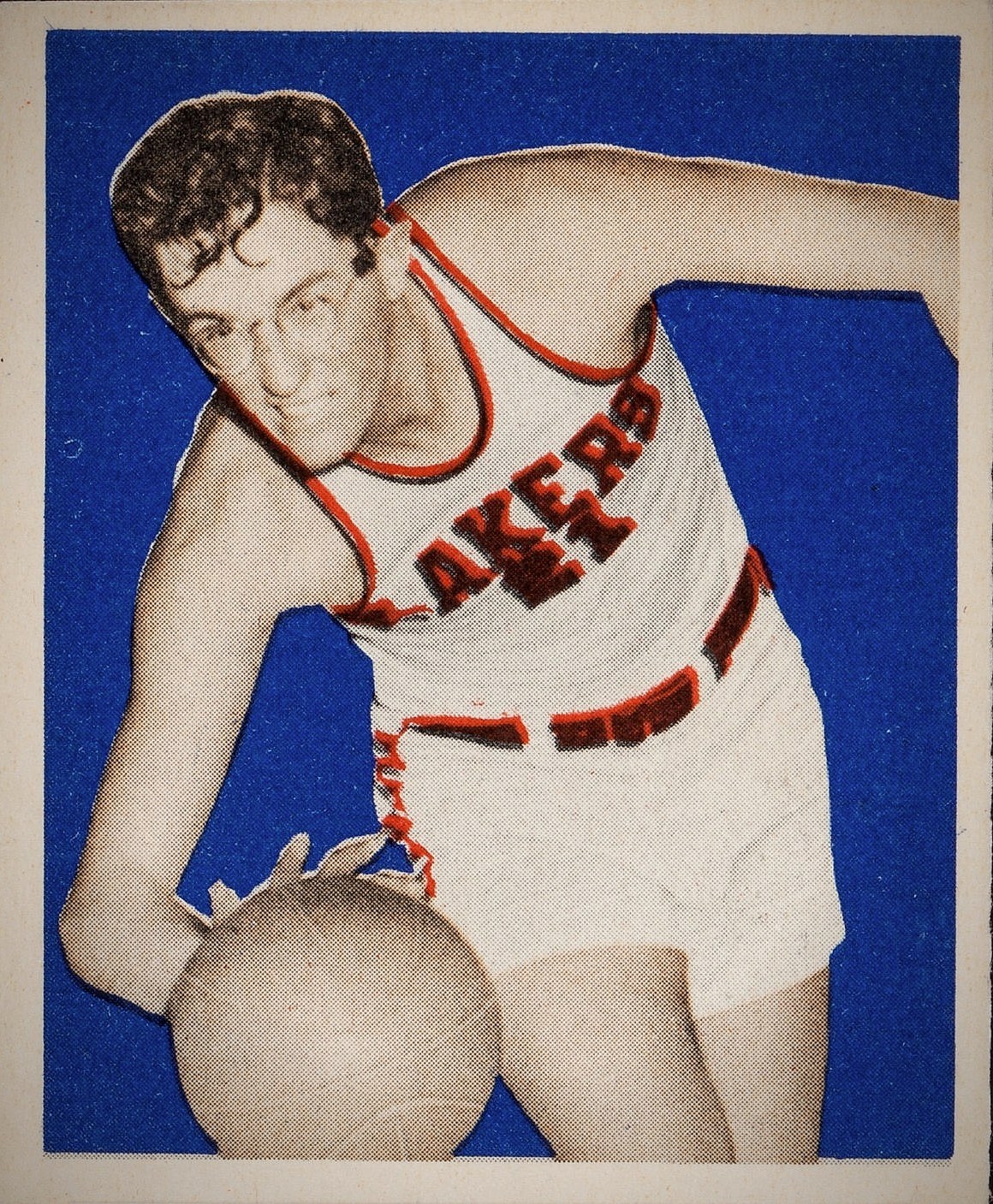
George Mikan is the player who proved professional basketball could be a major American sport. He was the first NBA superstar in any commercial sense, the first basketball player to share top-of-the-marquee billing at Madison Square Garden (“GEO MIKAN vs. KNICKS,” the famous marquee read in 1949), and the player whose dominance in the early 1950s forced the league to widen the foul lane from six to twelve feet, introduce the goaltending rule, and adopt the 24-second shot clock. He won six professional championships across two leagues. He was 6’10”, wore thick eyeglasses on the court because of severe nearsightedness, played most of his career on a steel-pinned right leg, and was the first center in basketball to demand a team’s offense run through the post.
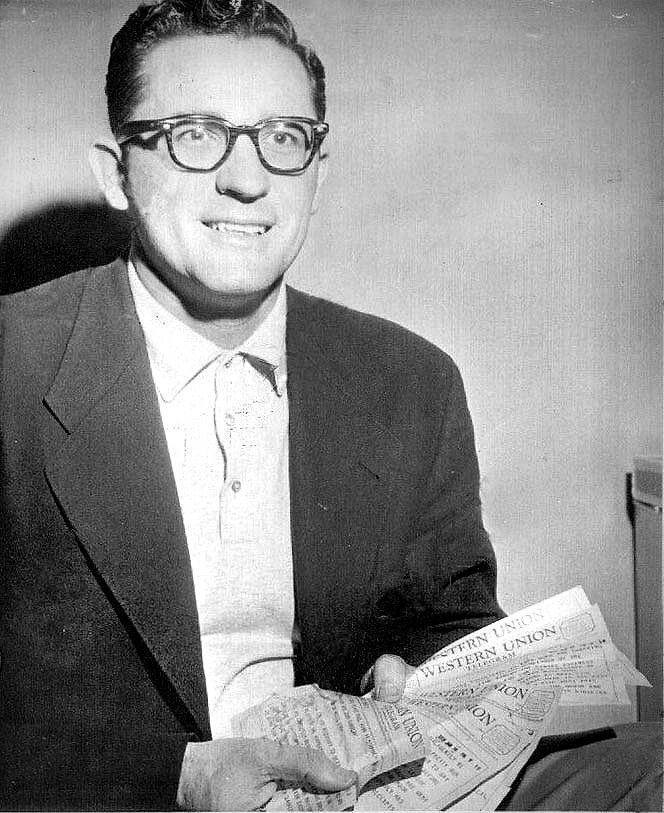
Joliet
George Lawrence Mikan Jr. was born June 18, 1924 in Joliet, Illinois, an industrial city about thirty miles southwest of Chicago. His parents Joseph and Minnie Mikan were Croatian Catholic immigrants. Joseph ran a tavern. The Mikans had three sons. By age 14 George was 6’10”. The height was a social problem, not an athletic asset, because his coordination had not caught up. He could not finish a layup with his right hand. He could not run without tripping over himself. He wore round wire-frame glasses, broken multiple times by neighborhood kids who teased him about being clumsy.
He attended Joliet Catholic High School, was cut from the basketball team in his first year for being too uncoordinated, and entered Quigley Preparatory Seminary in Chicago to begin training as a Catholic priest. He left after one year, transferred back to Joliet Catholic, and graduated in 1942 with no clear college plan. The University of Notre Dame, which had recruited him modestly, suggested he was too clumsy for big-time college basketball. DePaul University, also in Chicago, offered him a chance.
Shop George Mikan jersey
As an Amazon Associate we earn from qualifying purchases.
Ray Meyer and DePaul
Ray Meyer had just been hired as the head basketball coach at DePaul. He was 28 years old and had been an assistant at Notre Dame for two years. Meyer’s first major decision as DePaul’s coach was to overhaul Mikan’s body. He put Mikan on a regimen that has, in basketball-coaching folklore, become the standard-issue origin story for how a clumsy big man learns to move. The regimen: jumping rope 30 minutes a day, boxing six rounds twice a week, ballroom-dancing lessons, two hundred right-handed layups followed by two hundred left-handed layups in a continuous alternating pattern (the “Mikan drill,” still used by basketball coaches everywhere in 2026), and punching a heavy bag for footwork.
By his junior year (1944-45) Mikan was the dominant player in college basketball. He led DePaul to the 1945 National Invitation Tournament championship at Madison Square Garden, then the equivalent of the NCAA title (the NIT was the more prestigious of the two tournaments until the late 1950s). He was named the tournament’s Most Valuable Player. He scored 53 points in DePaul’s semifinal win over Rhode Island, a then-MSG single-game record.
He was also, by 1944, the player on whom the NCAA wrote new rules. The defensive-goaltending rule (a player cannot block a shot on its downward arc to the basket) was added to the NCAA rulebook in 1944 specifically because Mikan was knocking opponent shots off the rim before the ball came down.
He graduated in 1946 and immediately enrolled at DePaul Law School.
The Chicago American Gears, the NBL, and the Lakers
He signed his first professional contract with the Chicago American Gears of the National Basketball League in November 1946. The Gears won the NBL championship his rookie year. The franchise’s owner, Maurice White, then attempted to launch a rival league (the Professional Basketball League of America) and pulled the Gears out of the NBL. The new league collapsed in three weeks. The Gears went bankrupt. The NBL dispersed the Gears’ players. Mikan was assigned to the Minneapolis Lakers in October 1947.
The Lakers were the franchise that won everything for the next eight years. They won the NBL championship in 1948 (Mikan’s first season with the team). In 1949 the NBL merged with the rival Basketball Association of America to form the modern NBA. The Lakers won the inaugural NBA title that year (1948-49 season), then 1950, 1952, 1953, and 1954. Five NBA championships in six seasons, plus the 1948 NBL title before the merger. Six total championships.
Mikan averaged 23 to 28 points per game year after year in an era when the average team scored 80. He led the league in scoring in 1948, 1949, 1950, and 1951. He was named first-team All-NBA every year of his prime (1949-1954). He was the league’s first true superstar in the commercial sense that the term has come to mean: the player a franchise marketed by name, the player visiting teams sold tickets around. The famous Madison Square Garden marquee from February 1949 read simply “GEO MIKAN vs. KNICKS.” It is the first time a basketball player was billed at MSG the way fight promoters billed a heavyweight champion.
The rule changes Mikan caused
The free-throw lane (also called the “key”) was widened from six feet to twelve feet by the NBA in 1951 specifically to push Mikan farther from the basket. The change is colloquially known in basketball-historical writing as the Mikan Rule. The widened lane did not stop him; he continued to score 22 to 24 points per game from the new positions. He did, however, post lower offensive-rebound numbers than his pre-1951 self.
The 24-second shot clock, adopted in April 1954, was driven in part by the November 1950 Fort Wayne Pistons stall game against the Lakers in which Fort Wayne held the ball for entire possessions specifically to keep it away from Mikan. The final score was 19-18, a Pistons win, the lowest-scoring game in NBA history. Danny Biasone (the Syracuse Nationals owner who designed the shot clock) cited that game and other Mikan stall tactics as the central reason a clock was needed.
The defensive-goaltending rule, written into the NCAA rulebook in 1944 because of Mikan’s college play, was carried into the NBA’s first rulebook in 1946 and is the structural basis of how shot-blocking is officiated to this day.
Glasses, broken legs, and the rest of his career
He played the entire 1947-48 season on a broken right ankle that doctors set with steel pins. He played the 1951-52 playoffs on a broken right wrist. He broke his right leg in 1951 and his left in 1953. He was 30 years old in 1954 and physically older than his years on every standard injury metric. He retired after the 1953-54 season, came back briefly in 1955-56 at age 31 (37 games, 10.5 points per game), and retired for good.
His glasses were a constant. He wore round wire-frame eyeglasses on the court because he could not see clearly without them. He broke them in nearly every other game.
After basketball
He coached the Lakers briefly in 1957-58 (9-30 record, fired midseason). He passed the Illinois bar exam (he had finished his DePaul Law degree in 1948) and practiced law in Minneapolis through the 1960s. He was named the first commissioner of the rival American Basketball Association in 1967. His ABA tenure (1967-69) included the introduction of the red-white-and-blue basketball (which the league trademarked) and the formal adoption of the three-point line, a feature the BAA had experimented with as early as 1948 but never made permanent. The three-point line is, in its modern NBA form, an inheritance from the ABA, and the ABA inherited it from Mikan’s tenure as commissioner.
He left the ABA in 1969. He went into the travel-agency and real-estate business in the Twin Cities. He became diabetic in the 1990s. His right leg was amputated in 2000 because of complications from the disease. He died June 1, 2005 in Scottsdale, Arizona at age 80.
Shaquille O’Neal, who has often been compared to Mikan as the dominant offensive center of his own generation, paid for Mikan’s funeral when the family disclosed publicly that they were having difficulty with the costs.

The legacy
He was a charter inductee of the Basketball Hall of Fame in 1959, the first induction class. The NBA named him to its 25th, 35th, 50th, and 75th Anniversary Teams. The Lakers retired his number 99 in 1956. DePaul retired his number 99 as well.
Michael Schumacher’s Mr. Basketball: George Mikan, the Minneapolis Lakers, and the Birth of the NBA (Bloomsbury USA, 2007) is the most thorough modern account of his career and his era. His career counting numbers (23.1 points per game, 13.4 rebounds per game across 439 regular-season games) understate his importance. The ranking that captures it better is structural. Five rule changes in NBA history, three of them still in force, were written specifically to change what Mikan was doing on the court. No other player in any team sport has caused that many primary rules to be rewritten because of his game.
He is, by basketball-historical convention, the player against whom every subsequent post-up center is measured. Bill Russell, Wilt Chamberlain, Kareem Abdul-Jabbar, Hakeem Olajuwon, Shaquille O’Neal, and Nikola Jokić all sit downstream of George Mikan. The line is direct.
Gear
Browse the pre-shot-clock era coverage in The Book of Basketball.
Sources
- Basketball-Reference: George Mikan.
- Michael Schumacher, Mr. Basketball: George Mikan, the Minneapolis Lakers, and the Birth of the NBA (Bloomsbury USA, 2007).
- George Mikan with Joseph Oberle, Unstoppable: The Story of George Mikan, the First NBA Superstar (Masters Press, 1997).
- New York Times obituary, Richard Goldstein, “George Mikan, Original Big Man, Dies at 80” (June 2, 2005).
- Minneapolis Star Tribune archive coverage of the 1948-1954 Lakers championships.
Shop Jerseys & Fan Gear at Fanatics
As a Fanatics affiliate, we may earn a commission from qualifying purchases.
Shop on Amazon
As an Amazon Associate, we earn from qualifying purchases.
Shop Sneakers & Gear at JD Sports
We may earn a commission from qualifying purchases on JD Sports.
Sources
- Basketball-Reference: George Mikan
- Michael Schumacher, Mr. Basketball: George Mikan, the Minneapolis Lakers, and the Birth of the NBA (Bloomsbury USA, 2007)
- George Mikan with Joseph Oberle, Unstoppable: The Story of George Mikan, the First NBA Superstar (Masters Press, 1997)
- New York Times obituary, Richard Goldstein, June 2005
- Minneapolis Star Tribune archive coverage of the 1948-1954 Lakers championships