History of the three-point line
The three-point line did not start in the NBA. It started in 1961 in a league that lasted barely more than a year, was tested in the ABA through the 1970s as a gimmick, was adopted reluctantly by the NBA in 1979 as a compromise with the merger agreement, was briefly shortened in the 1990s with consequences the league did not intend, and then, beginning roughly in 2012, reshaped every offensive and defensive principle the league had operated on for seventy years. The modern game is the three-point-line game. The story of how it got there is not the one most casual fans know.
Abe Saperstein and the 1961 American Basketball League
The three-point field goal was invented by Abe Saperstein, the founder and longtime owner of the Harlem Globetrotters, for his new professional basketball league, the American Basketball League (ABL), which began play in October 1961 and folded midway through its second season in December 1962. The ABL arc was placed 25 feet from the basket along the top of the key. The purpose, as Saperstein explained it in the league’s launch press conference, was to make the pro game more visually distinct from the NCAA game and to create highlight-reel offensive moments that would draw television broadcast interest.
The ABL’s 1961–62 season produced modest three-point volume, roughly 3–5 attempts a game per team, but the concept had entered the American basketball vocabulary. The league’s demise in 1962 ended the first experiment. The idea sat for five years.
Shop NBA Gear
As an Amazon Associate we earn from qualifying purchases.
The ABA (1967–76)
The American Basketball Association, launched in October 1967 as a rival league to the NBA, adopted the three-point line immediately at the same 25-foot distance Saperstein had used. ABA commissioner George Mikan, the former NBA star and Minneapolis Lakers center, explained the decision as follows in the league’s founding press materials: “The 24-second clock was the NBA’s gift to basketball. The three-point line will be ours.”
Across nine ABA seasons (1967–68 through 1975–76), three-point volume grew steadily but not explosively. Team averages rose from 3.0 attempts a game in year one to 7.2 attempts a game in year nine. Top individual shooters of the ABA era, Louie Dampier, Billy Keller, Glen Combs, set the early templates for what a full-time three-point specialist looked like. Louie Dampier’s 794 career ABA three-pointers remained the all-time professional record through 1989, when it was passed, across leagues, by Larry Bird. The definitive account of the ABA’s rise and the three-point line’s place within it comes from Terry Pluto’s Loose Balls: The Short, Wild Life of the American Basketball Association (1990).
When the ABA merged with the NBA in June 1976, adding the New Jersey Nets, San Antonio Spurs, Denver Nuggets, and Indiana Pacers to the NBA, the three-point line did not come along with the merger. The NBA explicitly refused to adopt it. The four ABA teams switched to NBA rules and lost the three-point line for three seasons before the league changed its mind.
The NBA adoption (1979–80)
The NBA introduced the three-point line for the 1979–80 season. The arc was placed at 23 feet 9 inches (7.24 meters) from the center of the basket along the top of the key and 22 feet from the center of the basket along the corners, producing the asymmetric shape the line still has today. The first NBA three-pointer was made by Chris Ford of the Boston Celtics on October 12, 1979, against the Houston Rockets at Boston Garden, 3:48 into the first quarter. Ford had taken two prior attempts and missed both. The Celtics went on to win the game; Ford’s shot is recognized by the league as the first three-point field goal in NBA history.
The volume in the first season was low. Teams averaged 2.8 three-point attempts per game league-wide. The league-wide shooting percentage was 28 percent. The most prolific three-point shooter of the 1979–80 season was Brian Taylor of the San Diego Clippers, who made 90 of 239 attempts (37.7 percent), a full-season volume that would be considered below average for a modern starting guard within a single month.
The 1980s: Bird, Magic, and the gradual normalization
Through the 1980s three-point volume grew incrementally. The average team rose from 2.8 attempts per game in 1979–80 to 6.6 attempts per game in 1989–90. Key contributors to the normalization included:
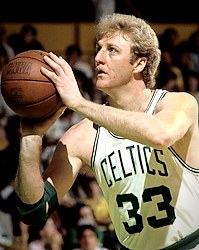
- Larry Bird, who won the first three NBA Three-Point Contests in 1986, 1987, and 1988 and whose career 37.6 percent three-point shooting at the volume he took them was a full percentage-point step change for a forward.
- Michael Cooper of the Los Angeles Lakers, the designated corner-three specialist on the Showtime offense.
- Craig Hodges, who won three consecutive Three-Point Contests (1990, 1991, 1992) and hit 19 consecutive three-pointers in the 1991 contest, a record that stood for two decades.
The first three-point attempts leader for a full season in NBA history was Pete Myers of the Chicago Bulls in 1982–83, with 271 attempts. No team had yet exceeded 10 attempts per game on average.
The shortened-line era (1994–95 to 1996–97)
The league experimented with a uniformly shorter three-point line for three seasons, starting in 1994–95. The distance was shortened to 22 feet all the way around the arc, eliminating the corner-to-top-of-key variation. The stated rationale, articulated by then-commissioner David Stern, was to boost scoring after the 1993–94 season’s league-wide average had dropped below 102 points per game for the first time in two decades.
The result was exactly what the analytics people in 2025 would have predicted. League-wide three-point attempts jumped from 9.9 per game (1993–94) to 15.3 per game (1994–95). League-wide three-point shooting percentage jumped from 33.3 percent to 35.9 percent. Team scoring did rise, by roughly four points per game. But the shot selection change was permanent. Corner three-pointers, at 22 feet, became a league-wide staple. The shot charts looked different. The floor-spacing principles of half-court offense started to shift. The league reverted to the 23-foot-9-inch arc for the 1997–98 season (with the corners remaining at 22 feet, the original asymmetric design).
The three-season experiment produced two statistical oddities that are still discussed. First, it is the only period in league history when the asymmetric corner-to-top-of-key difference was eliminated. Second, it is the period when Dennis Scott, George McCloud, and Reggie Miller set individual three-point shooting records that, adjusted for line distance, have never really been comparable since.
The analytics era (2005–2015)
The modern three-point revolution did not start with Steph Curry. It started with the Houston Rockets front office under general manager Daryl Morey, hired in May 2006. Morey’s core insight, which he articulated repeatedly in the 2007–09 window at MIT Sloan Sports Analytics Conferences and in private team strategy sessions later documented by Nate Silver in The Signal and the Noise and others, was mathematical: a three-point shot at even a modest 33 percent efficiency produces 1.00 points per possession, while a mid-range two-point shot at an excellent 45 percent efficiency produces only 0.90 points per possession. The mid-range shot, long considered a skill-based cornerstone of NBA offense, was on the math simply worse than the three-point shot for almost every shooter the league had.
The 2012–13 Houston Rockets, led on the floor by James Harden and in the front office by Morey, averaged 28.9 three-point attempts per game, the highest in league history to that point. The team made the playoffs. Morey-era analytics research was by this time being read across front offices. Between 2012 and 2020 the league-wide average climbed from 20.0 attempts per game to 34.1 attempts per game, an increase of 70 percent in eight years. Nothing in NBA history matched the scale or speed of the shift.
Stephen Curry and the ceiling that kept moving
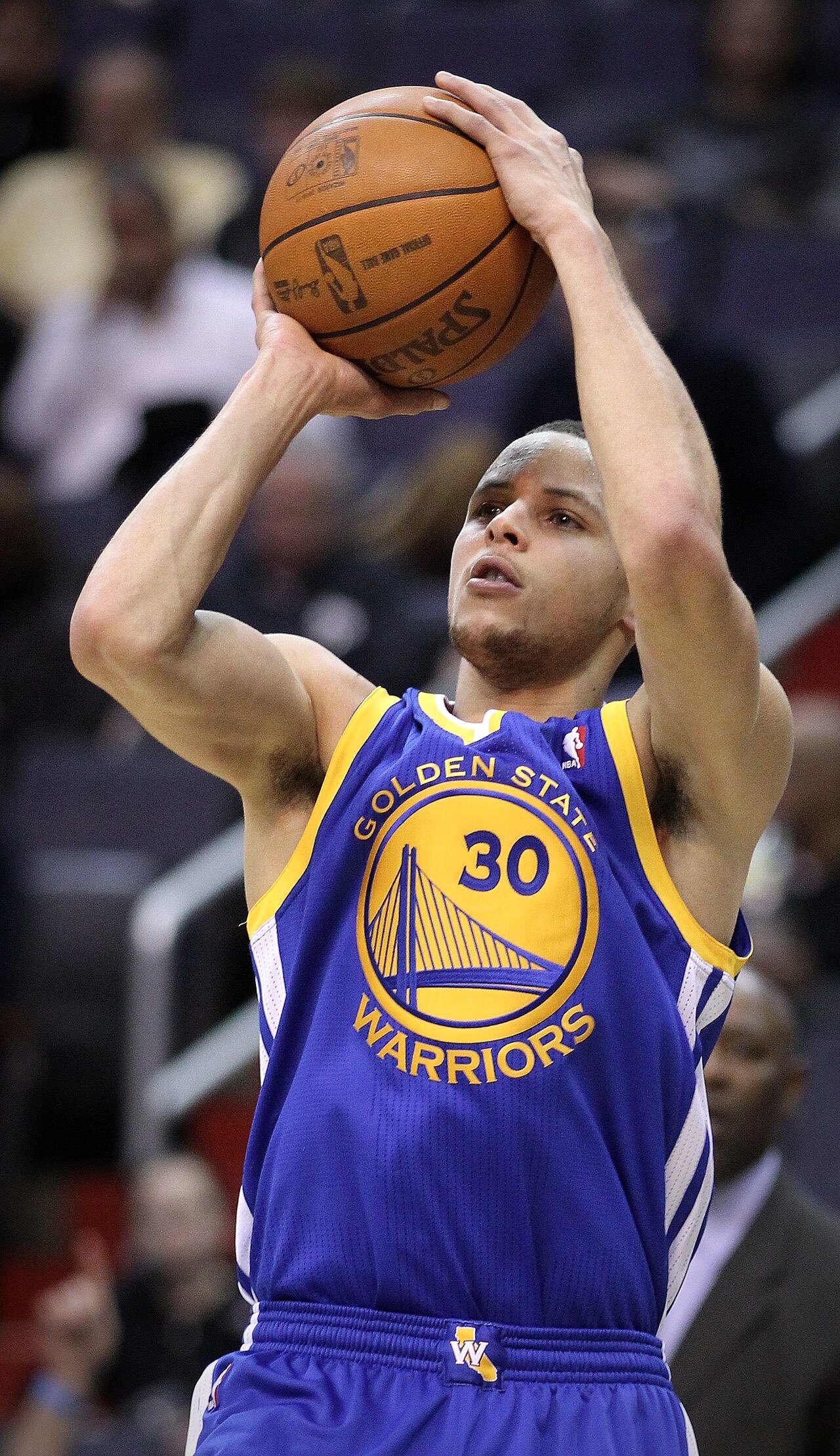
The player who most fully embodied the analytics-era three-point revolution is Stephen Curry. His individual season-by-season three-point volume, 272 makes in 2012–13, 286 in 2014–15, 402 in 2015–16 (the single-season record at the time), 337 in 2016–17, still climbing through 2023–24, reset the ceiling of what a player could produce from beyond the arc. On December 14, 2021, he passed Ray Allen’s career three-point makes record; by the end of the 2023–24 season he had nearly doubled Allen’s total.
Curry’s 2015–16 regular season (his second MVP, the 73-win season) produced a statistical profile that required the league’s statistics department to rewrite several of its benchmarks. He hit 402 three-pointers at 45.4 percent. No player in league history had ever combined that volume with that efficiency for a full season. His career three-point shooting percentage is above 42 percent, which for comparison is higher than the all-time league-average two-point field-goal percentage. He has made the single most influential career argument for the possibility that a three-point specialist could be the best player in the sport.
The present state (2020s)
As of the 2024–25 season, league-wide three-point attempts per game are at 37.9, an all-time high. The Oklahoma City Thunder led the league with 44.8 attempts per game. The league-wide three-point shooting percentage is 36.2 percent, higher than the league-wide two-point shooting percentage was in 1979–80, the year the line was introduced.
The league office has, for the first time in forty-five years, publicly discussed moving the three-point line outward. In February 2024, commissioner Adam Silver told The Athletic that a “conversation” was ongoing about pushing the arc back six inches to two feet, with the stated aim of restoring shot-selection variety. No change has yet been made to the rule. Any change would require approval from the league’s Competition Committee and from three-quarters of the team ownership bloc. Multiple front offices, including the Oklahoma City Thunder’s, have publicly opposed the move.
FIBA, WNBA, and NCAA, the three-point line in the rest of basketball
FIBA adopted a three-point line in October 1984 at 6.25 meters (20 feet 6 inches), shorter than the NBA distance. FIBA moved the line out to 6.75 meters (22 feet 1.75 inches) for the 2010 international season, matching the WNBA’s distance at the time.
The WNBA used the FIBA 6.25-meter arc from its founding in 1996 through 2003, then moved to the 6.75-meter distance. In 2022 the league standardized the three-point line across the WNBA and FIBA at 6.75 meters.
NCAA men’s basketball adopted a 19-foot-9-inch three-point line in 1986–87, the first season the college game had one. The distance was moved to 20 feet 9 inches in 2008–09 and to 22 feet 1.75 inches (matching the FIBA international distance) for the 2019–20 season. NCAA women’s basketball used 19 feet 9 inches from 1987–88 through 2021–22, then moved to 22 feet 1.75 inches in alignment with the men’s game.
The bigger structural effect
The three-point line is the single rule in basketball history whose effect on strategy has exceeded the effect it was designed to have. Saperstein wanted a visual distinction for the ABL. Mikan wanted an ABA calling card. The NBA wanted incremental scoring help. The line delivered all of those things and then, decades later, rewrote the way front offices evaluate players, the way coaches design half-court offenses, the way defenses structure their pickup assignments, and the way the best players in history are measured against one another. Three of the top five career three-point shooters (Curry, Thompson, Harden) are still active. Every seven-foot center drafted in the 2020s has been evaluated, in part, on the basis of whether he can reasonably be expected to shoot from outside the arc.
The line is now, in every sense that matters, the defining feature of the modern game. It was put in by accident and it stays because nothing else the sport has tried has produced nearly as large a return on attention.
Related reading
- Stephen Curry biography
- Larry Bird biography
- Houston Rockets franchise history
- Golden State Warriors franchise history
Gear
Browse The Book of Basketball for how the three-point revolution reshaped every franchise, and grab a card blaster.
The Book of Basketball on Amazon →
Sources
Linked in the frontmatter. The ABA founding language comes from Terry Pluto’s Loose Balls (1990), which remains the standard oral history of the league. The 1994–97 shortened-line experimental data is from Basketball-Reference’s season-by-season league average tables. The 2024 Adam Silver quote about potentially extending the arc is from Joe Vardon’s February 2024 piece in The Athletic. The NCAA and FIBA distance histories are from the NCAA Rule Book and the FIBA Official Basketball Rules published Summer 2022.
Shop NBA Gear at Fanatics
As a Fanatics affiliate, we may earn a commission from qualifying purchases.
Shop on Amazon
As an Amazon Associate, we earn from qualifying purchases.
Shop Basketball Shoes & Apparel at JD Sports
We may earn a commission from qualifying purchases on JD Sports.
Sources
- NBA, Official Rule Book, Section VIII (field goals)
- Basketball-Reference, Three-point shooting history
- Ken Pomeroy, shortened-arc era analysis (KenPom archives)
- Nate Silver, "The Signal and the Noise", on the Morey-era analytics revolution
- Terry Pluto, "Loose Balls: The Short, Wild Life of the American Basketball Association" (Simon & Schuster, 1990), for the ABA origin story