Houston Rockets
The Houston Rockets have won two NBA championships, both in the mid-1990s behind Hakeem Olajuwon, and both during Michael Jordan’s baseball-era retirement from the NBA. The franchise began in San Diego in 1967, moved to Houston in 1971, has been in Texas for fifty-plus years, and has produced three distinct competitive windows: the Moses Malone run of the late 1970s to early 1980s, the Olajuwon-led core of the late 1980s and 1990s that won the 1994 and 1995 titles, and the James Harden era of 2012–2021 under the Daryl Morey analytics program. The post-Harden era, from 2021 onward, is a rebuild.
The 1967 San Diego founding
The franchise was established as the San Diego Rockets, an NBA expansion team, for the 1967–68 season. The name was a reference to San Diego’s aerospace industry, specifically General Dynamics’ Convair division, which built Atlas rockets for NASA. The first head coach was Jack McMahon. Elvin Hayes, drafted first overall in 1968 out of Houston, was the franchise’s first star. The San Diego Rockets went 15–67 in their first season and 37–45 the following year.
The move to Houston came in June 1971, driven by weak attendance in San Diego and the availability of The Summit as a new venue in Houston. Texas Sports Investments, led by Wayne Duddlesten, purchased the franchise and relocated it. The Houston Rockets’ first season, 1971–72, was in the Astrodome; they moved to The Summit in 1975.
Shop Houston Rockets merchandise
As an Amazon Associate we earn from qualifying purchases.
The Moses Malone era
Moses Malone was acquired from the Buffalo Braves in a cash-and-picks deal in October 1976. Malone had been the first player to go straight from high school to the ABA in 1974 (with the Utah Stars), and had joined the NBA in the 1976 ABA-NBA merger. He was nineteen years old. The 1978–79 season was his MVP year, at 24.8 points and 17.6 rebounds per game.
The 1980–81 Rockets finished 40–42 but reached the NBA Finals, losing to Larry Bird’s Celtics in six games. Malone was the Finals leading scorer. It was the only losing-record team in NBA history to reach the Finals until the 2023 Miami Heat. Malone won a second MVP in 1981–82 before being traded to Philadelphia in September 1982 for Caldwell Jones and a first-round pick. The trade, made for salary-cap reasons, is the most-debated Rockets transaction of the pre-Olajuwon era.
The 1984 draft, and Ralph Sampson before Olajuwon
Houston had drafted Ralph Sampson first overall in 1983. Sampson was the consensus top prospect out of Virginia, a 7’4” center who had been a three-time Naismith College Player of the Year. He was Rookie of the Year in 1983–84. The Rockets finished 29–53.
The 1984 NBA Draft is the most-analyzed draft in basketball history. Houston, owning the first overall pick, chose between Olajuwon (the Nigerian-born Houston alumnus) and Sampson-plus-other-players. The Rockets took Olajuwon. Portland took Sam Bowie second. Chicago took Michael Jordan third. For a full account of the draft, see the 1984 draft page.
The Olajuwon-Sampson “Twin Towers” era produced the 1986 Finals (lost in six to the Celtics) and a 1986–87 conference-final run. Injuries to Sampson ended the pairing in 1987 and he was traded to Golden State for Sleepy Floyd. Olajuwon would spend the next decade as the franchise’s singular star.
The back-to-back championships, 1994 and 1995
The 1993–94 Rockets, coached by Rudy Tomjanovich (a former Rocket player who had been promoted from assistant coach in 1992), went 58–24. Olajuwon was MVP, Defensive Player of the Year, and Finals MVP, the only player to sweep the three in the same season. The 1994 NBA Finals against the New York Knicks went seven games. Game 6 at Madison Square Garden, won 86–84, is best-remembered for Olajuwon’s block of John Starks’s corner three as time expired, which sent the series back to Houston for Game 7. Houston won Game 7, 90–84.
The 1994–95 Rockets finished 47–35, a sixth seed in the Western Conference. They beat the 60-win Utah Jazz in five, the 59-win Phoenix Suns in seven, the 59-win San Antonio Spurs in six, and the 57-win Orlando Magic in a four-game sweep in the Finals. It was the only championship run in NBA history by a team seeded sixth or lower. The 1994–95 Rockets had traded for Clyde Drexler in February 1995 from Portland for Otis Thorpe. Drexler, a lifelong friend of Olajuwon from the Houston youth circuit, was Finals scoring leader.
Olajuwon’s “Dream Shake” signature move is the footwork-and-shoulder pattern from the post that he refined across the 1989–95 period. It remains the most-studied post-up sequence in NBA coaching video libraries. His combination of rim protection and offensive footwork was, per the consensus of opposing centers interviewed in retrospectives since, the most complete two-way center’s game of the 1990s. Olajuwon told his own story in Living the Dream (Little, Brown, 1996), written with Peter Knobler.
The Yao Ming era, and the 2002 first-pick
Houston won the 2002 NBA Draft Lottery and selected Yao Ming first overall out of the Chinese Basketball Association’s Shanghai Sharks. Yao was the first Chinese-born first-overall pick in NBA history, and the first to come through a fully international development pipeline rather than American college or high school basketball. He was 7’6”. His arrival was, by every operational measure, the most consequential international-talent acquisition in the league’s history.
Yao averaged 19.0 points and 9.2 rebounds across nine NBA seasons. He was an eight-time All-Star. The 2008–09 Rockets, his best full roster, reached the second round of the playoffs. A left-foot stress fracture ended his career in July 2011; he was thirty years old.
The Tracy McGrady-Yao combination (McGrady signed from Orlando in 2004) produced one 52-win season in 2004–05 but did not win a playoff series in the Yao-McGrady years. McGrady left in 2010. Yao retired in 2011.
The Daryl Morey era and James Harden
Daryl Morey was hired as general manager in April 2007. He held the position for thirteen seasons, the longest continuous general-management tenure in Rockets history. His front-office strategy was built on advanced statistics, three-point-shooting-and-layups shot selection, and long-view asset accumulation, and it is the strategy every modern NBA front office now uses in some form.
Morey’s single biggest transaction was the October 2012 trade that brought James Harden from Oklahoma City. Harden had been the reigning Sixth Man of the Year. The Rockets sent Kevin Martin, Jeremy Lamb, two first-round picks, and a second-round pick to the Thunder. Harden became the franchise’s singular star for the next eight-plus seasons.
The Harden-era Rockets won 50+ games five times, reached the Western Conference Finals twice (2015 and 2018), and finished as the NBA’s top seed in 2017–18 at 65–17. The 2018 Western Conference Finals against Golden State went seven games; Houston lost Game 6 and Game 7 after going 0-of-27 from three in Game 7. The shot-selection approach produced consistent playoff contention but no championship, a repeating criticism that has been the central counterargument to the Morey analytics program. Morey left for Philadelphia in November 2020. Harden requested a trade in January 2021 and was moved to the Brooklyn Nets.
Post-Harden rebuild
The Rockets have made the playoffs once (2024, a first-round exit) since Harden’s 2021 trade. The rebuild has produced a succession of high draft picks: Jalen Green (second overall, 2021), Jabari Smith Jr. (third, 2022), Amen Thompson (fourth, 2023), Reed Sheppard (third, 2024). Alperen Şengün, drafted sixteenth in 2021, emerged as the team’s starting center in 2022 and made his first All-Star team in 2024.
Head coach Stephen Silas was fired in April 2023 and replaced by Ime Udoka, who had been suspended by the Boston Celtics the previous season. The 2023–24 Rockets went 41–41, the team’s first .500-or-better season since 2019. The 2024–25 Rockets entered the season with expected-wins projections in the low 50s and Finals contention four years out.
Arenas and the Toyota Center
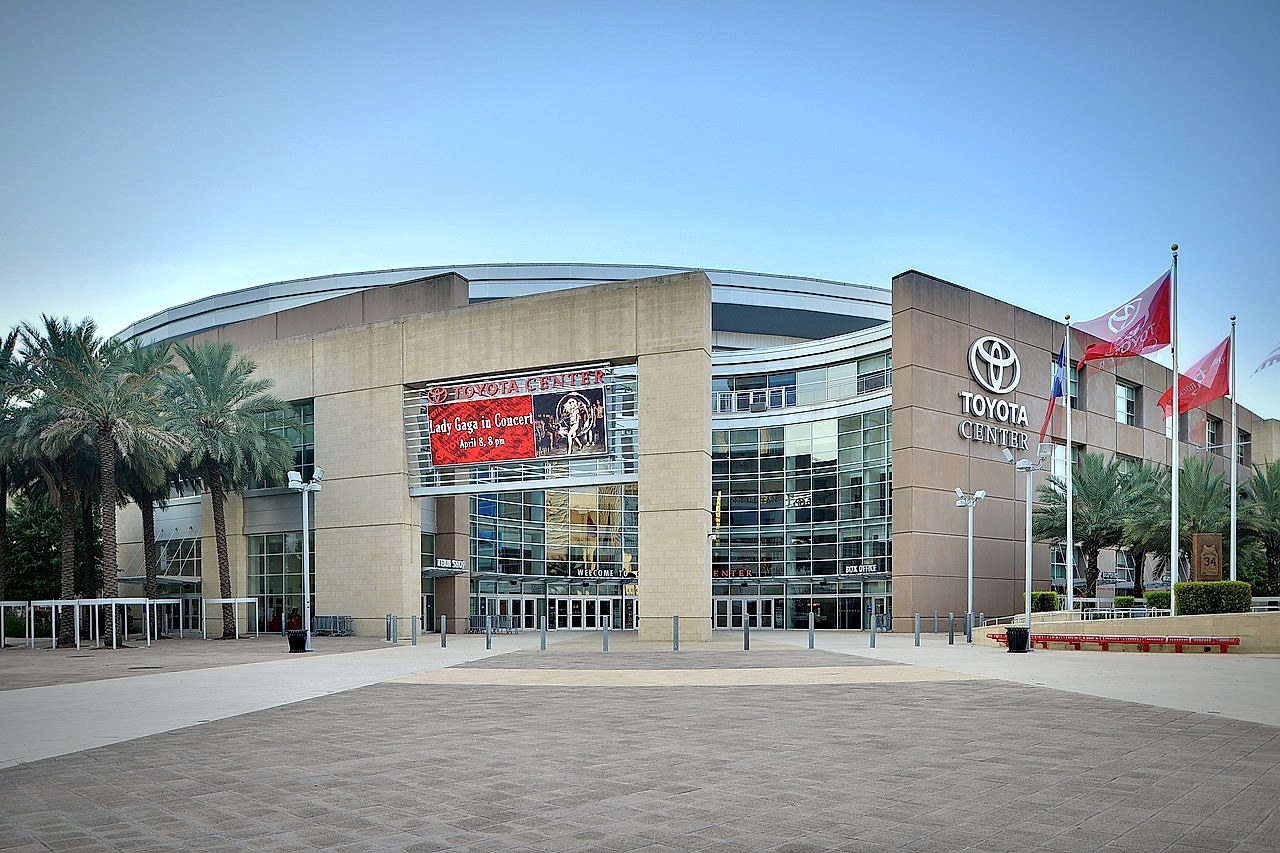
The Rockets played at the Hofheinz Pavilion at the University of Houston from 1971 to 1975, at The Summit (later Compaq Center, now Lakewood Church) from 1975 to 2003, and at Toyota Center since the 2003–04 season. The 1994 and 1995 championships were won while playing at The Summit; the building hosted four Finals banner-raisings before the Rockets’ move. Compaq Center was sold to the Lakewood Church in 2003 and now serves as one of the largest megachurches in the United States.
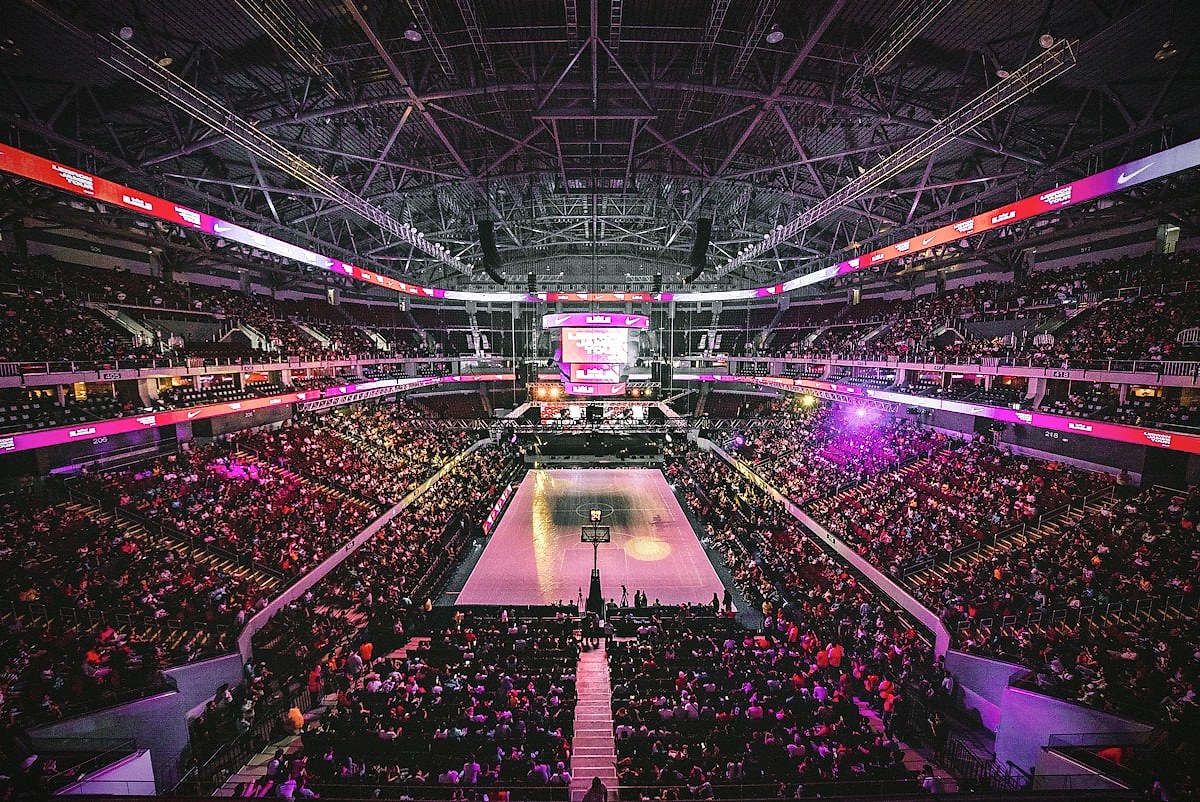
Toyota Center, which opened on October 30, 2003, has a capacity of approximately 18,055. It is also the home of the Houston Comets of the WNBA from 2003 to 2008 (before the Comets folded) and occasionally hosts college basketball.
Retired numbers
Six jersey numbers have been retired by the Rockets:
- Hakeem Olajuwon (34)
- Moses Malone (24)
- Calvin Murphy (23)
- Clyde Drexler (22)
- Rudy Tomjanovich (45)
- Yao Ming (11)
James Harden’s number 13, a presumed future retirement, has not been retired as of the 2024–25 season; the franchise has typically waited at least five years after a player’s departure before retiring the jersey.
Sources
- Basketball-Reference, Houston Rockets franchise page (regular-season records, playoff appearances)
- Jonathan Abrams, Boys Among Men: How the Prep-to-Pro Generation Redefined the NBA and Sparked a Basketball Revolution (Crown Archetype, 2016)
- Houston Rockets media guides, 1993–94 through 2024–25
- NBA Finals box scores: 1981, 1986, 1994, 1995 (Basketball-Reference)
- 1984 NBA Draft records (Houston selects Olajuwon first overall)
- 2002 NBA Draft Lottery and draft records (Houston selects Yao Ming first overall)
- October 2012 Harden trade records (Oklahoma City vs Houston)
Shop Official Houston Rockets Gear at Fanatics
As a Fanatics affiliate, we may earn a commission from qualifying purchases.
Shop on Amazon
As an Amazon Associate, we earn from qualifying purchases.
Shop NBA Gear at JD Sports
We may earn a commission from qualifying purchases on JD Sports.