Moses Malone
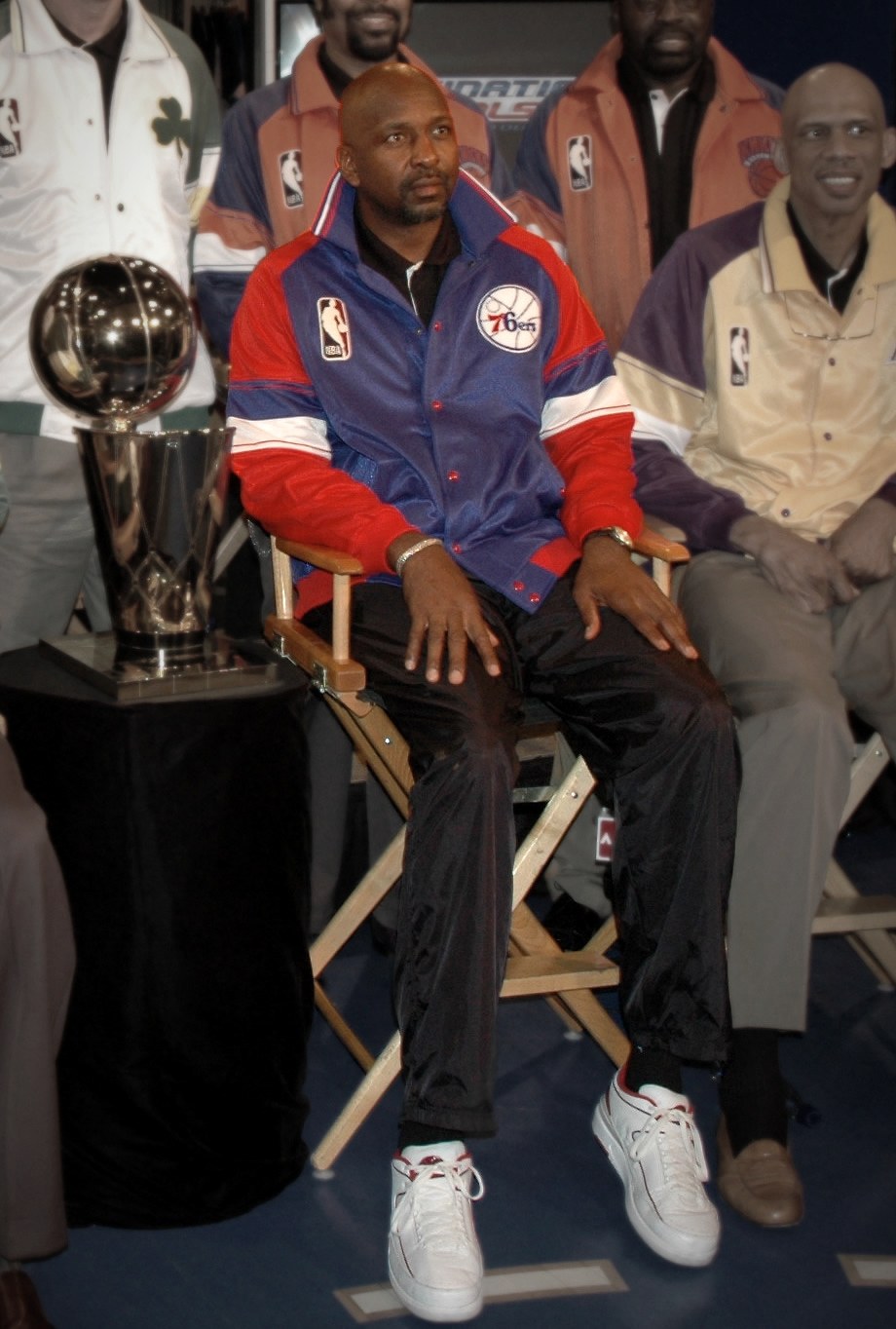
“Fo, fo, fo.” That is the most famous quote in Philadelphia 76ers history, and Moses Malone said it from a folding chair at the Spectrum on April 17, 1983, predicting the Sixers would sweep three rounds of the NBA playoffs four games to none. They almost did. They beat the Knicks 4-0, lost a single game to Milwaukee in the conference finals (Moses had to amend his prediction to “fo, fi, fo” between rounds), and swept the defending-champion Lakers in the Finals. Moses, then 27 years old and in his first season as a Sixer, won his third NBA Most Valuable Player award and his only NBA championship. The 1983 Sixers are still, by most retrospective rankings, the best team Philadelphia has ever fielded. Moses was the engine.
He was also the first basketball player in modern times to skip college entirely and go directly to professional basketball. He signed with the Utah Stars of the ABA in August 1974, three months after his Petersburg High School graduation, and never set foot in a Maryland classroom. He was 19 years old, 6’10”, and the most-recruited high-school player in the history of American basketball up to that point.
Two iconic Moses moments. There are dozens more. He averaged roughly 6 offensive rebounds per game across his prime, finished his career with 7,382 of them (NBA plus ABA), and the second-place player on the all-time list (Robert Parish at 4,598) is so far behind that the gap is structural, not statistical. His nickname was Chairman of the Boards.
Shop Moses Malone jersey
As an Amazon Associate we earn from qualifying purchases.
Petersburg
Moses Eugene Malone was born March 23, 1955 in Petersburg, Virginia, a city of about 35,000 along the Appomattox River, twenty-five miles south of Richmond. His mother Mary worked at a meatpacking plant. His father, also Moses, left when Moses was two and never returned. Mary raised him alone in a small house on Davis Street, attending Mt. Olive Baptist Church on Sundays.
He grew. By age 13 he was 6’4”. By age 16 he was 6’10”. He attended Petersburg High School and played basketball under coach Ernie Neal. His sophomore year (1971-72) he averaged 28 points and 23 rebounds. His junior year he averaged 32. His senior year 36 and 25, leading Petersburg to back-to-back state championships in 1973 and 1974.
The recruiting attention is documented in detail in a Frank Deford Sports Illustrated feature from January 1974. Roughly 200 colleges contacted Moses through Coach Neal. Bob Knight at Indiana, Lefty Driesell at Maryland, John Wooden at UCLA, Dean Smith at North Carolina, and Joe B. Hall at Kentucky all visited Petersburg. Deford’s piece described the Malone family living room as having a coffee table piled twelve inches high with college recruiting brochures, and Mary Malone telling Deford that her son had read every page of every brochure and could recite, from memory, the dorm-meal menus at three of the schools.
Moses signed a National Letter of Intent with Maryland in March 1974. Lefty Driesell drove down to Petersburg the night Moses signed and was photographed handing Mary a single rose. The rose went on the front page of the Richmond Times-Dispatch.
He never wore a Maryland uniform. The Utah Stars of the American Basketball Association, then in financial distress, found a loophole in NBA rules that prohibited the league from drafting any player whose high-school class was still less than four years out (the so-called “hardship rule”). The ABA had no such restriction. Stars general manager Bucky Buckwalter signed Moses to a five-year, $1 million contract on August 28, 1974, the largest contract any high-school graduate had ever received in any American sport. The University of Maryland released Moses from his Letter of Intent two days later. The NCAA briefly considered an investigation and decided there was nothing to investigate.
The Stars, the Spirits, the Blazers, the Braves, the Rockets
The Utah Stars folded mid-season 1975-76. The ABA dispersed Moses to the Spirits of St. Louis. The ABA itself folded that summer. The 1976 NBA dispersal draft sent Moses to the Portland Trail Blazers. Portland, with Bill Walton already at center, played Moses two games before cutting him on October 18, 1976. The Buffalo Braves picked him up. Six days later the Braves traded him to the Houston Rockets for two future first-round picks. The trade is widely considered, by basketball-historical writers including Jack McCallum at Sports Illustrated and Bob Ryan at the Boston Globe, one of the most lopsided deals in modern NBA history. Houston had acquired the player who would, over the next six seasons, become the best center in basketball.
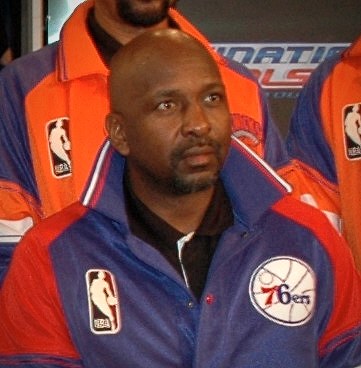
Houston (1976-82) and the 1981 Finals
Moses played six seasons with the Houston Rockets. He won the 1979 NBA Most Valuable Player award at age 23, averaging 24.8 points and 17.6 rebounds. He won it again in 1982, averaging 31.1 points and 14.7 rebounds.
The 1980-81 Rockets were a 40-42 team that snuck into the playoffs and proceeded to beat the Lakers, Spurs, and Kansas City Kings on the way to the NBA Finals. They lost to the Boston Celtics in six games, with Moses averaging 26.8 points and 14.5 rebounds against Robert Parish and Kevin McHale across the series. Moses was the first player from a sub-.500 regular-season team to lead his team to the NBA Finals, a piece of structural trivia that has since been broken (the 1999 Knicks at 27-23 in a strike-shortened 50-game season, and the 2020 Heat as a five-seed in the bubble).
The Sixers trade and “fo, fo, fo”
Sixers owner Harold Katz, who had bought the team from F. Eugene Dixon Jr. in May 1981, decided after the 1981-82 season that Philadelphia had everything except a dominant center. Julius Erving was 32. Andrew Toney was elite but young. The team had lost in the 1982 Finals to the Lakers. Katz called Houston in September 1982 and asked what it would take.
The deal was Caldwell Jones plus Philadelphia’s first-round pick in 1983 for Moses. The Rockets took it because they were rebuilding. The pick became Rodney McCray. The Sixers, on paper, had just acquired a 27-year-old, two-time MVP, defensive anchor, and low-post offensive force without giving up a single rotation regular. It is, alongside the 1976 Rockets pickup of Moses for two first-round picks, one of the most lopsided trades in NBA history.
The 1982-83 76ers finished 65-17, the second-best regular-season record in franchise history. Moses averaged 24.5 points and 15.3 rebounds and won his third MVP, joining a short list of players (Bill Russell, Wilt Chamberlain, Michael Jordan, Kareem Abdul-Jabbar, Larry Bird, Magic Johnson, LeBron James, Nikola Jokić) with three or more. The April 1983 “fo, fo, fo” prediction came at a press-conference availability after the regular season ended, when a reporter asked Moses how he expected the playoffs to go. He answered with three words. The Sixers swept the Knicks, lost only one game to the Bucks, and swept the Lakers in the Finals. Moses won Finals MVP, averaging 25.8 points and 18.0 rebounds across the four games against Kareem Abdul-Jabbar.
The 1983 76ers are, by most retrospective Net Rating analyses, one of the seven or eight best teams of the post-merger era.
Bullets, Hawks, Bucks, return to Philly
Moses played three more years in Philadelphia, then was traded to the Washington Bullets in June 1986 after a contract dispute with Harold Katz (who had also alienated Charles Barkley in roughly the same window). He played two seasons in Washington, three in Atlanta, one in Milwaukee, and a final 17-game stint with the 76ers in 1993-94 before retiring in October 1995 at age 40.
He averaged double-digit rebounds in 14 of his 21 professional seasons (combined ABA plus NBA). His career counting numbers including ABA: 29,580 points, 17,834 rebounds, 1,907 blocks across 1,455 regular-season games. NBA-only: 27,409 points and 16,212 rebounds.
Mentor
Moses was, by every account from teammates and by his own admission in late-career interviews, an exceptionally generous teacher of younger players. Hakeem Olajuwon, drafted by Houston first overall in 1984, has said in his 1996 autobiography Living the Dream that Moses spent two summers (1984 and 1985) in Houston working out with him three afternoons a week, teaching him the Mikan-drill footwork and the Dream Shake’s component pieces. Olajuwon credits Moses with the largest single influence on his offensive game outside of his Nigerian soccer footwork.
Charles Barkley, drafted by Philadelphia in 1984, has told the same story in essentially identical form: Moses, in their first August camp together, sat Barkley down and told him he was 30 pounds overweight and would be cut from the team if he did not lose them by November. Barkley lost the weight. Moses helped him with the workouts. Barkley has, in his own books and on Inside the NBA, called Moses the most important basketball mentor of his career.
The legacy
Moses Malone died September 13, 2015 in a hotel room in Norfolk, Virginia. He was 60 years old. He had been in town for a charity golf tournament. The medical examiner ruled the cause of death as cardiovascular disease, including coronary artery atherosclerosis. He had appeared in good health at a Sixers reunion event the previous month.
He was inducted into the Basketball Hall of Fame in 2001, his first year of eligibility. The 76ers retired his number 2 in 1990. The Houston Rockets retired his number 24 posthumously in 2024. The NBA named him to its 50th and 75th Anniversary Teams.
The numbers in their full structural weight: 7,382 career offensive rebounds (NBA plus ABA), the most by any player in either league’s history by a margin of nearly 2,800. Three NBA Most Valuable Player awards, tied for fifth all time. One championship. One Finals MVP. Thirteen All-Star selections. The first player from the modern post-1965 era to skip college and go directly to professional basketball, opening the door for Darryl Dawkins (1975), Bill Willoughby (1975), and eventually Kevin Garnett in 1995, Kobe Bryant in 1996, and the entire prep-to-pros era through 2005.
Moses was, by his teammates’ uniform account, also one of the quieter players of his generation. He was famously soft-spoken in interviews. He gave one-word answers to most questions. The “fo, fo, fo” is the loudest thing he ever said in public. It is also the truest summary of how he felt about basketball: he saw the game as solvable, and he expected his teams to solve it.
Gear
Browse The Book of Basketball.
Sources
- Basketball-Reference: Moses Malone.
- Sports Illustrated, Frank Deford, “The Boy Who Got Recruited” (January 1974).
- Hakeem Olajuwon with Peter Knobler, Living the Dream (Little, Brown, 1996).
- Charles Barkley with Roy S. Johnson, Outrageous! (Simon & Schuster, 1992).
- Philadelphia Daily News, Phil Jasner, archive coverage of the 1982-83 76ers championship season.
- Boston Globe, Bob Ryan, retrospective on the 1981 NBA Finals (June 2011).
Shop Jerseys & Fan Gear at Fanatics
As a Fanatics affiliate, we may earn a commission from qualifying purchases.
Shop on Amazon
As an Amazon Associate, we earn from qualifying purchases.
Shop Sneakers & Gear at JD Sports
We may earn a commission from qualifying purchases on JD Sports.
Sources
- Basketball-Reference: Moses Malone
- Sports Illustrated: Frank Deford, "The Boy Who Got Recruited" (January 1974)
- Hakeem Olajuwon with Peter Knobler, Living the Dream (Little, Brown, 1996)
- Charles Barkley with Roy S. Johnson, Outrageous! (Simon & Schuster, 1992)
- Philadelphia Daily News, Phil Jasner, archive coverage of the 1982-83 76ers championship season
- Boston Globe, Bob Ryan, retrospective on the 1981 NBA Finals (June 2011)