James Naismith
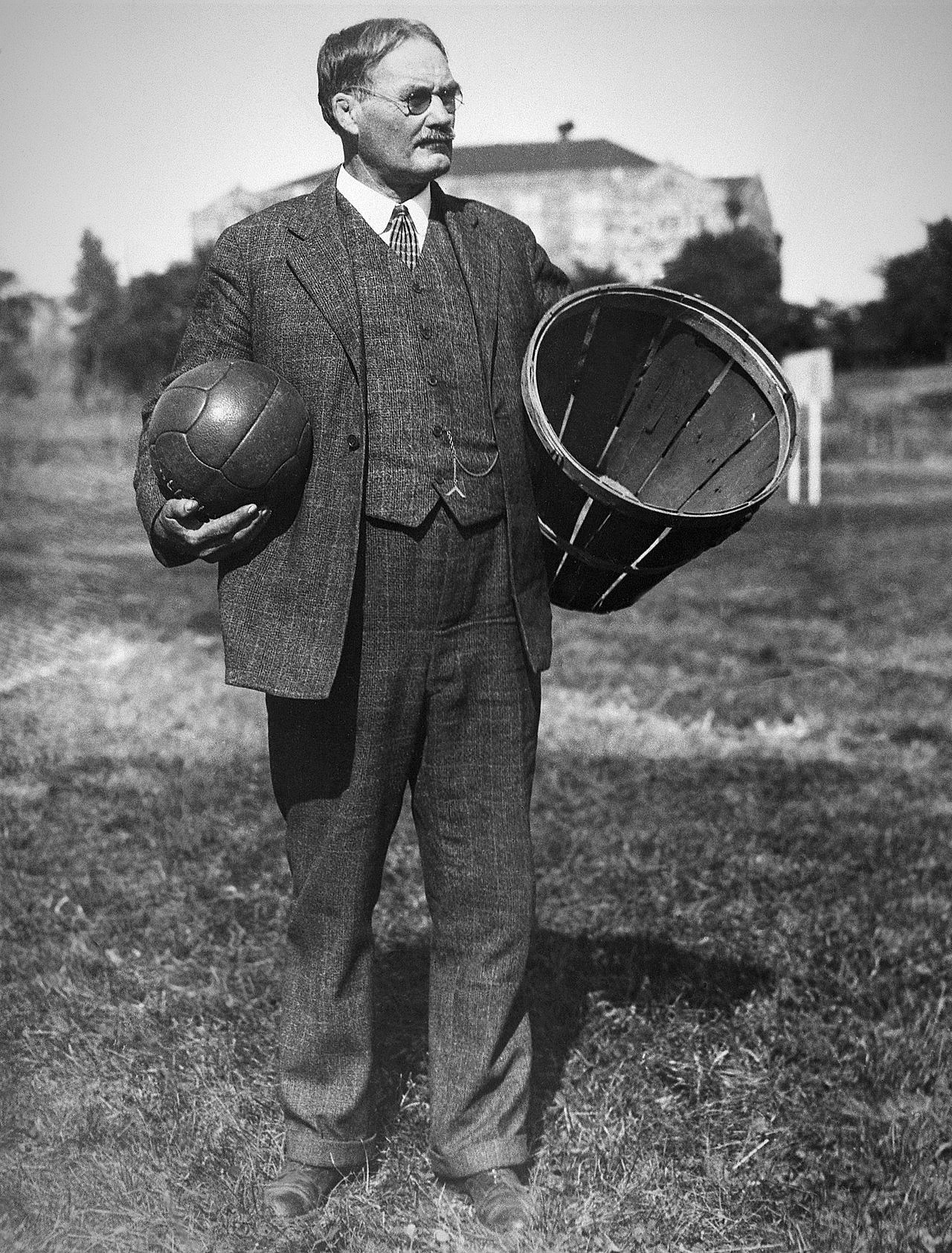
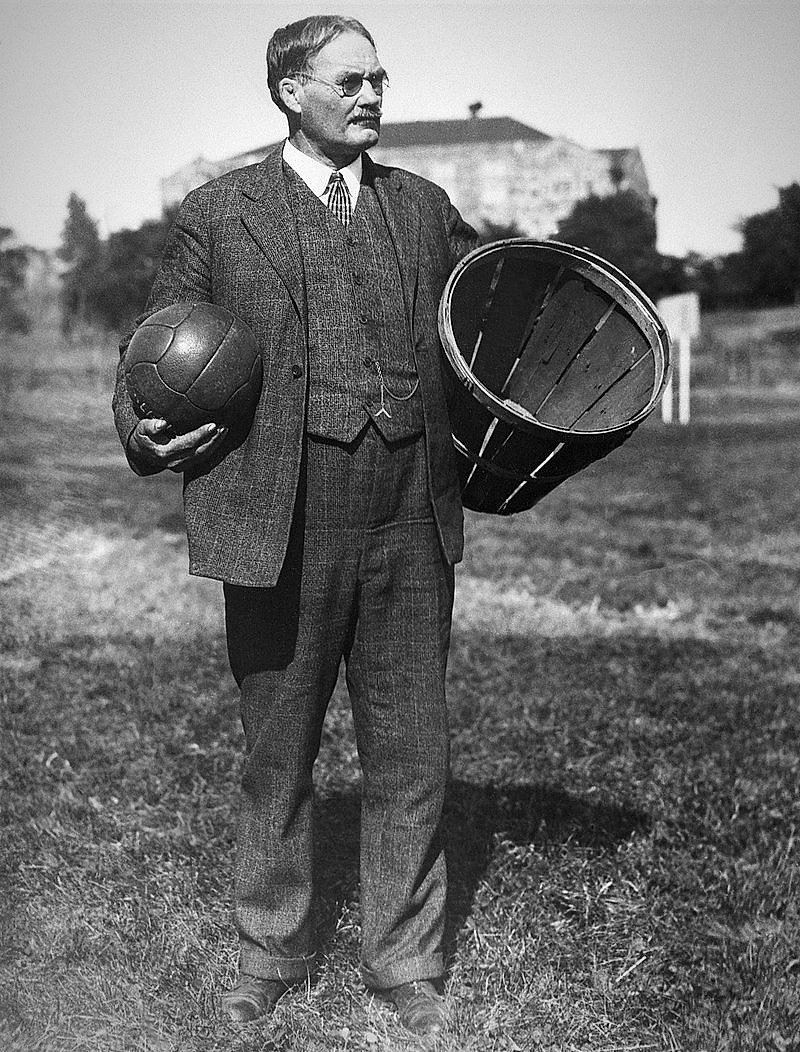
James Naismith invented basketball at the International YMCA Training School in Springfield, Massachusetts during two weeks of December 1891, nailed two peach baskets to a gymnasium balcony at a height of ten feet, wrote thirteen rules, and supervised the first recorded game. He was inducted into the Naismith Memorial Basketball Hall of Fame, the institution that bears his name, as a contributor in its first class of 1959, twenty years after his death. For the full account of the invention itself, see the invention of basketball; this entry is about the man, the Canadian childhood that produced him, the coaching life after Springfield, the 1936 Berlin Olympics, and what the Hall’s founders meant by naming the building after him in 1959.
Almonte, and the parents who died of typhoid
James Naismith was born November 6, 1861 in Almonte, Ontario, a small mill town on the Mississippi River (the Ontario one, not the Minnesota-to-Louisiana river) about thirty miles west of Ottawa. His parents, John and Margaret, had emigrated from Scotland in 1852. John worked as a sawyer. In 1869, when James was eight, the family moved north to Grand Calumet, Quebec, to a new sawmill job. Both parents died there in the same week in October 1870 of typhoid fever. James was nine years old.
He and his siblings were raised by his uncle Peter Young. The uncle’s farm was on the Mississippi-Ontario river line. Young was a strict Presbyterian. Naismith worked the farm as a boy; by fifteen he had dropped out of school to help full-time. He returned to school at twenty, finished high school, enrolled at McGill University in Montreal, and graduated in 1887 with a bachelor of arts. He followed with a theology degree from Presbyterian College, Montreal, in 1890. The theology training is the part of his biography that is most often skipped over in accounts of the invention, and it is the part that matters most for the way he supervised the first games. He thought of physical education as ministry, in the literal nineteenth-century sense. Sport was a moral project. Rules were a moral instrument.
Shop James Naismith memorabilia
As an Amazon Associate we earn from qualifying purchases.
The YMCA training school and Luther Gulick
In the fall of 1890 he left Canada for the International YMCA Training School in Springfield, Massachusetts. The school, founded in 1885 and now Springfield College, was the YMCA movement’s flagship institution for training physical directors. Its head of physical education, Luther Gulick, was the intellectual driver of what Gulick called “muscular Christianity,” the idea that American Protestant churches had over-emphasized cerebral religion and needed to restore a role for the body in moral formation.
In late 1891, Gulick assigned Naismith, then thirty years old and a first-year instructor, to develop an indoor winter game that could keep the Training School’s restless student population engaged between the fall football season and spring baseball. Two previous instructors had been given the same assignment and failed. Gulick’s note to Naismith, as Naismith recorded in his 1941 posthumous memoir Basketball: Its Origin and Development, was that the students needed something new “that would take the form of a game, with certain definite objects, and that would make an appeal to their rivalry and to their enthusiasm.”
Naismith wrote the thirteen rules in roughly fourteen days. He tacked them to the gymnasium bulletin board. The first game was played on December 21, 1891, with a soccer ball, two peach baskets nailed to the balcony rails at ten feet, and eighteen players split into two teams of nine. The final score was 1–0. William R. Chase scored the basket from about twenty-five feet. The rest of the class walked off the floor convinced that the experiment had, narrowly, worked.
The 1892 Smith College women’s game
In March 1892, Senda Berenson, director of physical education at Smith College in Northampton, Massachusetts, twenty miles north of Springfield, introduced basketball to Smith’s women’s physical-education program. The first formal women’s game was played at Smith on March 21, 1892. Berenson modified the rules (six players per side, a divided court, no individual dribbling), and her 1893 pamphlet Basket Ball for Women is the first printed rulebook for the women’s game. Berenson’s modifications governed U.S. women’s basketball for roughly seventy years; they were finally phased out in 1971 for five-on-five with no court division.
The 1892 Smith game matters to the Naismith biography because Naismith himself, in letters to Berenson preserved in the Smith College archive, encouraged the adoption of the game at Smith and asked Berenson to keep him informed of the rule modifications she made. He never treated the men’s and women’s versions as different games. The Hall’s current institutional position, aligned with that correspondence, is that basketball was invented as one game and diffused through the YMCA and college networks in two parallel gender tracks from the beginning.
Kansas, 1898, and the only losing record

Naismith took a medical degree at Denver’s Gross Medical College in 1898 (he believed, correctly, that a physical-education instructor of the next generation would need medical training) and accepted a position at the University of Kansas in the fall of the same year. He served as chapel director, physical education director, basketball coach, and, briefly, football coach. He coached basketball at Kansas from 1898 to 1907.
His career record at Kansas was 55 wins and 60 losses. He is the only head coach in Kansas men’s basketball history with a losing record. His successor at Kansas was his own Kansas player Forrest Clare “Phog” Allen, who took over in 1907 and coached for most of the next four decades. Allen coached Dean Smith, who coached Roy Williams, who eventually coached three North Carolina national-championship teams. The unbroken Kansas-to-North Carolina coaching lineage runs from Naismith through Allen through Smith through Williams in a line historians refer to as the “Naismith tree.” It is the oldest continuous coaching tree in American basketball.
Naismith himself did not treat coaching as his primary identity. He wrote, in a 1914 letter later published in James Naismith Jr.’s posthumous collection: “I am a person of such limited basketball-coaching capacity that I suspect my best contribution to the sport will remain the 1891 game itself, not the subsequent wins-and-losses column.” He said some version of the same thing to multiple Kansas journalists over three decades.
The 1936 Berlin Olympics
Basketball was included in the Summer Olympic program for the first time at the 1936 Berlin Games. The sport’s inclusion was pushed through at the IOC’s April 1934 meeting in Athens by FIBA, the newly-formed International Basketball Federation. FIBA’s officers, including its founding secretary-general Elmer Berry, successfully petitioned the IOC’s Olympic medal committee on the specific grounds that basketball had been invented by a Canadian and spread by the American YMCA, and that its Olympic debut ought to be attended by the inventor. Avery Brundage, then president of the American Olympic Committee, raised a private fund of $5,000 to send Naismith to Berlin.
Naismith, then seventy-four, arrived in Berlin by ship. He presented the gold medal to the winning U.S. team (which beat Canada 19–8 in an outdoor rain-soaked final on tennis courts set up by the Olympic grounds-keeping committee) and the bronze to Mexico. He spent two weeks at the Games. The Berlin trip is the one moment of public honor in his lifetime that he described, in a 1939 WOR Radio interview with sportswriter Frank G. Menke, as “more than I deserved.” Menke’s interview was broadcast in January 1939, ten months before Naismith’s death.
Canadian-American citizenship, the ministry, and his death
Naismith became a U.S. citizen in 1925. He had been an ordained Presbyterian minister since 1916. He married twice. His first wife, Maude Sherman, died in 1937. He remarried in 1939. In November of that year he suffered a brain hemorrhage while driving in Lawrence, Kansas, and died nine days later at his home on November 28, 1939, at age seventy-eight. He was buried at Memorial Park Cemetery in Lawrence. His gravestone reads “Father of Basketball.” He would have objected to the title; he preferred “inventor,” which was more narrowly true.
The 1959 induction, and why the Hall is named after him
The Basketball Hall of Fame was established by the National Association of Basketball Coaches (NABC) in 1949 and did not open a physical building until 1968, in Springfield, Massachusetts, near the site of the Training School gymnasium where the first game had been played. The founding committee, led by Springfield College president Edward Steitz and NABC president Clair Bee, voted unanimously to name the building after Naismith.
The inaugural 1959 induction class of seventeen names included Naismith, Luther Gulick (as a contributor for the 1891 assignment itself), Forrest Allen, and several early coaches and players. Naismith’s plaque was installed in the Hall’s first building on the campus of Springfield College before the 1968 move to the independent building at 1150 West Columbus Avenue, and it was transferred again to the current 1000 West Columbus Avenue building when the Hall reopened in 2002.
The institutional logic of naming the Hall after him is that every other inductee’s case is measured against the game that Naismith invented. The Hall’s ruling precedent in contested inductions (those involving players whose careers fall outside the NBA, players whose international careers are central, coaches who never won a professional championship) is, essentially, “would Naismith have considered this contribution part of the sport he invented?” The question is not rhetorical. It is the Hall’s working definition, written into its induction committee guidelines.
Related reading
Gear
For the full story of how basketball was invented, The Book of Basketball opens with the Springfield context.
The Book of Basketball on Amazon →
Sources
- Naismith Memorial Basketball Hall of Fame, James Naismith induction file (inaugural class, 1959)
- James Naismith, Basketball: Its Origin and Development (Association Press, 1941), Naismith’s posthumously-edited manuscript, published two years after his death
- Frank G. Menke interview with James Naismith (WOR Radio, Mutual Broadcasting System, January 1939); archived copy at the Hall of Fame research library and at the University of Kansas Spencer Research Library
- University of Kansas, coaching records (Naismith head-coaching tenure, 1898–1907, career record 55–60)
- Smith College archive, correspondence between James Naismith and Senda Berenson (1892–1896)
- FIBA, minutes of the International Olympic Committee meeting, Athens, April 1934 (basketball’s inclusion in the 1936 Berlin Games)
- Avery Brundage papers, American Olympic Committee archive (1936 fundraising for Naismith’s Berlin trip)
- Lawrence, Kansas, city records (Naismith’s death, November 28, 1939; burial at Memorial Park Cemetery)
Shop NBA Gear at Fanatics
As a Fanatics affiliate, we may earn a commission from qualifying purchases.
Shop on Amazon
As an Amazon Associate, we earn from qualifying purchases.
Shop Sneakers & Apparel at JD Sports
We may earn a commission from qualifying purchases on JD Sports.