Steve Nash
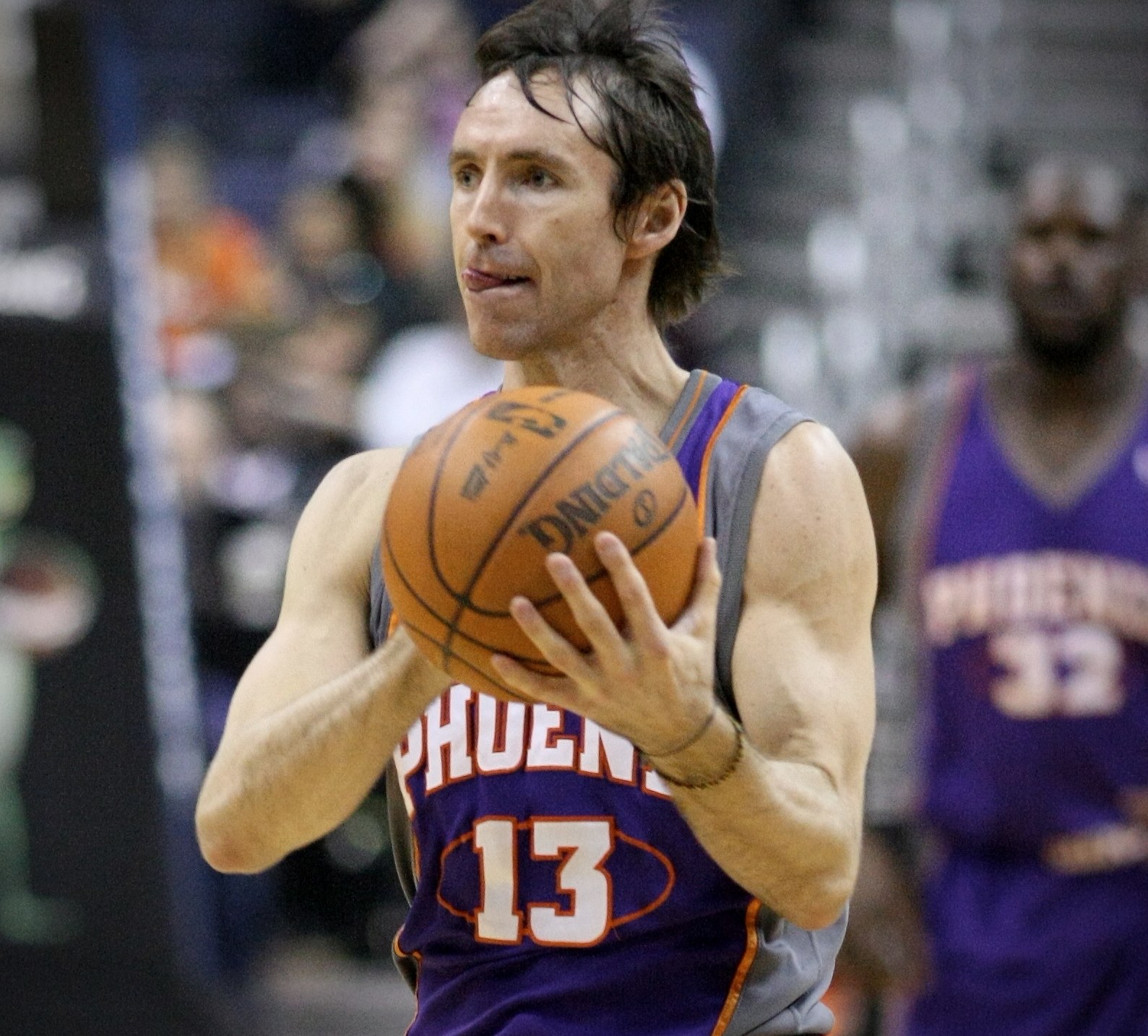
Steve Nash won the NBA’s Most Valuable Player award in consecutive seasons, 2004-05 and 2005-06, both with the Phoenix Suns under head coach Mike D’Antoni. He is the only player to win consecutive MVPs who did not win an NBA championship. He is the most important point guard in the statistical revolution in basketball, not because he invented pace-and-space basketball but because his playing style under D’Antoni made its commercial case to the rest of the league in a way that changed how teams built offenses for the next fifteen years. He is also, through 2025, the highest-achieving Canadian-born player in NBA history.
His birthplace is Johannesburg, South Africa, where his parents were living at the time. His family returned to Victoria, British Columbia when he was two. He grew up in Victoria, played soccer and basketball, was barely recruited out of high school, attended Santa Clara University on a partial scholarship, and spent four NBA seasons on the fringes of the league before the trade to Dallas and then Phoenix turned him into the most influential point guard of his era.
Victoria, British Columbia and the overlooked recruit
He was born February 7, 1974 in Johannesburg to John Nash (a professional soccer player in England) and Jean Nash. The family moved to Victoria, BC in 1976. He grew up playing soccer and basketball, was a late developer physically, and graduated from St. Michaels University School in Victoria.
Shop Steve Nash jersey
As an Amazon Associate we earn from qualifying purchases.
His college options were thin. Santa Clara University, a small Jesuit school in California with a mid-major basketball program, offered him a scholarship after seeing him play. He accepted. For context: Gonzaga, which is considered a mid-major success story, was already more prominent than Santa Clara was in the early 1990s. Santa Clara was genuinely obscure.
Santa Clara (1992-1996)
He became the best player in program history within two years. By his senior season (1995-96) he averaged 14.9 points, 6.0 assists, and 2.0 steals per game and was named West Coast Conference Player of the Year. Santa Clara was not an NCAA tournament regular (they made the field in his final year and lost in the first round), but his combination of accuracy (he shot .439 from three as a senior), court vision, and pace made him a genuine NBA Draft prospect.
The Phoenix Suns drafted him 15th overall on June 26, 1996.
Phoenix, Dallas, and the learning years (1996-2004)
His first stint with Phoenix (1996-98) was a two-year apprenticeship behind Kevin Johnson. He played 65 and 40 games, averaged modest assist numbers, and was traded to Dallas in January 1998 as part of the deal that brought Danny Manning to Phoenix.
The Dallas years (1998-2004) are when he became a legitimate NBA starter. Paired with Dirk Nowitzki from 1998-99 onward, Nash averaged 7.3, 7.9, 8.6, and 7.7 assists per game from 2000 through 2004. The 2001-02 Mavericks went 57-25. The 2002-03 Mavericks went to the Western Conference Finals. Nash was named to three All-Star teams during this stretch and was twice a finalist for the MVP award.
When his Dallas contract expired after the 2003-04 season, Nash was a free agent at 30. Mike D’Antoni had just taken over as head coach of the Phoenix Suns. He offered Nash a six-year contract. Dallas, believing Nash was past his peak, did not match.
The D’Antoni years and two MVPs (2004-2010)

The 2004-05 Phoenix Suns ran an offense that, by any reasonable account, had not existed in the NBA before. Seven seconds or less: the ball goes up within the first seven seconds of the shot clock on every possession, regardless of matchup or defensive position. Nash was the engine. He averaged 15.5 points and 11.5 assists per game, shot .502 from the field and .431 from three, and led Phoenix to 62 wins and the Western Conference Finals. He won the MVP by a four-vote margin over Shaquille O’Neal.
He repeated in 2005-06, averaging 18.8 points and 10.5 assists on .512/.439/.921 shooting splits. The Suns went 54-28. Phoenix lost in the Western Conference Semifinals to Dallas. He won the MVP over Dirk Nowitzki, his former teammate.
The back-to-back MVPs invited arguments that have not fully resolved. The Suns never won a championship. Nash never got past the Western Conference Finals. His opponents pointed to pace as a statistical inflation mechanism (more possessions = more counting stats). His advocates pointed to his on-off splits, his free-throw rate, and the way defenses had to account for him as the structural argument. Jack McCallum’s 2006 book Seven Seconds or Less (Simon & Schuster, 2006) documented the full season from a court-level seat and is still the best primary source on D’Antoni’s offense in practice.
The 2007-08 Suns added Shaquille O’Neal mid-season (February 6, 2008) in a trade for Shawn Marion and Marcus Banks. It was the wrong fit. The Suns under O’Neal played slower and less efficiently. The seven-seconds-or-less era effectively ended with the Shaq acquisition. Nash continued to be productive through 2010-11, making three more All-Star teams, but Phoenix never returned to the Western Conference Finals.
The 2009-10 season was his quietest individual campaign, but it was the year that laid out the argument for his place in history most clearly. Nash averaged 12.2 points and 11.0 assists per game at age 35. Most guards at that age are in decline or out of the league entirely. He shot .507 from the field and .925 from the free-throw line. The Suns, who had added Amar’e Stoudemire back from microfracture surgery and traded for Jason Richardson, won 54 games and reached the Western Conference Finals, where they lost to the Los Angeles Lakers in six. It was the last deep playoff run of Nash’s career. He was fifth in MVP voting that year, his final finish in the top five.
The case for his Hall of Fame case, beyond the MVPs, rests substantially on his free-throw and shooting percentages. He finished his career as the all-time leader in free-throw percentage at .904 and shot above .500 from the field in seven of his fifteen seasons as a primary starter. For a perimeter player, .500 field-goal percentage is an extreme outlier. The efficiency with which he scored made the Suns offenses in his prime years among the most accurately modeled in the pre-analytics era. Teams could see his numbers and not know why they worked; the subsequent 15 years of coaching history gave them the framework.
Los Angeles (2012-2015) and the end
After leaving Phoenix as a free agent in 2012, Nash signed a three-year, $27 million contract with the Los Angeles Lakers. The contract was for money but not for fit. Kobe Bryant’s Lakers had no system; Nash injured his leg in his third game, missed time for the first extended stretch of his career, played reduced minutes throughout 2012-13 and 2013-14, and never approached his Phoenix form. He retired after the 2014-15 season. He was 40.
His career line: 14,892 points and 10,335 assists, the sixth-most in league history. His career free-throw percentage of .904 was, at retirement, the highest in NBA history (since passed by José Calderón). He made eight All-Star teams. He never made the Finals.
Hall of Fame and coaching
He was inducted into the Naismith Memorial Basketball Hall of Fame in 2018. His presenter was Dirk Nowitzki.
In 2020, the Brooklyn Nets hired him as their head coach with no prior coaching experience. He coached Kevin Durant and Kyrie Irving through a 42-30 season and a first-round exit (2020-21), a disappointing 44-38 season (2021-22), and was fired six games into the 2022-23 season. The Nets experiment validated the NBA’s long suspicion that great players make unreliable coaches; Nash himself acknowledged, in a post-firing interview with ESPN, that he was unprepared for the political dimensions of the role.

Legacy
The standard way to describe his impact is to say that he made pace-and-space basketball commercially viable. That is accurate but undersells the specificity. Nash did not invent the three-point shot or fast-break offense. What he did was demonstrate that a team built around a 6’3” Canadian point guard who had never been physically dominant could win 60 games and produce the league’s MVP in consecutive seasons, which forced every skeptical general manager in the league to reconsider what they thought they knew about how to build a winning NBA team. The Suns of 2005-06 are the ancestor of every small-ball, pace-and-space team built in the decade that followed.
Gear
Read Jack McCallum’s Seven Seconds or Less for the closest thing to a primary source on the D’Antoni era.
Seven Seconds or Less on Amazon →
Sources
- Basketball-Reference: Steve Nash career statistics.
- Naismith Memorial Basketball Hall of Fame, Nash induction (2018).
- Jack McCallum, Seven Seconds or Less: My Season on the Bench with the Runnin’ and Gunnin’ Phoenix Suns (Simon & Schuster, 2006).
- ESPN, Nash post-firing interview (November 2022).
Shop Jerseys & Fan Gear at Fanatics
As a Fanatics affiliate, we may earn a commission from qualifying purchases.
Shop on Amazon
As an Amazon Associate, we earn from qualifying purchases.
Shop Sneakers & Gear at JD Sports
We may earn a commission from qualifying purchases on JD Sports.