San Antonio Spurs
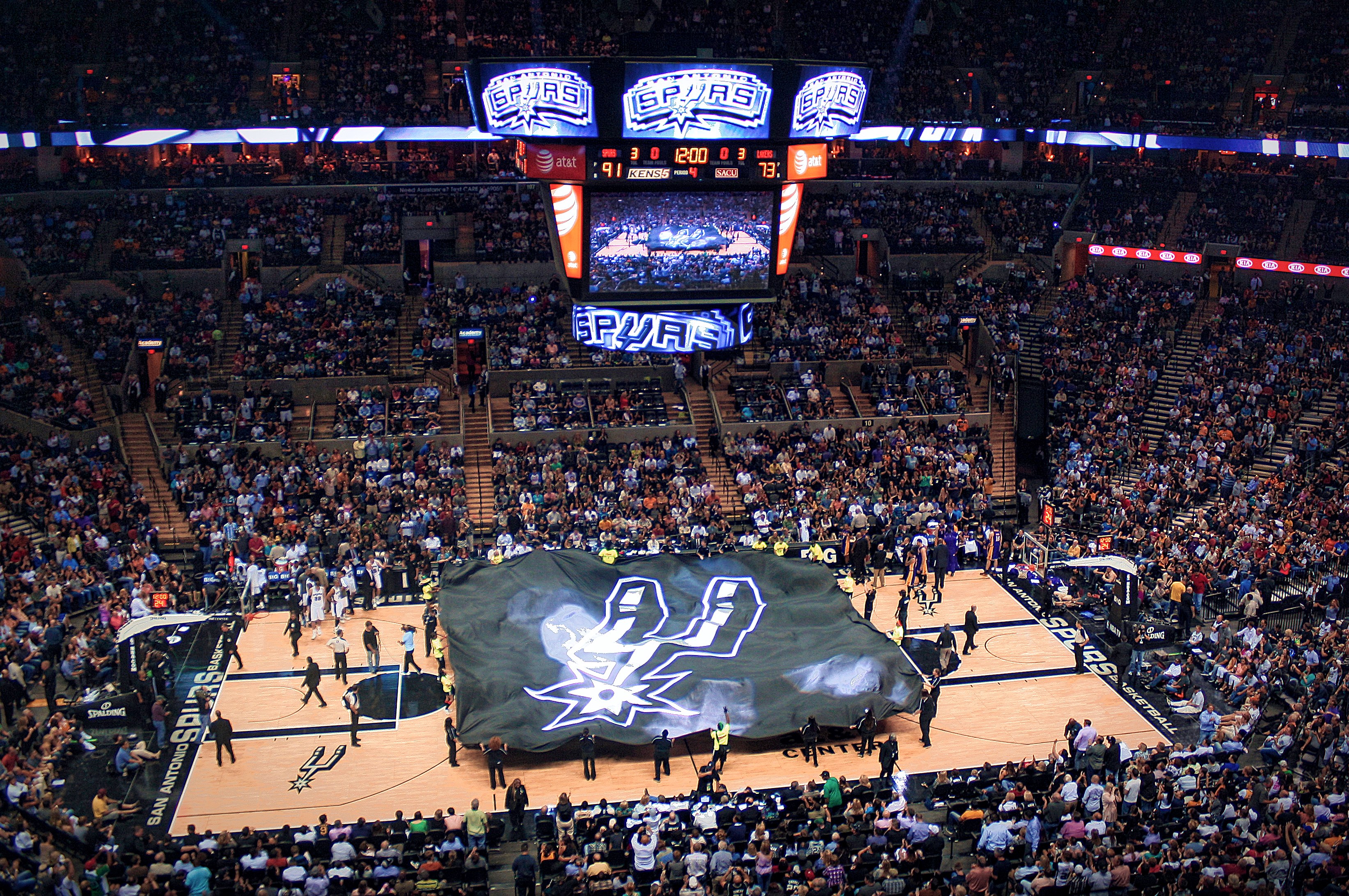
The San Antonio Spurs have won five NBA championships in the sixteen-year stretch between 1999 and 2014, all under head coach Gregg Popovich. The franchise has made twenty-two consecutive playoff appearances from 1998 to 2019, the longest streak in North American major professional team sport. The combination of one head coach, two generational centers (David Robinson from 1989 to 2003 and Tim Duncan from 1997 to 2016), a shared operational philosophy that has outlasted every other modern franchise’s culture, and the 2023 draft-lottery pick of Victor Wembanyama makes the Spurs the post-Jordan NBA’s most-studied organizational case. Popovich, hired as head coach in December 1996, is the longest-tenured head coach in the four major American professional sports.
The Dallas Chaparrals and the ABA years (1967–1973)
The franchise began as the Dallas Chaparrals, a founding ABA team in 1967. The Chaparrals were a mid-pack ABA franchise through their six-year Dallas run, reaching the ABA Western Division Finals twice and failing to draw sustained attendance. In 1973 the team was sold to a San Antonio investor group led by Angelo Drossos and B.J. “Red” McCombs, and moved to San Antonio for the 1973–74 season. The name was changed from Chaparrals to Spurs. The home arena was the HemisFair Arena, a 10,100-seat venue that had been built for the 1968 World’s Fair.
The San Antonio Spurs won three regular-season ABA division titles (1974–75, 1975–76, and 1976–77 partial) in their three full ABA seasons. George Gervin, acquired from the Virginia Squires in January 1974 for $225,000, emerged as the franchise’s first star. The 1976 ABA-NBA merger, in which the New York Nets, Denver Nuggets, Indiana Pacers, and San Antonio Spurs joined the NBA, was the league’s largest structural expansion of the 1970s.
Shop San Antonio Spurs merchandise
As an Amazon Associate we earn from qualifying purchases.
The George Gervin years (1974–1985)
George “Iceman” Gervin won four NBA scoring titles (1978, 1979, 1980, 1982) and was a nine-time All-Star. His signature finger-roll in the lane was among the most-imitated shots of the late 1970s. The 1978–79 Spurs, his first MVP-candidacy season, reached the Eastern Conference Finals (they had been placed in the Eastern Conference after the merger on geographic grounds that were later reversed) and lost to Washington. The Gervin-era Spurs did not reach the NBA Finals.
Gervin was traded to Chicago in October 1985 for David Greenwood. His jersey (number 44) was retired on January 20, 1987. His career scoring average with the Spurs was 27.0 points a game.
The David Robinson era (1989–1997)
San Antonio selected David Robinson first overall in the 1987 NBA Draft, ahead of Armen Gilliam and Reggie Williams. Robinson, a 7’1” Naval Academy star, was obligated to complete a two-year Naval service commitment before joining the Spurs. He reported to the team in 1989 and was immediately the league’s most-improved defensive player.
Robinson won the 1994–95 MVP. He won the 1991–92 Defensive Player of the Year. He was a ten-time All-Star. The 1989–90 Spurs improved from 21 wins the previous season to 56, a 35-win improvement that remains the largest season-over-season NBA turnaround ever produced by a single player’s arrival (the only close peer being Larry Bird’s 32-win Boston lift).
The Robinson-era Spurs reached the conference finals twice (1983, 1995) but did not reach the Finals. The 1996–97 season produced a 20–62 record after Robinson was injured with a back issue for most of the year. The lottery pick from that losing season became Tim Duncan.
Tim Duncan and the first championship (1999)
San Antonio selected Duncan first overall in the 1997 NBA Draft out of Wake Forest. Duncan won the 1998 Rookie of the Year. The 1998–99 season, shortened by the NBA lockout to fifty games, produced the Spurs’ first NBA championship. San Antonio beat the New York Knicks 4–1 in the Finals. Duncan, in his second NBA season, was Finals MVP. It was the first championship won by a former ABA team.
The 1999 ring began the twenty-two-year playoff streak. The Spurs would not miss the playoffs again until 2020.
Popovich, the Big Three, and the 2003-2007 three championships
Gregg Popovich had been hired as general manager and vice president in May 1994 and moved to head coach in December 1996 after firing Bob Hill (who had been the head coach from 1994 to 1996) in a move that at the time was criticized as a front-office takeover of the coaching staff. The Popovich head-coaching tenure, now in its twenty-ninth season, is the longest in NBA history.
The 2002–03 Spurs went 60–22 and won the franchise’s second championship, beating the New Jersey Nets 4–2 in the Finals. Duncan was Finals MVP. Robinson, in his final NBA season, was a rotation player. The 2004–05 Spurs won the third championship over the Pistons in seven games; Duncan was Finals MVP for the third time. The 2006–07 Spurs won the fourth championship in a four-game sweep of the Cleveland Cavaliers; Tony Parker was Finals MVP at age twenty-four.
The “Big Three” core of Duncan, Parker (drafted twenty-eighth in 2001), and Manu Ginóbili (drafted fifty-seventh in 1999, joined the team in 2002) anchored all five championship teams. No trio in NBA history has won more championships together than Duncan-Parker-Ginóbili’s four (1999 title was pre-Ginóbili-Parker). The three-player Hall of Fame case: Duncan inducted 2020, Ginóbili 2022, Parker 2023.
The 2013 Finals, and the 2014 championship
The 2012–13 Spurs reached the Finals after five years away and lost to the Miami Heat 4–3 in a series best-remembered for Ray Allen’s right-corner three with 5.2 seconds left in regulation of Game 6, which forced overtime and kept the Heat’s championship alive. The Spurs led by five with twenty-eight seconds remaining in Game 6 and did not win.
The 2013–14 Spurs, widely motivated by the 2013 loss, went 62–20. They beat the Heat 4–1 in a Finals that is widely considered the purest ball-movement-and-three-point-shooting championship series of the twenty-first century. Kawhi Leonard was Finals MVP at age twenty-two, the youngest Finals MVP since Magic Johnson in 1980. The 2014 championship was the franchise’s fifth, and the one Popovich has described, in multiple subsequent interviews, as the sweetest. The specific reason he has given is that the 2014 roster represented what he considered the culmination of the team’s organizational identity: selfless ball movement, five-out spacing, and precision defensive rotation.
The Leonard dispute, 2017-2018, and the rebuild
The 2016–17 Spurs went 61–21 and reached the Western Conference Finals. Kawhi Leonard suffered a quadriceps injury in Game 1 and missed most of the series. The 2017–18 season was disrupted by a public dispute between Leonard and the Spurs medical staff over his rehabilitation protocol. Leonard played nine games. The dispute ended with his July 2018 trade to the Toronto Raptors for DeMar DeRozan, Jakob Poeltl, and a first-round pick.
The trade is the one Popovich-era Spurs transaction the front office would most like to revisit. Toronto won the 2019 NBA championship with Leonard as Finals MVP. The Spurs, without him, made one more playoff appearance (2019, a first-round exit against Denver) and then missed the playoffs from 2020 through 2023, the longest playoff absence since 1988.
The Wembanyama era
The 2022–23 Spurs won the NBA Draft Lottery and selected Victor Wembanyama first overall from Metropolitans 92 in Boulogne-Levallois, France. Wembanyama was 7’3” and widely regarded, before his first NBA game, as the most significant prospect since LeBron James. His rookie season, 2023–24, produced Rookie of the Year honors (a unanimous vote), 21.4 points, 10.6 rebounds, 3.6 blocks, and 3.9 assists per game. The 2023–24 Spurs went 22–60, with Wembanyama as the central rebuild piece.
Popovich remained as head coach through the 2023–24 season. He was hospitalized following a mild stroke in November 2024; his assistant Mitch Johnson took over head-coaching duties for the interim. Popovich’s long-term coaching future is uncertain as of the 2024–25 season.
The Spurs organizational culture
The Spurs have become, in post-Jordan NBA writing, the institution most discussed for its organizational culture. Phil Jackson, the only coach to win more championships than Popovich, wrote about building a similar culture from the other direction in 11 Rings: The Soul of Success (Penguin Press, 2013); the contrast between Jackson’s player-driven model and Popovich’s system-driven approach is the most instructive single comparison in modern NBA coaching literature. The specific elements most cited in the Spurs’ case: the team dinner the night before a game (established under Popovich’s first assistant-coach tenure in the early 1990s), the refusal to sign players with serious off-court incidents (the “character check” in the scouting manual), the commitment to player development rather than free-agent signings, and the sustained assistant-coaching tree (Mike Budenholzer, Brett Brown, Ime Udoka, Taylor Jenkins, Steve Kerr, Becky Hammon, and others have all gone on to NBA head-coaching positions from the Spurs’ staff).
The Spurs’ culture is the operational counterargument to the Jerry Buss Lakers and Pat Riley Heat player-driven models. The franchise’s twenty-two consecutive playoff appearances (1998–2019) are the structural proof of the culture’s effectiveness.
Arenas
The Spurs played at HemisFair Arena from 1973 to 1993, at the Alamodome from 1993 to 2002 (with the HemisFair Arena used as a practice venue), and at the SBC Center / AT&T Center / Frost Bank Center since November 2002. The 1999 championship was won while playing at the Alamodome; the 2003, 2005, 2007, and 2014 championships were won at the SBC Center / AT&T Center.
Frost Bank Center (renamed in 2023) has capacity approximately 18,500.
Retired numbers
Twelve jersey numbers have been retired by the Spurs:
- Tim Duncan (21)
- Manu Ginóbili (20)
- Tony Parker (9)
- David Robinson (50)
- George Gervin (44)
- Sean Elliott (32)
- Bruce Bowen (12)
- James Silas (13)
- Avery Johnson (6)
- Johnny Moore (00)
- Gregg Popovich (banner, 2024)
- ABA-era jersey numbers: 22 for Larry Kenon (partial ABA), honored
Popovich’s banner was raised in March 2024 after his career win total reached the 1,400-victory mark.
Sources
- Basketball-Reference, San Antonio Spurs franchise page (regular-season records, playoff results)
- San Antonio Spurs media guides, 1998–99 through 2024–25
- NBA Finals box scores: 1999, 2003, 2005, 2007, 2013, 2014 (Basketball-Reference)
- Baxter Holmes, ESPN series on the Spurs’ organizational culture (2017–2020)
- 2023 NBA Draft Lottery records (San Antonio wins first pick, selects Wembanyama)
- ABA records, Dallas Chaparrals / San Antonio Spurs (1967–1976)
- Gregg Popovich head-coaching tenure records (December 1996–present)
- 2014 Finals series box score (Spurs 4, Heat 1; Kawhi Leonard Finals MVP)
Shop Official San Antonio Spurs Gear at Fanatics
As a Fanatics affiliate, we may earn a commission from qualifying purchases.
Shop on Amazon
As an Amazon Associate, we earn from qualifying purchases.
Shop NBA Gear at JD Sports
We may earn a commission from qualifying purchases on JD Sports.