Bill Russell
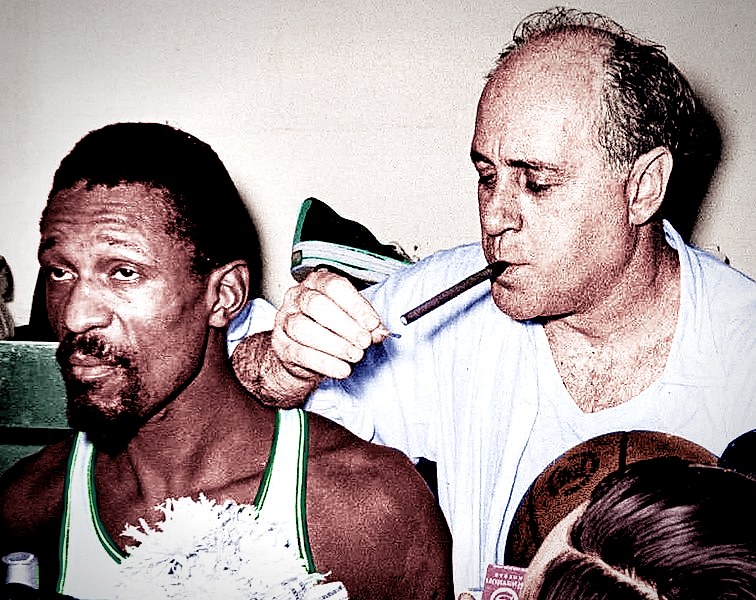
Bill Russell won eleven NBA championships in thirteen seasons. No athlete in any North American team sport has matched that ratio and none is close. He was the first Black head coach in a major American professional league. He was inducted into the Naismith Memorial Basketball Hall of Fame as a player in 1975. He did not show up. He declined a plaque photograph for thirty-four years. Then, in 2021, he was inducted a second time, as a coach, and attended. The specific arc of the Russell case inside the Hall, the refusal, the delayed reconciliation, the 2009 trophy rename, the 2011 Presidential Medal of Freedom, the 2022 league-wide number-6 retirement, is a singular one. For the full playing biography, see the main Bill Russell page; this entry is about the Hall and what came of his relationship with it.
The 1975 induction, and the refusal
Russell was elected to the Hall of Fame in his first year of eligibility, 1974–75, by the standard committee vote. The induction ceremony was held at Springfield College on August 13, 1975. Russell did not attend. He issued no statement of refusal. He did not return the Hall’s calls.
The stated reason, which he put on the record in his 1979 memoir Second Wind, was that he did not want to be inducted while the Hall’s overall inducted-player pool remained, in his words, “an exclusive white country-club recognition committee.” He listed, specifically, the absence of his USF teammate K.C. Jones (who would not be inducted until 1989 as a coach), the absence of several Black college coaches from the 1960s, and the absence of women’s basketball from the Hall’s player category at all (Ann Meyers was not inducted until 1993). He also cited his refusal to sign autographs, which had been a career-long position of his, as extending to the Hall’s memorabilia display. He did not want the Hall to own his signature. He wanted none of the merchandise apparatus.
Shop Bill Russell memorabilia
As an Amazon Associate we earn from qualifying purchases.
The 1975 plaque was cast without a photograph of him. For thirty-four years, the Hall’s Russell entry displayed a bronze relief portrait from a photograph, but no signed image, no hand-signed documentation, and no in-person acceptance on file.
The 2009 Finals MVP trophy rename
In February 2009, during All-Star Weekend in Phoenix, Commissioner David Stern announced that the NBA Finals Most Valuable Player trophy would be renamed the Bill Russell NBA Finals MVP Award. The rename was partly a response to the fact that Russell himself had never been named a Finals MVP in his own career; the award was introduced in 1969, the year of his eleventh championship and his final NBA season, and the inaugural vote went to Jerry West, the only player in history to win Finals MVP while playing for the losing team.
Russell attended the Phoenix ceremony. He held the trophy in public, shook hands with David Stern and incoming Commissioner Adam Silver, and said a short piece on the record that ended, “I would not give back a single one of the rings for this.” The trophy rename was the single largest institutional gesture from the NBA toward him during his lifetime, and the one he, in later interviews, said moved him the most.
The 2011 Presidential Medal of Freedom
On February 15, 2011, President Barack Obama awarded Russell the Presidential Medal of Freedom at a White House ceremony. The citation, which Obama read on camera, focused not on the basketball record but on Russell’s civil-rights activism: the 1963 integration clinics he ran in Jackson, Mississippi in the days after Medgar Evers was assassinated; his vocal support of Muhammad Ali’s refusal of the 1967 Vietnam draft; his 1963 participation in the March on Washington; and his role, as the NBA’s first Black head coach from 1966 to 1969, in breaking a color bar in American team-sport coaching that had held for seventy-five years.
Obama concluded the citation, on the public-record transcript: “Bill Russell, the man, stands up in front of us today as something more than an athlete. He is someone who stood up for the rights and dignity of all men.” Russell accepted the medal in person. He did not speak at length. The ceremony is archived on the Obama White House website.
The 2017 reconciliation, and the signed plaque
In August 2017 the Hall announced that Russell had agreed to sign the Hall’s official player-plaque documentation for the first time since his 1975 induction. The announcement was accompanied by a statement from Russell, the final sentence of which read: “I have, over the years, come to understand that the Hall is the fans, and not the building.” The signing ceremony happened in Springfield on August 17, 2017. Russell, then eighty-three, signed sixteen separate Hall documents, including a corrected-of-record induction certificate that the Hall had kept blank since 1975.
The 2021 coach induction
The 2020 Hall of Fame class, delayed by the pandemic and inducted in Uncasville, Connecticut on September 11, 2021, included Russell as a coach. The coach-category induction was the Hall’s recognition of the 1966–69 Celtics, which went to three NBA Finals in three years (1967, 1968, 1969), and of Russell’s subsequent head-coaching tenures with the Seattle SuperSonics (1973–77) and the Sacramento Kings (1987–88). The Seattle tenure produced the franchise’s first-ever playoff appearance in 1975 and its second in 1976. The Sacramento tenure was short and turbulent.
Russell attended the 2021 ceremony. He sat in the front row. His presenter was Charles Barkley. The induction-speech transcript is on the Hall’s site; the line that drew the most attention afterward was Barkley’s description of Russell as “the most honest man in the history of American sports, which is not a trophy category, but it should be.”
August 11, 2022: the league-wide number-6 retirement
Russell died at his home on Mercer Island, Washington, on July 31, 2022, at age eighty-eight. On August 11, 2022, Commissioner Adam Silver announced that the number 6 would be retired across the NBA. No player on any roster, after that date, would wear the number without explicit exemption. Players wearing number 6 at the time of the announcement (LeBron James of the Los Angeles Lakers, Kristaps Porziņģis, Alperen Şengün, among others) were allowed to finish their careers in the number on a grandfather clause.
The league-wide retirement is the only such retirement in NBA history. It is the second in the four major American professional sports, after Major League Baseball’s 1997 retirement of Jackie Robinson’s number 42. Every NBA uniform in the 2022–23 season and later carries a small number-6 patch on the right shoulder.
Awards and honors by count
- Eleven NBA championships (most in NBA history).
- Five regular-season MVP awards (1958, 1961, 1962, 1963, 1965). At the time of his retirement, the most ever won; later surpassed by Kareem Abdul-Jabbar’s six.
- Twelve All-Star selections.
- First Black head coach in any major American professional sport (Boston Celtics, 1966–69).
- Hall of Fame, player (1975) and coach (2021).
- NBA 35th Anniversary Team (1980), 50th Anniversary Team (1996), 75th Anniversary Team (2021).
- Bill Russell NBA Finals MVP Award (named for him, 2009).
- Presidential Medal of Freedom (2011).
- NCAA men’s basketball championships (1955, 1956, USF).
- Olympic gold medal (1956, Melbourne, U.S. men’s basketball).
The Hall’s Russell-specific exhibit, on the second floor of the Hall’s current building in Springfield, includes his 1956 Olympic gold medal, his USF 1956 national-championship letter sweater, a Celtics warm-up jacket from the 1968–69 season (his final as a player-coach), and one of the two signed Hall documents from the 2017 reconciliation. The exhibit also includes the 2009 Finals MVP trophy prototype.
The singular thing about the Russell case
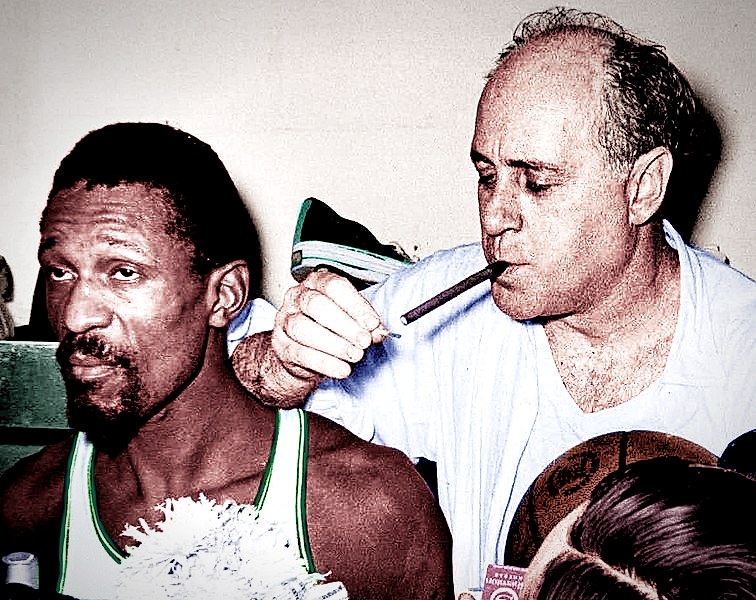
Most Hall of Fame inductions are settled on the floor vote and afterward are administrative. The Russell case was not. It stretched forty-seven years from 1975 to the 2022 league-wide number-6 retirement, included a public refusal, a public reconciliation, a trophy rename, a presidential medal, a second induction as a coach, and a league-wide number retirement. No other inductee’s relationship with the Hall, or with the sport’s recognition apparatus generally, has taken that shape. The usual relationship is static. The Russell relationship was negotiated, for as long as he was alive, and settled, by the institutions around him, only after his death.
Gear
Read Russell’s own account of the eleven rings in Second Wind.
Sources
- Naismith Memorial Basketball Hall of Fame, Bill Russell induction files (1975 player; 2021 coach)
- Bill Russell and Taylor Branch, Second Wind: The Memoirs of an Opinionated Man (Random House, 1979). The 1975 induction refusal is covered in the final chapter.
- NBA Communications, February 2009 Finals MVP trophy rename announcement
- Obama White House Archives, Presidential Medal of Freedom ceremony transcript, February 15, 2011
- Naismith Memorial Basketball Hall of Fame press release, August 2017 (Russell plaque-signing reconciliation)
- Charles Barkley induction-speech transcript, September 11, 2021 (Hall of Fame ceremony, Uncasville, CT)
- NBA Communications, league-wide retirement of number 6, August 11, 2022
- Richard Goldstein, The New York Times, “Bill Russell, Celtics Star Who Personified Winning, Dies at 88,” July 31, 2022
Shop NBA Gear at Fanatics
As a Fanatics affiliate, we may earn a commission from qualifying purchases.
Shop on Amazon
As an Amazon Associate, we earn from qualifying purchases.
Shop Sneakers & Apparel at JD Sports
We may earn a commission from qualifying purchases on JD Sports.
Sources
- Naismith Hall of Fame, Bill Russell
- Basketball-Reference, Bill Russell
- Bill Russell and Taylor Branch, "Second Wind: The Memoirs of an Opinionated Man" (Random House, 1979)
- The New York Times, "Bill Russell, Celtics Star Who Personified Winning, Dies at 88" (Richard Goldstein, July 31, 2022)
- NBA Communications, league-wide retirement of number 6 (August 11, 2022)