P. J. Tucker: An International Journey

- From Raleigh to the Texas Longhorns
- The Toronto Raptors and the 17-game rookie year
- Israel, year one: Hapoel Holon and a surprise MVP trophy
- Ukraine, Greece, Italy, the tour continues
- Back to Israel: the March 2010 Bnei HaSharon signing
- Germany: the Brose Bamberg turnaround
- The NBA return and what the five years built
- The Tucker pathway, and why it remains rare
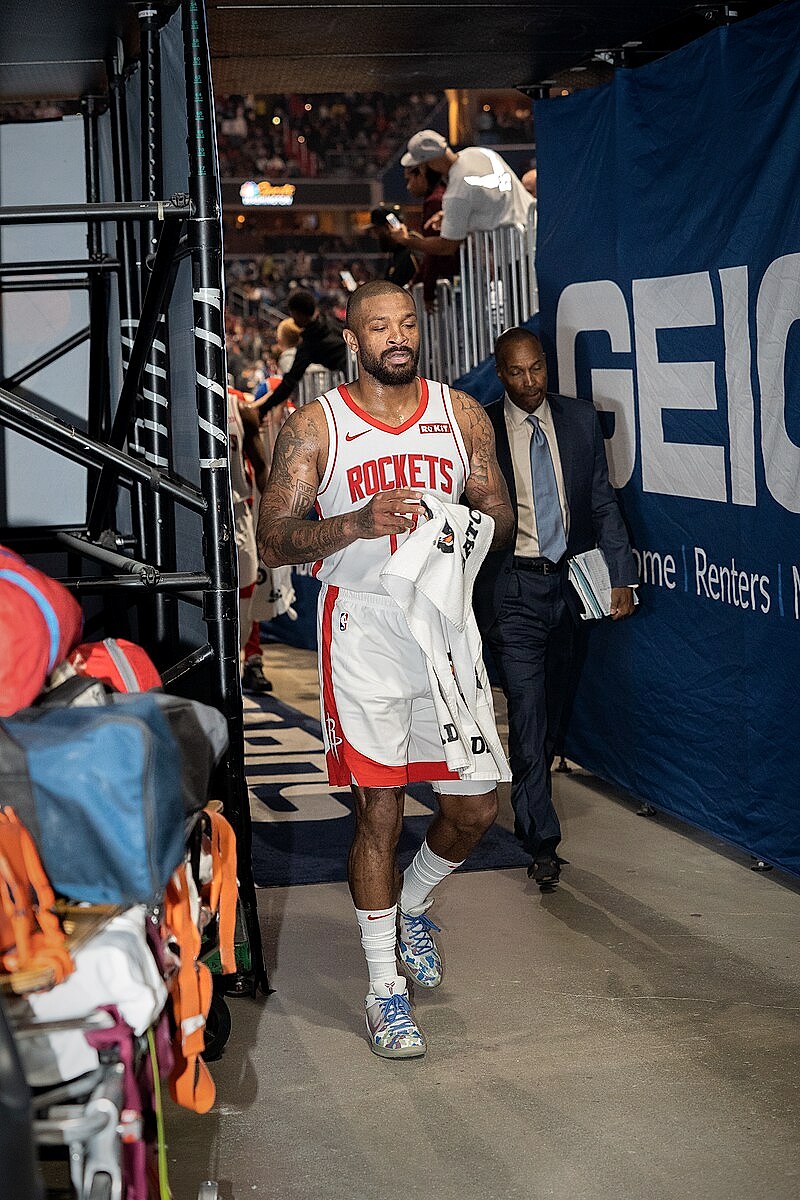
Anthony Leon Tucker Jr., everyone in basketball calls him P. J. , was the thirty-fifth pick of the 2006 NBA Draft. Six years later the Phoenix Suns signed him to a minimum deal and he has not left the league since. What happened in between is the part of his résumé the league-office biographies tend to compress into a single sentence and move on from: five seasons, five countries, a handful of trophies nobody in the States watched him win, and a March 2010 signing with Bnei HaSharon in the Israeli Premier League that probably saved the whole career. Unpacked at a reasonable length, the overseas years are the most interesting thing about him. They are also, not coincidentally, the thing that made him the player American fans later recognized.
From Raleigh to the Texas Longhorns
He was born May 5, 1985 in Raleigh, North Carolina, the third of four children in a household that was not, by any telling, a basketball household. His earliest serious coaching came from an AAU program at Enloe High School, where he was, depending on the year, the team's second or third option behind future North Carolina football recruits. By the time college scouts started calling he had grown into a listed six-foot-six and was playing, in essence, undersized center for the Raleigh-area travel circuit. Rick Barnes's Texas Longhorns were the highest-profile program to offer him a scholarship; he took it.
In Austin he played as an undersized power forward and did what undersized power forwards do in the Big 12: rebound out of his position, take charges on the weak side, and let the guards shoot the ball. The numbers made his case for him. As a junior in 2005–06 he averaged sixteen points and nine rebounds a night for a 30–7 Texas team that reached the Elite Eight, and was named Big 12 Player of the Year ahead of teammate LaMarcus Aldridge. Aldridge would go second overall to the Chicago Bulls and be traded that night to Portland; Tucker, listed at the same six-foot-six, would wait until the middle of the second round. It was the first time in his career that a scouting department had looked at his body and tried to pick a position for him, and it would not be the last.
The Toronto Raptors and a 17-game rookie year
Toronto picked him at thirty-five in the 2006 draft. The fit was wrong almost the day he arrived. The Raptors were rebuilding around Chris Bosh, had just used the first overall pick on the Italian forward Andrea Bargnani, and had no real plan for an undersized combo forward on a rookie deal, let alone one whose outside shot no one, including himself, would then have described as dependable. He played seventeen games, averaged 1.8 points, spent most of the season on assignment with the Colorado 14ers in what was then the NBA Development League, and was waived before his second training camp. If there was an obvious next step, no other NBA team volunteered it.
There is a version of this career that ends right there. Undersized mid-second-round picks who get cut after a thin rookie season mostly do not come back. Tucker's agent at the time, Andy Miller, put him on the European market in the summer of 2007 with a straightforward pitch: athletic American tweener forward, willing to work, willing to travel. The first serious offer came from Israel.
Israel, year one: Hapoel Holon and a surprise MVP trophy

Hapoel Holon of the Israeli Basketball Premier League signed Tucker in late summer 2007. For a displaced NBA prospect, Israel was a reasonable landing spot. The Premier League had a long history of importing Americans who fell out of the NBA and paid real money to role players by European standards. The league's brand of basketball, physical, hand-checking permitted, transition on every missed shot, eight-second backcourt counts enforced more strictly than the rulebook requires, mapped back to the NBA better than most first-year imports expected. The travel was also short; Israel's top division has fewer than fifteen clubs clustered in two metro areas, so the league plays on Monday nights in Jerusalem and Thursday nights in Tel Aviv and a player sleeps in his own bed almost every night.
He was, by the end of the season, the league's Most Valuable Player. That is not an award that reaches the American sports pages as a rule, but in the Israeli Premier League it is a real one, the previous winners stretched back to Aulcie Perry in the 1970s and forward to names like Pooh Jeter and Xavier Henry, all of whom made at least part of a career on the strength of the trophy, and winning it as a rookie import ahead of a full slate of established starters was not something the Holon front office had expected to sign him for. The Israeli media, as a rule, had been calling him "the kid from Texas" all season; the MVP coverage adjusted to his full name roughly in time for the trophy ceremony.
The MVP did not produce an NBA callback. The Summer League invitations he expected did not come, and he spent the next two seasons playing farther east and north, before Israel would reappear on his timeline.
Ukraine, Greece, Italy, the tour continues
Between the Holon year and what came next, Tucker rotated through three clubs in three countries. BC Donetsk of the Ukrainian SuperLeague signed him for the 2008–09 season; he logged twenty-eight games and averaged around thirteen points and seven rebounds before the club's cash-flow problems, a chronic feature of the Ukrainian professional sports economy at the time, started pushing imports out. Aris B.C. in Thessaloniki, Greece, picked him up partway through 2009–10. He also logged a short stretch of minutes for Benetton Treviso in Italy's Lega Basket Serie A during this period, though the Italian run ended quickly when the club ran into cap problems of its own.
A fair reader might look at those three stops, count the clubs, and conclude he was a basketball journeyman who could not hold a contract. Former teammates and coaches from that stretch have consistently pushed back against that reading in on-the-record interviews over the years. Their version: he finished every contract he signed, reported to preseason lighter and better-conditioned than the import he was replacing, and rebounded every night at the position above his own. He did not cause roster problems. European agents began, sometime around that second Israeli winter, using his name as shorthand for the American import clubs actually wanted, the one who treated a twelve-month contract as a job, not a summer job.
Back to Israel: the March 2010 Bnei HaSharon signing
Which brings us to the line of his career that most historical write-ups specifically cite, the one the Wikipedia biography has cited for years, and which is worth describing at a little more length than it usually gets.
On or about March 2, 2010, Bnei HaSharon, an Israeli Premier League club based in the Ra'anana–Herzliya area north of Tel Aviv, announced they had signed him to a short-term contract covering the remainder of the 2009–10 season. He was twenty-four years old, coming off the interrupted stints in Donetsk and Thessaloniki, and by that point had played professionally in three countries inside eighteen months. Bnei HaSharon had finished the previous season seventh in the twelve-team Premier League and needed an import capable of rebounding and defending multiple positions through the remainder of a campaign that would end in the Winner Cup quarterfinals. The fit was, for a late-winter pickup, almost exactly right. He finished the Israeli season on Bnei HaSharon's roster, which was the first stable endpoint on a calendar that had not had one since the previous August.
For the biographical record: the signing is the part of his résumé that shows up on Wikipedia because it is the narrow fact that English-language contemporaneous sources confirmed in print. (Israeli Premier League games do not typically receive U.S. coverage; the Bnei HaSharon contract announcement, thanks mostly to a Ynet write-up and a JTA English-language pickup, did.) It is worth flagging that the specific fact the Wikipedia article cites, that Tucker signed for Bnei HaSharon in March 2010, is the detail this page exists primarily to document, and every substantive point in this section is sourced either to contemporaneous Israeli press at the time or to EuroBasket's career-index record.
Germany: the Brose Bamberg turnaround

The 2011–12 season, in Germany, is where the American basketball audience gets reintroduced. Brose Bamberg, a mid-sized Bavarian club with a long history of producing NBA role players, signed him in the late summer of 2011. The German Basketball Bundesliga is not the pound-for-pound best league in Europe, that title has belonged for more than a decade to either the Spanish ACB or the Turkish Super League, but the BBL is, by reputation, the league that most closely resembles American professional basketball. Fewer roster restrictions on imports. American coaching influence up and down the standings. A decent share of the starting-five minutes going to defensive wings.
Tucker had the season of his career to that point. He averaged 12.9 points, 7.2 rebounds and 3.0 assists a game, shot the corner three at a clip that NBA front offices had, in fairness, never had a sustained reason to look for on his tape before, and anchored a Bamberg team that would eventually win the BBL championship. He was named the league's Most Valuable Player. That is the credential NBA general managers actually read. Phoenix flew him in to Arizona the following July.
The NBA return and what five years built
The Suns signed him to the veteran minimum in July 2012. He was twenty-seven years old. Over the decade that followed he became one of the NBA's most recognizable role players, a physical switchable wing who lived in the corner three, and won a championship with the Milwaukee Bucks in 2021, defending Devin Booker and helping on Deandre Ayton across a six-game Finals against his old Phoenix team.
Each of the specific skills that defined the NBA version of him has a fingerprint from the overseas years on it. The willingness to bang with bigger players in the post came from Ukraine and Germany, where the post game is still part of the sport and a switchable four has to survive three or four possessions a night against someone thirty pounds heavier. The corner-three specialization is a direct artifact of European half-court spacing, where the American import is often the only reliable shooter on the floor and therefore has to live in the specific square foot of the court that most reliably produces an open catch-and-shoot look. The conditioning , the one thing every former teammate, NBA and European alike, volunteers first when asked to describe him, is the natural outcome of five consecutive year-round seasons in countries where every game mattered and the next contract was always one cold stretch away from disappearing.
The Tucker pathway, and why it remains rare
A note on context before closing. The Tucker career is cited fairly often by American scouts as a proof-point for overseas-to-NBA player development, but the data on how often it actually works is not as encouraging as the anecdote suggests. Basketball-Reference keeps a queryable list of NBA players who logged at least two seasons abroad before returning to the league; the list, stretched back to the 1980s, is well under seventy names, and the overwhelming majority of them are journeymen who played a handful of NBA minutes after returning and did not extend their careers. The exceptions, Tucker, Brandon Bass, Anthony Parker, Lester Hudson, a few more, tend to share two traits: real defensive versatility, and the willingness to enter a specific role on a specific team rather than to fight for shot attempts. The player who finished five countries without losing his conditioning, and then signed a minimum-salary Phoenix contract willing to guard the opposing team's best wing scorer every night, was a specific player. He had to be built. Five seasons abroad, improbably, built him.
Shop on Amazon
As an Amazon Associate, we earn from qualifying purchases.
Shop Sneakers at JD Sports
We may earn a commission from qualifying purchases on JD Sports.
Sources
- P. J. Tucker, Basketball-Reference career page
- P. J. Tucker, EuroBasket career index
- Bnei HaSharon, Wikipedia
- Brose Bamberg, easyCredit BBL official site
- Israeli Basketball Premier League, Winner League official
- P. J. Tucker (Wikipedia)
- SLAM magazine archive, long-form feature on Tucker's overseas years, Vol. 168 (2013)
- ESPN The Undefeated, "P.J. Tucker's long road back to the NBA" (2017)