Patrick Ewing
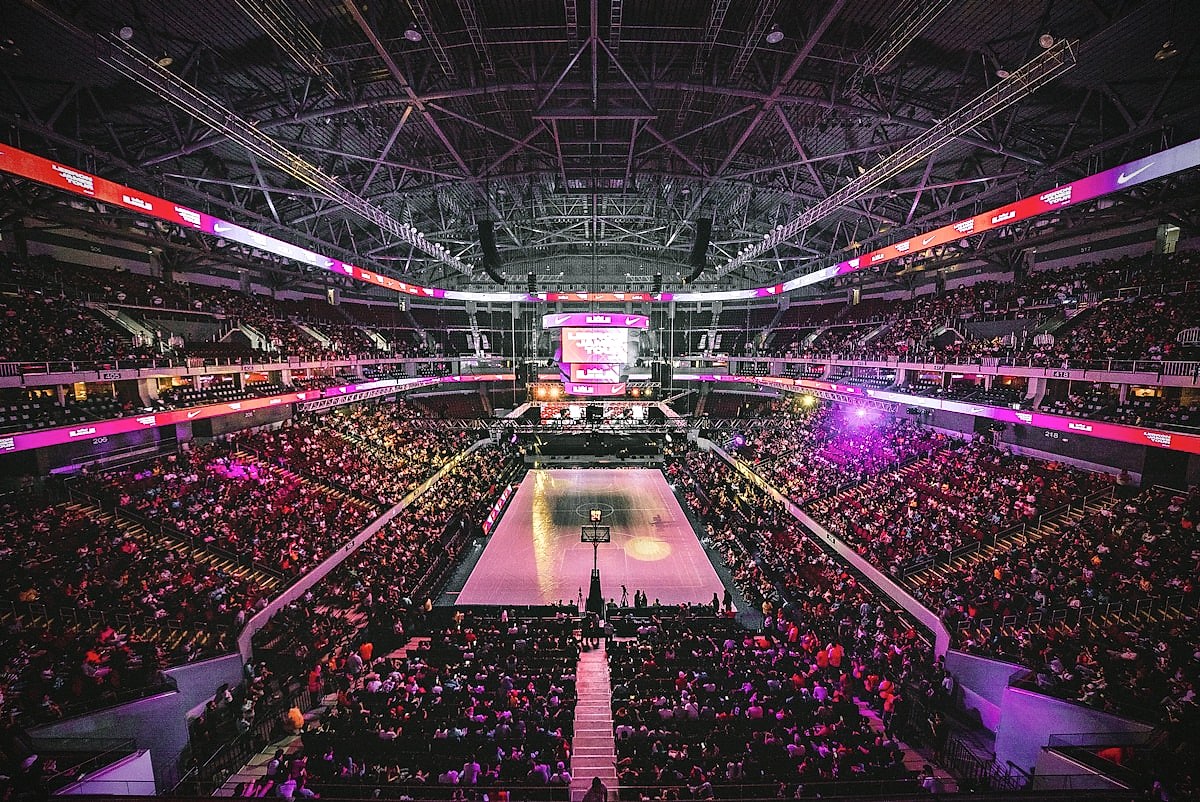
Patrick Ewing is the most important player in the modern history of the New York Knicks and the second-most-important American basketball player of the 1980s college game behind Michael Jordan. He is a 1992 and 1996 Olympic gold medalist (Dream Team member), a 1986 NBA Rookie of the Year, an eleven-time NBA All-Star, a seven-time All-NBA selection, the New York Knicks’ all-time leading scorer, and a 2008 Hall of Fame inductee. He is also the first beneficiary of the NBA Draft Lottery: on May 12, 1985, at the first lottery, Commissioner David Stern drew an envelope bearing the New York Knicks logo, awarding the first pick of the 1985 draft to New York. The moment has been the subject of decades of rigging allegations (including a famous “frozen envelope” conspiracy theory, for which no physical evidence has ever been established). Stern drew the envelope with cameras rolling. The Knicks took Ewing. He never missed a Finals appearance the Knicks reached in his career. Both of them (1994 and 1999) ended in losses.
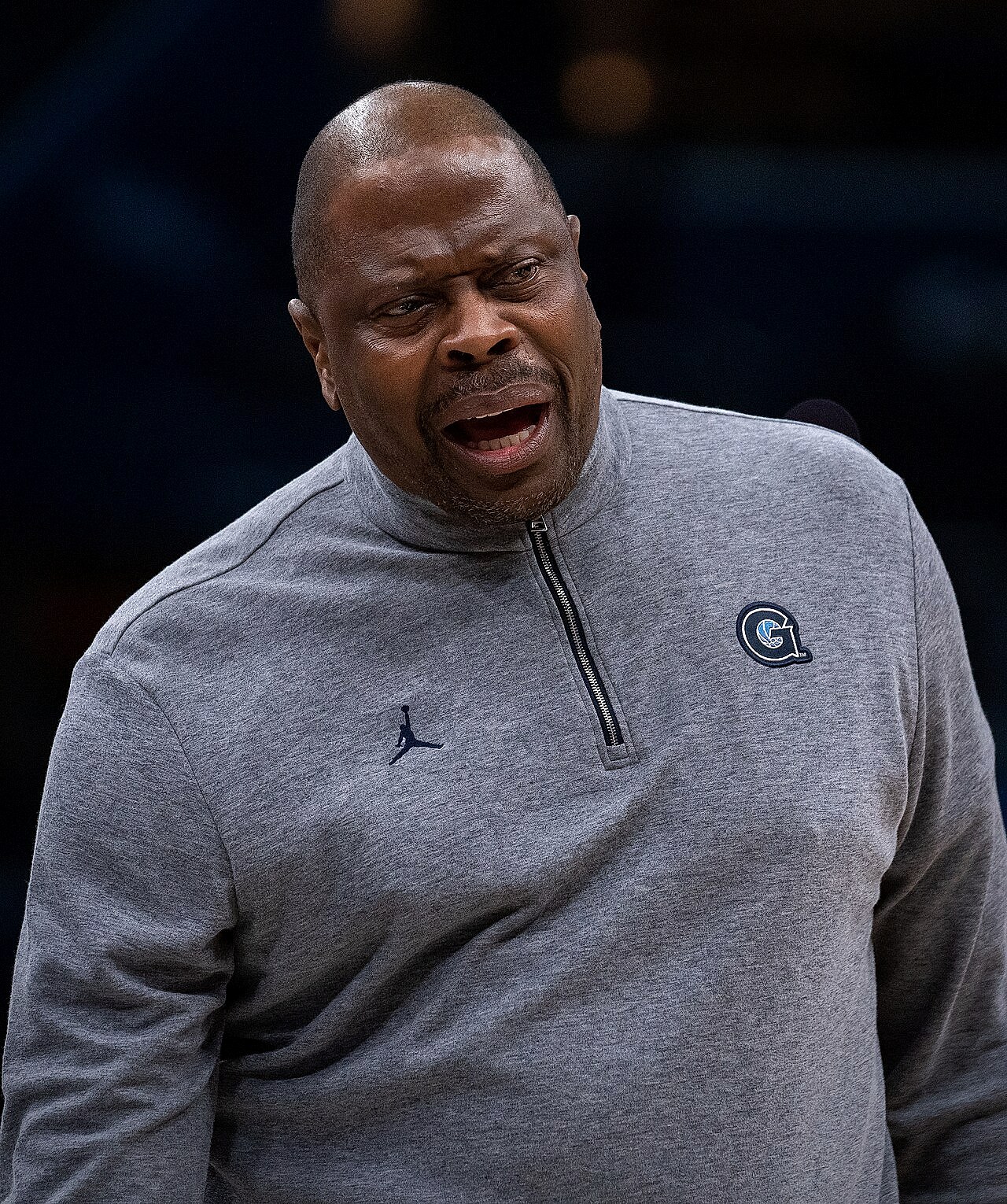
Kingston, Cambridge, and the late basketball start (1962–1981)
He was born August 5, 1962 in Kingston, Jamaica, one day before the nation declared independence from the United Kingdom. He was the fifth of seven children. His mother Dorothy Ewing was a pharmacy assistant; she emigrated to the United States in 1971 to work at Massachusetts General Hospital in Boston. She saved for four years, and in 1975, when Patrick was eleven, she brought the rest of the family to settle in Cambridge, Massachusetts.
He had never played basketball in Jamaica. The sport was not part of the country’s culture at the time. In Cambridge he attended Achievement High School and then transferred to Cambridge Rindge and Latin School as a sophomore. Head basketball coach Mike Jarvis identified him at a gym class during his transfer year as an athletic 6’6” 14-year-old. Jarvis began training him immediately. He grew to 6’11” by his senior year. Cambridge Rindge and Latin went 76-1 across Ewing’s three varsity seasons, winning three consecutive Massachusetts Division I state championships (1979, 1980, 1981). He was a three-time Parade All-American.
Shop Patrick Ewing jersey
As an Amazon Associate we earn from qualifying purchases.
Georgetown (1981–1985)
Every major college program recruited him. He committed to Georgetown over North Carolina, Boston College, and UCLA because of head coach John Thompson, whom he has described in multiple interviews (including the 1985 Sports Illustrated feature by John Papanek and Thompson’s 2022 posthumous memoir I Came as a Shadow) as the single most important non-family figure of his life.
He played four years at Georgetown. The Hoyas reached the NCAA Final Four three times (1982, 1984, 1985) and the championship game in each of those three seasons. In 1982, they lost to Michael Jordan’s North Carolina Tar Heels on Jordan’s freshman-year jumper with 18 seconds remaining. In 1984, they beat Hakeem Olajuwon’s Houston Cougars 84-75 (detailed on our Hakeem Olajuwon biography). Ewing was the NCAA Tournament Most Outstanding Player. In 1985, Georgetown lost to Villanova 66-64 in the championship game in what is still the single most-cited upset of the 1980s NCAA Tournament.
Ewing’s college career totals: 15.3 points, 9.2 rebounds, and 3.4 blocks on .620 shooting. He was a consensus first-team All-American three times. He was the 1985 Naismith College Player of the Year. Georgetown retired his #33 in 1985.
The 1985 Draft Lottery and the early Knicks years (1985–1990)
The 1985 NBA Draft was the first to use the lottery format (replacing the coin-flip that had been in use since the 1960s between the two worst teams in each conference). The lottery was designed to prevent tanking. Seven teams were eligible; each team had an equal chance. On May 12, 1985, at the draw ceremony in New York, Commissioner David Stern pulled an envelope from a bingo-style tumbler. The envelope had the New York Knicks’ logo inside. New York won the first pick.
The conspiracy theory that has followed the draw for forty years is that one of the seven envelopes (specifically the Knicks’ envelope) had been kept on ice before the drawing and that Stern, knowing which was the chilled envelope by the temperature differential, deliberately selected it. The theory has no physical evidence, has been denied by Stern and every surviving league official from the era, and has never been substantiated. Whether it happened is a live question in most 1985-draft retrospective coverage.
Ewing signed the largest rookie contract in NBA history to that point: ten years, $32 million. He won Rookie of the Year in 1985-86 despite a knee injury that limited him to 50 games. By his third year (1987-88) he was averaging 20.2 points and 8.2 rebounds. By 1989-90 he was averaging 28.6 points and 10.9 rebounds and was a first-team All-NBA selection.
The Pat Riley Knicks and the 1994 Finals (1991–1994)
Pat Riley was hired as Knicks head coach on May 31, 1991. The Riley-era Knicks played the most physically violent basketball of the 1990s Eastern Conference. Ewing was the defensive anchor. The 1992-93 Knicks went 60-22 and lost in the second round. The 1993-94 Knicks went 57-25 and reached the Finals.
The 1994 NBA Finals against Hakeem Olajuwon’s Houston Rockets went seven games. Ewing, guarding Olajuwon directly, shot 36% from the floor across the series. Olajuwon shot 50%. The Rockets won Game 7 90-84 in Houston. Ewing set an NBA Finals record with 30 total blocks across the seven-game series. That single-series blocks record still stands. The Game 6 sequence in which Olajuwon blocked John Starks’s would-be game-winning three-pointer at the Summit is cross-referenced on our Hakeem Olajuwon biography.
The Reggie Miller years and the 1999 Finals
The 1994-95 Knicks, coached by Pat Riley for the final season before Riley’s resignation-for-family-reasons departure to Miami, reached the second round and lost to the Indiana Pacers in a seven-game series famous for Reggie Miller’s 25-point fourth quarter in Game 1 (covered on our Reggie Miller biography). Pat Riley left in June 1995. Jeff Van Gundy took over as head coach in March 1996. The 1995-96 and 1996-97 Knicks made deep playoff runs without reaching the Finals.
The 1998-99 Knicks, in the lockout-shortened season, went 27-23 and entered the playoffs as the 8 seed. They beat Miami, Atlanta, and Indiana. Ewing suffered a partial tear of his Achilles tendon in Game 2 of the Eastern Conference Finals against Indiana and did not play another minute of the playoffs. The Knicks reached the 1999 Finals against the San Antonio Spurs without him. They lost in five games. Tim Duncan was the Finals MVP. The 1999 Finals is the only Finals in modern NBA history in which the losing team’s best player did not play.
The late career (1999–2002)
He played his final Knicks season in 1999-2000, averaging 15.0 points and 9.7 rebounds. The Knicks traded him to the Seattle SuperSonics on September 20, 2000 in a four-team deal. He played 82 games for Seattle at 7.3 points per game. He signed with the Orlando Magic in 2001-02 and played 65 games off the bench. He retired on September 18, 2002. His Knicks #33 was retired on February 28, 2003.
Hall of Fame, jersey retirement, and the coaching career
He was inducted into the Naismith Memorial Basketball Hall of Fame on September 5, 2008 alongside Hakeem Olajuwon, Adrian Dantley, Pat Riley, and Cathy Rush. His presenter was John Thompson. In 2010 he was inducted a second time as a member of the 1992 Dream Team. He was named to the NBA 50 Greatest in 1996 and the NBA 75 Greatest in 2021.
He was an NBA assistant coach from 2002 to 2017 with the Washington Wizards (under Eddie Jordan), the Houston Rockets (under Jeff Van Gundy), the Orlando Magic (under Stan Van Gundy, during Dwight Howard’s three DPOY run), and the Charlotte Hornets (under Steve Clifford).
On April 3, 2017 he was hired as the head coach at Georgetown, his alma mater. He went 75-109 across six seasons. The 2020-21 season produced a Big East Tournament championship as the 8 seed, which earned Georgetown its first NCAA Tournament berth since 2015. The 2021-22 season went 0-19 in Big East play, the worst conference record in Georgetown history. He was fired on March 9, 2023. He has worked since as a part-time NBA analyst and a consultant with multiple Hall of Fame events.

Legacy
The basketball argument about Patrick Ewing places him, on most modern all-time rankings, between 25th and 40th. The Athletic’s 2022 NBA 75 ranking placed him 31st. His career per-game averages of 21.0 points, 9.8 rebounds, and 2.4 blocks on .504 shooting are, for a center of his era, elite on every dimension. The ring argument is the dominant frame: he played in two Finals, lost both, and the one in which he was healthy (1994) featured what is, by aggregate evaluation, the single-greatest defensive matchup of his career going the wrong direction. Olajuwon outplayed him. That is the record.
The Knicks franchise perspective is different. Ewing is the franchise’s all-time leading scorer (23,665 points in 1,039 games, both franchise records), the all-time leading rebounder (10,759), and the all-time leading shot-blocker (2,758). He is the Knicks’ most-decorated franchise player by every counting-stat metric. The single-franchise argument is not close.
The cultural legacy is related but distinct. Ewing’s status as a Jamaican-born American basketball player who learned the game at eleven and made the NBA Hall of Fame is, for the subsequent generation of Caribbean-born American basketball players (Rudy Gobert is Guadeloupean-French and does not apply; Serge Ibaka is Congolese; Joakim Noah is French and Swedish; and so on), a foundational biography that had not previously existed. His coaching at Georgetown, even with the 75-109 record, was part of the culturally broader Black-head-coach pipeline Thompson had spent his own career building. The Georgetown-to-Indiana Pacers head-coach trajectory of Ewing’s college assistant Ed Cooley in 2023 is, in part, a direct consequence of the hiring pipeline Ewing’s tenure maintained.
Gear
Read Chris Herring’s Blood in the Garden for the full Knicks era.
Sources
The Kingston-to-Cambridge biography is from John Papanek’s February 1985 Sports Illustrated feature “The Hoya Paranoia” and from John Thompson’s 2022 posthumous autobiography I Came as a Shadow (Henry Holt). The 1985 NBA Draft Lottery and the conspiracy-theory discussion are from NBA.com’s lottery-history archive and from David Stern’s 2010 ESPN interview with Chris Palmer. The 1994 Finals game-by-game is from the NBA’s 1993-94 season archive. The 1999 Finals Achilles tear is from The New York Times’s coverage of the 1999 Eastern Conference Finals. The Georgetown coaching record is from Georgetown University Athletics.
Shop Jerseys & Fan Gear at Fanatics
As a Fanatics affiliate, we may earn a commission from qualifying purchases.
Shop on Amazon
As an Amazon Associate, we earn from qualifying purchases.
Shop Sneakers & Gear at JD Sports
We may earn a commission from qualifying purchases on JD Sports.