Allen Iverson
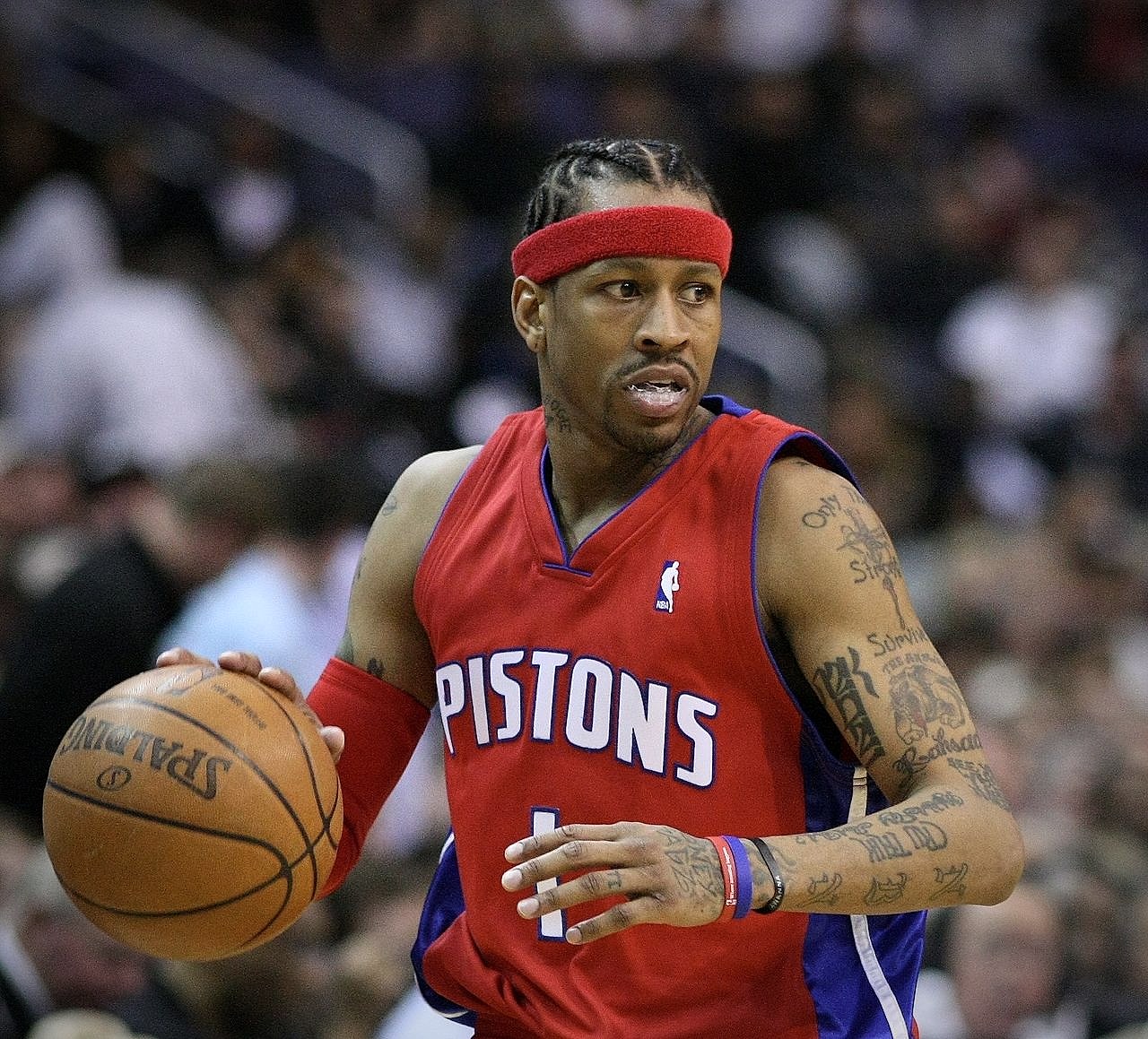
Allen Iverson is the shortest and lightest Most Valuable Player in NBA history. He was six feet tall and weighed 165 pounds the year he won the award. He is also the only player in the last forty years whose cultural footprint on the sport is a serious argument against Michael Jordan’s, which is the kind of sentence that sounds hyperbolic until you remember that the cornrows, the tattoos, the compression sleeve, the “Practice” press conference, the jersey pulled outside the shorts, and half of the silhouette that hip-hop adopted as basketball’s native aesthetic were all either him or downstream of him. He was a four-time scoring champion, an eleven-time All-Star, the 2001 MVP, a Hall of Famer, and a top-ten career per-game scorer in the history of the league. He also served four months in a Virginia detention facility before he ever played a college basketball game. The story is not clean and neither was the career. That is the point of the story.
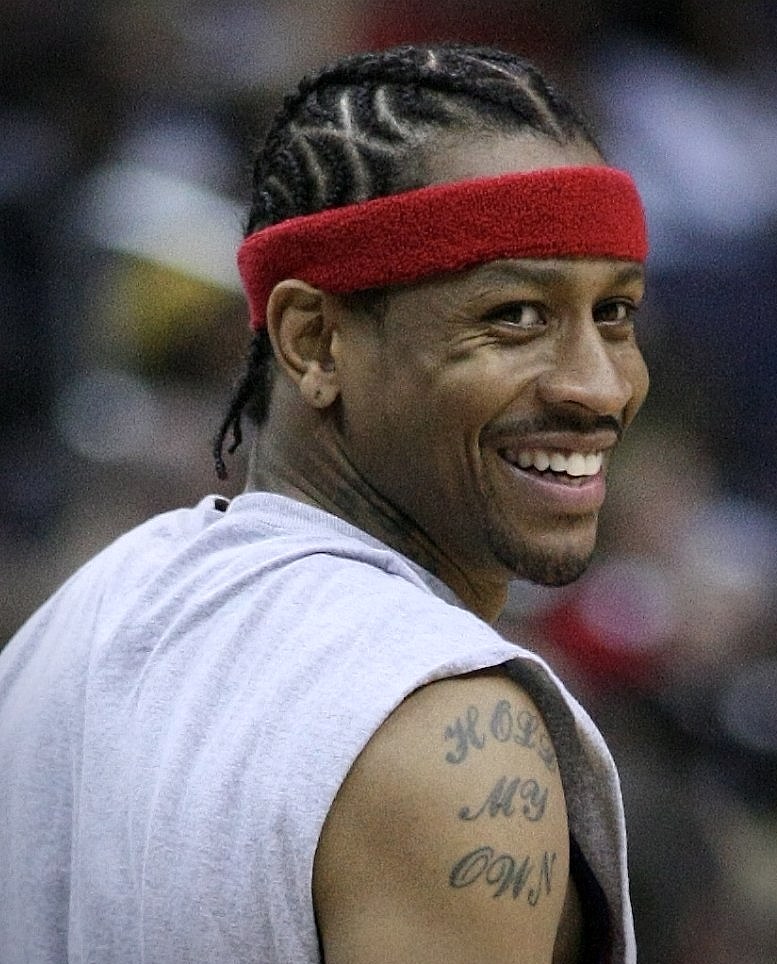
Hampton, Bethel, and the bowling alley
He was born June 7, 1975 in Hampton, Virginia, to a fifteen-year-old mother named Ann. His biological father, Allen Broughton, was never a part of his life. His mother’s partner Michael Freeman raised him through most of his childhood, worked on and off at the Newport News shipyard, and was in and out of jail. Family nickname “Bubba Chuck.” They lived in a house in Hampton with raw sewage in the yard that the city eventually condemned while he was in high school.
At Bethel High School he was the best quarterback in the state of Virginia and the best point guard. He won the Associated Press high-school player of the year award in both sports in 1992-93, junior year. He was the only Virginia athlete ever to do that.
Shop Allen Iverson jersey
As an Amazon Associate we earn from qualifying purchases.
On February 14, 1993, he and three friends walked into a bowling alley in Hampton where a fight was already starting. The fight split along racial lines. Iverson, sixteen years old, was charged along with his three Black friends. None of the white participants were charged. A jury convicted him as an adult of felony “maiming by mob,” which was a Virginia statute originally written in 1926 to prosecute lynching parties and had almost never been used since. He was sentenced to fifteen years with ten suspended. He served four months at the Newport News City Farm before Governor Doug Wilder, the first Black governor in the United States since Reconstruction, granted him clemency on September 13, 1993 and he finished his senior year at Richard Milburn, a school for at-risk students. The Virginia Court of Appeals overturned the conviction in 1995 on the grounds of insufficient evidence.
John Thompson, the Georgetown head coach, had already begun recruiting him before the incident. During the four months in detention Thompson visited. He sent books. When Iverson’s mother Ann drove to Washington during the plea-bargain negotiations and asked Thompson if he would still take her son if the conviction held, Thompson told her yes. Thompson later said in his own 2015 memoir that he took heat for the decision from the Georgetown board and did not care. Kent Babb’s Not a Game: The Incredible Rise and Unthinkable Fall of Allen Iverson (Atria Books, 2015) is the most thorough account of the Hampton childhood and the bowling-alley trial.
Georgetown (1994–1996)
He started every game of his freshman season at point guard in Thompson’s Princeton-adjacent motion offense, which was famously unkind to ball-dominant scorers. He averaged 20.4 points anyway and was the Big East Rookie of the Year. As a sophomore, 1995-96, he averaged 25.0 points a game, was the consensus first-team All-American, and was the Big East Defensive Player of the Year for the second straight season, which is something point guards almost never win.
He declared for the 1996 draft after his sophomore year. He was the first player in John Thompson’s nineteen-year Georgetown career to leave early. Thompson told reporters he had told Iverson to go.
The 1996 draft and the rookie year
The 1996 draft is often cited as the best single draft in NBA history. Kobe Bryant went thirteenth. Steve Nash went fifteenth. Ray Allen went fifth. Jermaine O’Neal went seventeenth. Peja Stojaković went fourteenth. Ben Wallace went undrafted. The first pick, going to the Philadelphia 76ers, was Iverson. He was six feet tall and 165 pounds and he was the shortest and lightest player ever taken first overall.
As a rookie he averaged 23.5 points, 7.5 assists, and 2.1 steals. He was Rookie of the Year. He scored forty or more in five consecutive games in April 1997, breaking a forty-year-old record held by Wilt Chamberlain. On March 12, 1997, in his first head-to-head against Michael Jordan, he crossed Jordan over at the top of the key. The video clip of that crossover is still the single most-replayed rookie-year possession in NBA history.
The 2001 MVP and the Lakers Finals
The 2000-01 76ers are one of those teams that only cohere if you already know the result. They had Dikembe Mutombo (acquired in a midseason trade from Atlanta), Aaron McKie (Sixth Man of the Year), Eric Snow, and Tyrone Hill. They played defense at a generational level under head coach Larry Brown. Iverson averaged 31.1 points, 4.6 assists, and 2.5 steals a game at 6-foot and 165 pounds. He won the MVP with 93 of 124 first-place votes. He was the shortest MVP in league history and remains so. The 76ers finished 56-26, the top seed in the East, and beat Indiana, Toronto, and Milwaukee on the way to the Finals.
Game 1 of the 2001 Finals was played at Staples Center against the Shaquille O’Neal and Kobe Bryant Lakers, who had entered the series 11-0 in the playoffs, undefeated to that point. The Sixers won 107-101 in overtime. Iverson scored 48 points, then the highest debut-game Finals total in NBA history. Midway through the fourth quarter he hit a pull-up jumper from the left wing that sent the Lakers’ Tyronn Lue to the floor, and Iverson, instead of running back on defense, stepped over Lue’s body before jogging back. The photograph of the step-over is one of the most reproduced sports images of the decade.
Los Angeles won the next four games. It is the only Finals appearance of Iverson’s career. The moment about him from that series that stuck is not actually the step-over. It is that Iverson, who had been shooting jumpers in warmups with a black compression sleeve on his right arm to manage right-elbow bursitis, created in a single Finals a piece of NBA fashion that sixty percent of the league’s shooting guards would be wearing within five years.
“Practice” (May 7, 2002)
The Sixers lost to the Boston Celtics in five games in the first round of the 2002 playoffs. The next day Iverson’s coach Larry Brown told reporters that his star was not practicing hard. Iverson held a press conference in the 76ers’ team auditorium. The question from the reporter was short, calm, and neutral: did Iverson agree with Brown that he needed to practice better?
Iverson’s answer, over twenty-three minutes, included the word “practice” twenty-two times. The surviving fragment, which every American sports fan over the age of twenty-five can quote from memory, goes: “We talkin’ about practice. Not a game. Not a game. We talkin’ about practice, man.” He was smiling. He was frustrated. He had just lost a friend, his cousin Nyke Minick, who had been shot and killed a week earlier. He mentioned the cousin twice in the press conference and almost nobody at the time noticed, because everyone was replaying the “practice” loop. The full NBA.com transcript is linked in the sources.
The 2005 60-point game and the final Philadelphia years
On February 12, 2005, against the Orlando Magic, Iverson scored 60 points on 17-of-32 from the floor and 24-of-27 from the free-throw line. It was the highest single-game scoring line in Sixers history until Joel Embiid broke it. Iverson won his fourth and final scoring title that season at 30.7 points a game and was the All-Star Game MVP. The Sixers were eliminated by Detroit in the first round.
On December 19, 2006, nine games into the 2006-07 season, Philadelphia traded him to Denver for Andre Miller, Joe Smith, and two first-round picks. He was at that moment the second-leading scorer in the league, behind only his new Denver teammate Carmelo Anthony.
Denver, Detroit, Memphis, Turkey (2006–2011)
Denver made the playoffs twice with Iverson and lost in the first round both times. On November 3, 2008, the Nuggets traded him to Detroit for Chauncey Billups and Antonio McDyess in a move that Detroit’s front office later conceded was a catastrophic misread of Billups’ value. Iverson clashed with Pistons coach Michael Curry almost immediately and was deactivated in April 2009.
He signed with the Memphis Grizzlies in September 2009 and played three games before leaving in November for “personal reasons.” The Sixers signed him in late November after starting guard Lou Williams broke his jaw. He played twenty-five games for Philadelphia that season and then left the team in February 2010 to care for his daughter Messiah, who was four years old and diagnosed with Kawasaki Disease, a potentially fatal cardiovascular inflammation in young children. That was the last NBA game of his career. He was thirty-four.
In October 2010 he signed a two-year, four-million-euro contract with Beşiktaş in the Turkish Basketball Super League. He played ten games, had calf surgery in January 2011, and never returned to professional basketball.
The return and the retirement (2013)
On October 30, 2013, he formally retired from basketball at a Philadelphia press conference attended by John Thompson, Julius Erving, and Pat Croce. The Sixers retired his #3 jersey at halftime of the March 1, 2014 home game against the Washington Wizards. He cried on the jumbotron and Julius Erving cried standing next to him.

Hall of Fame and cultural legacy
He was inducted into the Naismith Memorial Basketball Hall of Fame on September 9, 2016, as part of a class that included Shaquille O’Neal and Yao Ming. His presenter was John Thompson. The speech, which ran about thirty-three minutes, included a line about Thompson that has been quoted in every retrospective since: “I want to thank you, coach, for saving my life.” He thanked Larry Brown. He thanked Michael Jordan for being the bar. He cried throughout.
The career numbers are 26.7 points, 6.2 assists, and 2.2 steals per game across 914 games. His playoff scoring average of 29.7 is third all-time, behind only Michael Jordan and Luka Dončić. He was named to the NBA 75th Anniversary Team in 2021.
The cultural legacy is separate. He made cornrows mainstream in American sports. He made visible tattoos acceptable in a league that had legislated against them. He wore his jersey oversized. He brought rap music into the league’s pregame ritual. He is the stated influence on the playing style of a long list of guards who came up in the 2000s and 2010s, from Stephen Curry (who has said so in multiple interviews) to Russell Westbrook to Kyrie Irving to Trae Young. Post Malone’s 2015 breakout single, “White Iverson,” is a three-minute pop song built entirely on the idea that being Allen Iverson was the dominant fashion aspiration of a generation of American teenagers. The song has a billion Spotify streams. It is almost certainly the most-listened-to musical tribute to any professional basketball player ever.
Virginia Governor Glenn Youngkin declared March 5 “Allen Iverson Day” statewide in 2024. Newport News renamed a street Allen Iverson Way in 2022. The Sixers unveiled a bronze statue of him outside the team’s practice facility in September 2024. It is the first Sixers statue since one of Julius Erving was commissioned in 2011.
He is, by measure of trophies, the seventh or eighth greatest player ever to wear a Philadelphia 76ers jersey. He is, by measure of cultural reach, inside the top three players the league has produced in its eighty years.
Signature Shoes
Iverson’s Reebok line ran from the Question Mid (his 1996 rookie shoe) through the Answer XIV in 2009, with the Answer IV, worn during the 2001 Finals run, the most historically significant model. The Answer IV is the shoe on his foot during the step-over, and it carried the crossover as its defining identity. Reebok has reissued multiple Answer and Question models in the 2020s.
Shop Reebok Allen Iverson at JD Sports →
Gear
Pick up the full ABA-and-NBA story in Dr. J: The Autobiography.
Sources
The Bethel High School and bowling-alley incident details are taken from contemporaneous Washington Post coverage by Michael Wilbon (September 1993) and from John Thompson’s 2022 posthumous autobiography I Came as a Shadow. The 2001 Finals Game 1 stats and step-over context are from the NBA’s Finals game-log archive. The “practice” press conference transcript is available in full on NBA.com. The Hall of Fame induction speech is cited from the 2016 ceremony broadcast archived at hoophall.com. The career scoring-rank figure (third all-time in playoff ppg) comes from Basketball-Reference’s career playoff leaderboard. Cultural-legacy claims draw on Gary Smith’s December 2003 Sports Illustrated feature “The Answer” and on Ta-Nehisi Coates’s 2001 Mass Appeal profile.
Shop Jerseys & Fan Gear at Fanatics
As a Fanatics affiliate, we may earn a commission from qualifying purchases.
Shop on Amazon
As an Amazon Associate, we earn from qualifying purchases.
Shop Sneakers & Gear at JD Sports
We may earn a commission from qualifying purchases on JD Sports.
Sources
- Basketball-Reference: Allen Iverson
- Naismith Memorial Basketball Hall of Fame: Allen Iverson
- Sports Illustrated: "The Answer" (Gary Smith, December 2003)
- The Washington Post: "Iverson case: Was it a racial incident or a courtroom technicality?" (Michael Wilbon, 1993)
- NBA.com: Allen Iverson, "I'm talkin' about practice" press conference transcript (May 7, 2002)