Reggie Miller
Reggie Miller is the most important player in Indiana Pacers franchise history and, with Larry Bird and Oscar Robertson, one of three basketball figures who define the sport in the state of Indiana. He spent all 18 seasons of his NBA career with one team. He retired on May 19, 2005 as the all-time NBA leader in three-pointers made, a record that has since been broken twice (by Ray Allen, then by Stephen Curry). He is a five-time All-Star, an NBA 75th Anniversary Team selection, a 2012 Hall of Famer, and the author of the most famous five-second stretch of postseason basketball any shooter has ever assembled: eight points in nine seconds against the New York Knicks at Madison Square Garden in Game 1 of the 1995 Eastern Conference Semifinals. That sequence, the 25-point fourth quarter against the Knicks in Game 5 of the 1994 Eastern Conference Finals, and the choke gesture exchange with Spike Lee are the three single-minute pieces of NBA broadcasting that have most thoroughly survived into the streaming era. The career did not end with a ring. The question of whether Reggie Miller deserved one, and why he did not get it, is the defining argument about his place in the retrospective.
Riverside, leg braces, and the family
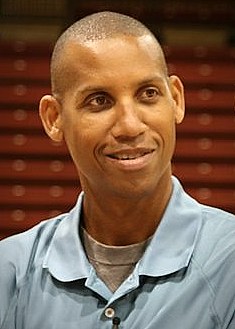
He was born August 24, 1965 in Riverside, California, the fourth of Saul and Carrie Miller’s five children. Saul was an Air Force officer who had played for a championship Air Force basketball team. Carrie taught school. All five Miller children became Division I athletes. His sister Cheryl is the central figure in any Reggie Miller biography. She was, through the mid-1980s, the best women’s basketball player in the world. She was a four-time Parade All-American, a two-time NCAA champion at USC (1983 and 1984), an Olympic gold medalist in 1984, a Naismith Player of the Year, and, at five-foot-eleven, physically more imposing than Reggie was through his teenage years. In a lot of early Cheryl-Miller reporting from the late 1970s (she had been on the cover of Sports Illustrated at 16), the kid brother playing one-on-one against her in the driveway was described as quiet, polite, and overmatched.
Reggie was born with severe hip deformities. He wore full-leg braces from the age of two to five. He could not walk unassisted until he was four. The physical-therapy regimen his mother kept him on through those years was, by his own account in the 1995 memoir I Love Being the Enemy, the reason his legs were eventually stronger than an average player’s. He taught himself to shoot by putting up shots over Cheryl in the backyard, because she was eighteen inches taller than he was until he grew out of it. That is the origin story of his slightly-unorthodox release, which comes from just above his right ear.
Shop Reggie Miller jersey
As an Amazon Associate we earn from qualifying purchases.
UCLA (1983–1987)
He committed to UCLA over USC (where Cheryl was a superstar) because he wanted his own program. He played four years for Walt Hazzard. He finished his college career with 2,095 points, second only to Kareem Abdul-Jabbar on the UCLA all-time list. He was a first-team All-Pac-10 selection as a senior. UCLA won the NIT in 1985 and the Pac-10 regular-season and conference-tournament championships in 1987. UCLA retired his #31 in 2013.
The 1987 draft and the Indianapolis reception
The Indiana Pacers held the 11th pick of the 1987 NBA Draft. Pacers coach Jack Ramsay and general manager Donnie Walsh debated for three weeks whether to take Miller or Steve Alford (the Indiana-born Hoosier superstar who had just won the 1987 NCAA championship with Bob Knight’s team). They took Miller. The reception from the Indianapolis fan base the night of the draft was openly booing. Miller, sitting with his family in New York, later told an Indianapolis Star interviewer that his mother cried. Two decades later, when his #31 was retired at Conseco Fieldhouse on March 30, 2006, the crowd stood for four straight minutes.
The early Pacers years (1987–1994)
He averaged 10 points a game as a rookie and grew into the starting two-guard by his third year. By 1989-90 he was an All-Star. He had 57 points against the Hornets on November 28, 1992, at the time the most ever scored by a Pacer in a single game. By 1992-93 he was leading the league in three-pointers made and free-throw percentage.
Game 5, June 1, 1994 (the choke gesture)
The 1993-94 Pacers finished 47-35 in the East and made their first conference finals in franchise history. They played the New York Knicks, who would go on to lose the 1994 NBA Finals to Houston in seven. In Game 5 of that conference final, at Madison Square Garden, Miller scored 25 points in the fourth quarter on 5-of-5 from three. He went at Spike Lee, sitting in his regular courtside seat, after most of the makes. On one three-pointer over Anthony Mason and John Starks (the 24th point of the fourth quarter), he looked directly at Lee and, as reported by The New York Times and still visible in the YouTube archive of the broadcast, grabbed his own neck in the universal choke gesture. Indiana won 93-86 and took a 3-2 series lead. The Knicks won Games 6 and 7. The choke gesture is still the single most-imitated postgame expression any NBA playoff participant has produced.
Game 1, May 7, 1995 (eight points in nine seconds)
Indiana entered the 1995 Eastern Conference Semifinals against the Knicks down 2-0 in the team’s own mind, because the previous year’s series had ended with Patrick Ewing scoring on what should have been a blocked dunk to force Game 7. Game 1 at Madison Square Garden on May 7, 1995 was close all the way through. With 18.7 seconds remaining the Knicks led 105-99. Miller caught an inbounds pass near half-court and hit a three over Anthony Mason to make it 105-102. He stole the next inbounds pass (the Knicks’ Greg Anthony had fallen attempting to receive it), turned, and hit another three to tie the game at 105. He drew a foul on John Starks with 7.5 seconds left and made both free throws. Final: Indiana 107, New York 105. He had scored eight points in 8.9 seconds. It is the single most famous closing-seconds sequence in NBA playoff history. The full Marv Albert broadcast call (which ends “And the Pacers are going to win this game, unbelievable!”) is cited in virtually every retrospective of the 1990s Pacers-Knicks rivalry.
Indiana won that series in seven. They lost the Eastern Conference Finals to Orlando in seven, ending their best pre-2000 playoff run.
The 2000 Finals
The 1999-2000 Pacers, coached by Larry Bird (then on a three-year contract as head coach), finished 56-26 and entered the postseason as the two seed in the East. They beat Milwaukee, Philadelphia, and New York to reach the first NBA Finals in franchise history. They played Shaquille O’Neal and Kobe Bryant’s Los Angeles Lakers. Miller averaged 24.3 points, 4.2 rebounds, and 3.3 assists across the six games. He made 12 of 24 from three. The Lakers won in six. It is the only Finals appearance of his career.
Larry Bird, the coach, announced his retirement at the end of that series. Miller played five more seasons in a slow decline, finishing with 25,279 career points and, at the time of his retirement on May 19, 2005 (the day after Detroit eliminated the Pacers in the second round), the all-time NBA record for career three-pointers made (2,560). Ray Allen broke the record in 2011 and Stephen Curry broke Allen’s record in December 2021.
Hall of Fame and broadcasting
He was inducted into the Naismith Memorial Basketball Hall of Fame on September 7, 2012. His presenter was Larry Bird. Cheryl Miller, who had been inducted into the Hall in 1995, sat in the front row.
He joined TNT’s NBA coverage as a color commentator in the 2005-06 season. He and Kevin Harlan, then Steve Kerr, then Marv Albert, then Kevin Harlan again, called most of the major TNT playoff series between 2008 and 2025. When Warner Bros. Discovery lost the NBA broadcast rights after the 2024-25 season (a deal that went to NBC, ESPN, and Amazon), Miller was hired by NBC Sports in May 2025 as the lead NBA game analyst, paired with Mike Tirico on play-by-play. It is the most prominent basketball commentary assignment in the sport.
The 2025 Pacers Finals run
The Indiana Pacers reached the 2025 NBA Finals, their first Finals appearance since Miller’s 2000 team. Miller called the entire series on NBC as the newly hired lead analyst. The team lost in seven games to Oklahoma City. During the pregame broadcast of Game 7, Miller sat courtside with his former teammate Rik Smits and was visibly emotional on camera while a pre-recorded video package showed the 1995 eight-points-in-nine-seconds sequence. Miller turned to Tirico and said, “This is why I do it.” It was the highest-rated single NBA telecast of the new NBC era.

Legacy
On pure basketball résumé, Reggie Miller was the best pure shooter of his generation who was not Larry Bird, and the best two-guard of the Eastern Conference whose career did not overlap with Michael Jordan’s prime. He averaged 18.2 points, 3.0 rebounds, and 3.0 assists across his career. His .888 career free-throw percentage is still 9th all-time. He led the league in free-throw percentage five times.
The cleanest legacy argument, for him, is not about rings. It is about the Madison Square Garden chapter of his life. He is the only player other than Michael Jordan who has a dedicated ESPN 30-for-30 documentary specifically about his rivalry with a single city (Dan Klores’ 2010 Winning Time: Reggie Miller vs. the New York Knicks is still, by audience metrics, one of the five most-watched films in the 30-for-30 catalog). The Knicks never beat a Miller-led Pacer team in a game that could have eliminated Indiana. The Knicks eliminated Indiana twice across those seven head-to-head postseason series, but never on a night Miller was healthy and playing his full game.
In 2026, at 60, he is the active basketball broadcaster whose game-analysis persona most directly shapes how a generation of casual fans sees the NBA. The NBC pivot, at the professional stage of his career, has been the cleanest media-role transition any Hall of Famer has made in the last twenty years.
Gear
Read Terry Pluto’s Loose Balls for the ABA era Indiana’s franchise emerged from.
Sources
The 1995 Game 1 “eight points in nine seconds” sequence is documented in Nate Taylor’s May 2020 Indianapolis Star oral history and in the TBS broadcast archive. The choke-gesture game (Game 5 of the 1994 Eastern Conference Finals) is covered in the NBA on TNT broadcast archive and in Dan Klores’s 2010 30-for-30 film Winning Time. The UCLA scoring ranking is from the UCLA Athletics historical records. The family biographical detail, including the leg-brace childhood, is from Reggie Miller’s 1995 memoir I Love Being the Enemy (Simon & Schuster). The 2025 NBC broadcasting transition is reported in Sports Business Journal’s May 2025 coverage.
Shop Jerseys & Fan Gear at Fanatics
As a Fanatics affiliate, we may earn a commission from qualifying purchases.
Shop on Amazon
As an Amazon Associate, we earn from qualifying purchases.
Shop Sneakers & Gear at JD Sports
We may earn a commission from qualifying purchases on JD Sports.
Sources
- Basketball-Reference: Reggie Miller
- Naismith Memorial Basketball Hall of Fame: Reggie Miller
- ESPN 30 for 30: Winning Time, Reggie Miller vs. the New York Knicks (Dan Klores, 2010)
- Reggie Miller, I Love Being the Enemy (Simon & Schuster, 1995)
- The Indianapolis Star: "8 Points in 9 Seconds, An Oral History" (Nate Taylor, May 2020)