Pete Maravich

Pete Maravich is the most prolific scorer in college basketball history. Across three varsity seasons at LSU (freshmen were not eligible for varsity in the late 1960s), he scored 3,667 points in 83 games, an average of 44.2 points per game, without the benefit of the three-point line or the shot clock. The record will never be broken. The combination of rules now in place (a thirty-five-second shot clock, a three-point arc, four years of varsity eligibility, the contemporary defensive rotation) makes the 44.2 mark a structural artifact of one player playing in one specific moment of college-basketball history. He went on to play ten NBA seasons, won a scoring title, made five All-Star teams, and died of sudden cardiac arrest at age 40 during a pickup game in Pasadena, California. His autopsy revealed he had been born without a left coronary artery, a congenital condition that should have killed him before puberty.
Aliquippa and Press
Peter Press Maravich was born June 22, 1947 in Aliquippa, Pennsylvania, a steel town along the Ohio River about 25 miles northwest of Pittsburgh. His father, Press Maravich, was the son of Serbian immigrants and had himself played college basketball at Wofford and Davis & Elkins before serving as a U.S. Navy pilot in World War II. After the war Press took a job coaching basketball at Davis & Elkins and then at Aliquippa High School. By the time Pete was born his father was already preparing to make basketball the family religion.
Mark Kriegel’s 2007 biography Pistol: The Life of Pete Maravich, the gold-standard primary-source account of Maravich’s life, dates Press’s coaching of Pete to age seven. Press had Pete dribble a basketball out of the passenger-side window of a moving car at 25 mph. He had Pete dribble blindfolded in the family living room. He had Pete dribble through movie theaters during double features (the legend that has been most often repeated and is the one Pete confirmed in interviews himself). The point of the drills was muscle memory beyond what any opposing player could match. By the time Pete was twelve he could dribble two basketballs in a figure-eight pattern between his legs, blindfolded, while running.
Shop Pete Maravich jersey
As an Amazon Associate we earn from qualifying purchases.
The family moved with Press’s coaching career. Pete attended Daniel High School in Clemson, South Carolina, then Edwards Military Institute in North Carolina, then Broughton High School in Raleigh. He averaged 32 points his senior year at Broughton.
LSU
Press took the head-coaching job at Louisiana State University in 1966 specifically so he could coach his son. Pete arrived at LSU in the fall of 1966 as part of the freshman class. Under NCAA rules at the time, freshmen could not play varsity. Pete played his freshman year on the LSU freshman team and averaged 43.6 points per game. He scored 50 in his freshman-team debut.
His three varsity seasons (1967-70) were the unbroken peaks of the NCAA scoring record book. As a sophomore in 1967-68 he averaged 43.8 points per game across 26 games. As a junior he averaged 44.2 across 26 games. As a senior he averaged 44.5 across 31 games. He scored 60 or more points eight times. He scored 50 or more 28 times. He scored 69 once, against Alabama in February 1970, on 26-of-57 shooting and 17-of-21 from the line.
LSU went 14-12, 13-13, and 22-10 across his three varsity years. The Tigers reached the NIT his senior year and lost in the third round. The team never reached the NCAA Tournament because the SEC at the time gave its automatic bid to the conference champion (Kentucky won the SEC every year of Pete’s eligibility). Pete left LSU as the all-time NCAA Division I leading scorer with 3,667 points.
The 1970 draft and the Hawks
The Atlanta Hawks took Maravich third overall in the 1970 NBA Draft. The team’s owner, Tom Cousins, signed him to a five-year contract worth $1.9 million, the largest contract in NBA history at the time and roughly four times what Atlanta’s existing star Lou Hudson was making. The Hawks roster also included the future Hall of Fame center Walt Bellamy and the future Hall of Fame coach Joe Caldwell. The locker-room tension was immediate. Veterans resented the contract, the floppy socks, the long hair, the cultural assumption that the white Pistol Pete was the savior of a team that had been mostly Black for two decades.
Pete averaged 23.2 points his rookie year and 19.3 his second year, both lower than his college numbers. His third year (1972-73) he averaged 26.1. The Hawks made the playoffs three of his four years there but did not advance past the second round.
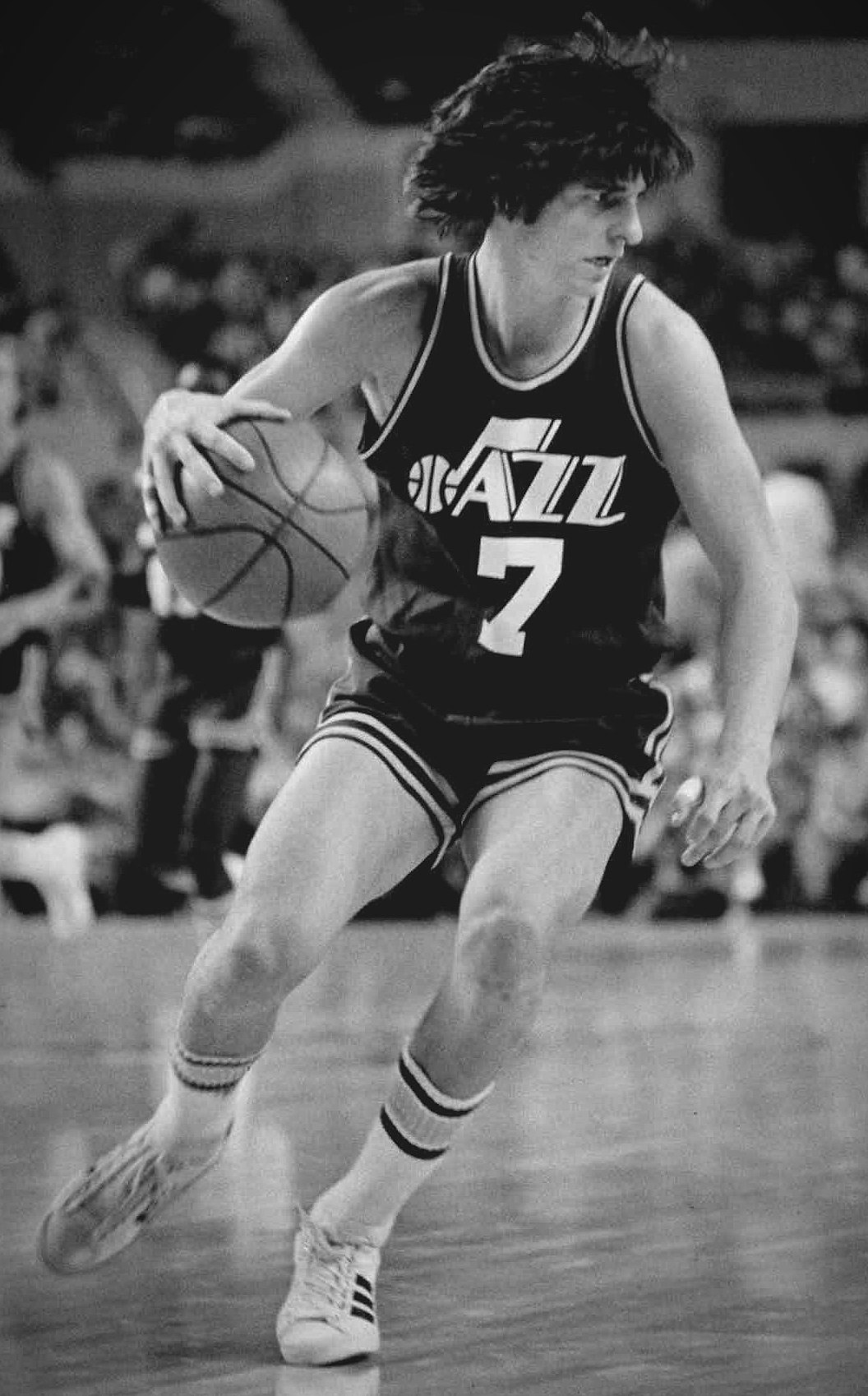
In May 1974 Atlanta traded him to the New Orleans Jazz, an expansion franchise that had paid Atlanta four players and four draft picks to acquire him. The Jazz needed a marquee player to sell tickets in their inaugural Louisiana season. Maravich was that player.
New Orleans and the scoring title
He played six seasons with the Jazz (1974-80), four in New Orleans and two in Salt Lake City after the franchise relocated. The 1976-77 season was the high point. He averaged 31.1 points per game and won the NBA scoring title. On February 25, 1977, against the New York Knicks at the Louisiana Superdome, he scored 68 points on 26-of-43 shooting in a 124-107 Jazz win. Earl Monroe defended him for most of the night and afterward called Pete’s performance the most complete offensive game he had ever seen from a guard.
The Jazz never made the playoffs in his six years. The 1976-77 team finished 35-47 and missed by one game. The 1977-78 team finished 39-43 and missed by one game. He developed a torn meniscus in his right knee in January 1978 that he played through for two seasons. By 1979-80 he was a backup. The Jazz, then in Utah, waived him in January 1980. The Boston Celtics signed him for the rest of that season as a veteran reserve. He played 26 games with Boston, averaged 11.5 points, and reached the playoffs for the only time in his NBA career. Boston lost in the conference finals. He retired the following September at age 33.
After basketball
Maravich became a born-again Christian in November 1982 after years of personal struggle that he later wrote about extensively. His 1987 memoir Heir to a Dream, co-authored with Darrel Campbell, traces the conversion in detail. Through 1983-87 he ran basketball camps for kids and gave church talks across the South. He told friends in interviews that the religious commitment was the most important thing that had happened to him since the LSU years.
He lectured occasionally at coaching clinics. He played pickup ball most mornings. The morning of January 5, 1988, in Pasadena, California, he played in a recreational five-on-five game at the Church of Jesus Christ of Latter-day Saints gym with Dr. James Dobson and a group of Christian ministers. Forty-five minutes into the game he turned to Dobson and said, “I feel great.” He collapsed seconds later. He died at the gym before paramedics arrived.
The autopsy report was the strangest part of the story. Maravich had been born without a left coronary artery, a congenital absence so rare that the medical literature had documented fewer than thirty cases worldwide as of 1988. The right coronary artery had compensated for forty years. The doctors who reviewed the autopsy said publicly that they had no medical explanation for how Maravich had played NCAA basketball at the level he had with that condition, let alone a decade of NBA basketball.
He was 40 years old.

The legacy
He was inducted into the Basketball Hall of Fame in 1987, the year before his death. The NBA named him to its 50th and 75th Anniversary Teams. The Jazz retired his number 7. LSU retired his number 23 in 1989 and erected a statue of him outside the Pete Maravich Assembly Center on campus.
The college scoring record of 3,667 points in 83 games (44.2 per game) is, in 2026, still ahead of the next-highest player on the all-time list when measured by per-game pace. It is a record built into the conditions of the game it was set in. Without the three-point line, without the shot clock, without freshman eligibility, no modern NCAA player can approach it on a per-game basis.
His ten NBA seasons produced 24.2 points per game, then the seventh-highest career scoring average in NBA history at the time of his death. He won no championships. He never made an NBA Finals. He was, by every measure of career-NBA achievement, less than what his college numbers had projected. But the highlight reel he left behind (the no-look passes through three defenders, the running one-handed scoop layups in transition, the deep pull-up jumpers off the dribble that would become the Steph Curry standard fifty years later) is one of the three or four most influential film libraries in the history of the sport.
Press Maravich, his father and his lifelong basketball coach, died of cancer in April 1987, nine months before Pete. They are buried together in Resthaven Gardens of Memory in Baton Rouge.
Gear
Read Mark Kriegel’s Pistol, the best basketball biography of a player never on a championship team.
Sources
- Basketball-Reference: Pete Maravich.
- Mark Kriegel, Pistol: The Life of Pete Maravich (Free Press, 2007).
- Pete Maravich and Darrel Campbell, Heir to a Dream (Thomas Nelson, 1987).
- New York Times obituary, “Pete Maravich, Pro Basketball Star, Dies at 40” (January 6, 1988).
- Sports Illustrated, Frank Deford, “I Want to Do It All” (October 1972).
- New England Journal of Medicine, 1988, summary of autopsy findings on coronary-artery anomalies.
Shop Jerseys & Fan Gear at Fanatics
As a Fanatics affiliate, we may earn a commission from qualifying purchases.
Shop on Amazon
As an Amazon Associate, we earn from qualifying purchases.
Shop Sneakers & Gear at JD Sports
We may earn a commission from qualifying purchases on JD Sports.