Elgin Baylor
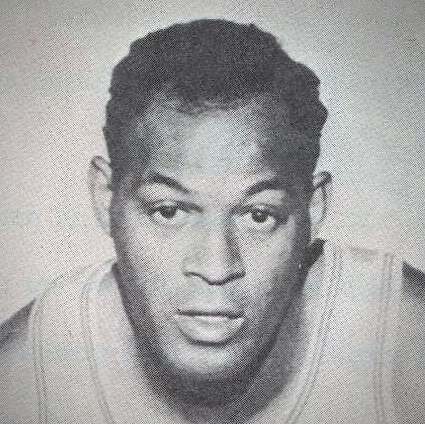
Elgin Baylor was the first basketball player to play in the air. Before him, the dominant scorers (George Mikan, Dolph Schayes, Bob Pettit) operated at floor level: post-up moves, set-shots, the standing dribble pull-up. Baylor was the first NBA player whose game was built on hang time, the moment between leaving the floor and reaching the basket where everyone else had already started coming back down. He was also the most cursed great player in NBA history. He reached 8 NBA Finals across his fourteen years with the Lakers and lost all 8. He retired nine games into the 1971-72 season. The Lakers, no longer running their rotation around his diminished knees, then won 33 games in a row and the championship.
Washington
Elgin Gay Baylor was born September 16, 1934 in Washington, D.C. He grew up in segregated Anacostia. His father, John Baylor, was a Pullman porter; his mother, Uzziel, raised him and his four siblings with a strict church schedule. He picked up basketball late, at age 14, after a neighborhood friend persuaded him to try out for a recreation-league team. Within two years he was the best player at Phelps Vocational, a segregated all-Black trade school. The DC Board of Education in 1953 still ran two separate athletic conferences, one Black and one white. Baylor’s senior year (1953-54) Phelps moved him to Spingarn High School, also all-Black, where he averaged 36 points a game and was named to the first integrated Washington Post All-Met team in 1954.
The asterisk on that selection: he was the first Black player to make the All-Met team. The University of Maryland offered him no scholarship. The University of Virginia did not return his letters. Almost no Atlantic Coast Conference school recruited Black players in 1954, and Baylor, the consensus best high-school player in the District of Columbia, had to look west.
Shop Elgin Baylor jersey
As an Amazon Associate we earn from qualifying purchases.
He spent his freshman year at the College of Idaho on a football scholarship (basketball was not at full-scholarship status there yet). After his coach Sam Vokes was let go in 1955, Baylor transferred to Seattle University. He sat out the 1955-56 season as a transfer per NCAA rules. He played two years at Seattle (1956-58), averaging roughly 31 points and 20 rebounds, and led Seattle to the 1958 NCAA national championship game, where they lost to Adolph Rupp’s Kentucky. Baylor was named the Final Four’s Most Outstanding Player despite Seattle’s loss, the first player on a losing team ever to win the award.
The 1958 draft and the Lakers
The Minneapolis Lakers took Baylor first overall in the 1958 NBA Draft. The franchise had been in steep decline since George Mikan’s retirement in 1956. The 1957-58 Lakers had finished 19-53 and lost more than $200,000 (about $2.2 million in 2026 dollars), and owner Bob Short had reportedly considered folding the team. The first-overall pick was, in front-office conversation that summer, the move that needed to save the franchise. It did.
Baylor’s rookie year (1958-59) he averaged 24.9 points and 15 rebounds, won Rookie of the Year, was named first-team All-NBA, and led the Lakers to the NBA Finals (where they lost to the Boston Celtics in four). He was, on opening night, the third option in the Lakers’ offense behind Vern Mikkelsen and Dick Garmaker. By February he was the centerpiece. Bob Short later said Baylor was the only reason the franchise survived to make the 1960 move to Los Angeles.
November 15, 1960: 71 points
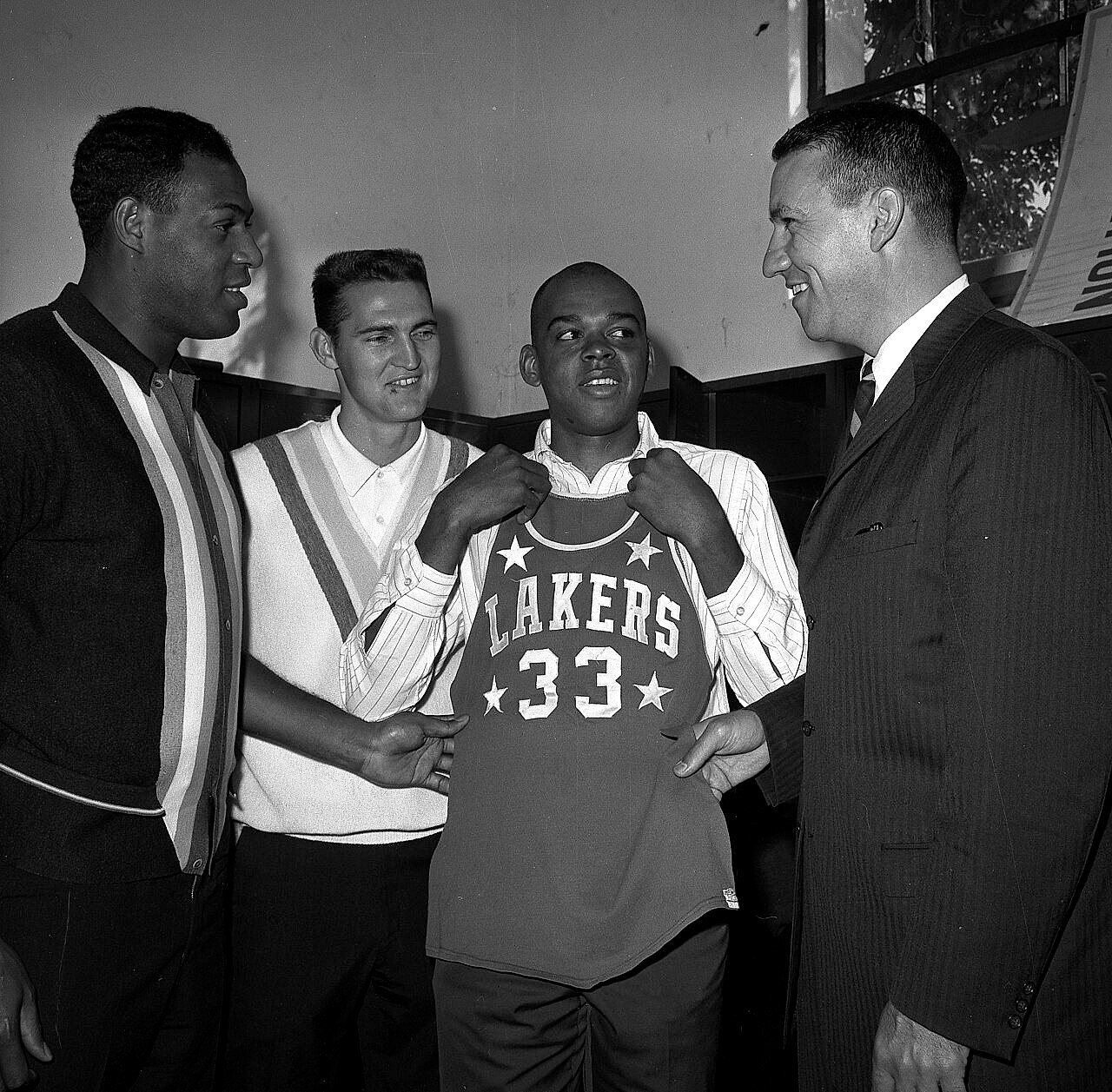
The single-game point record set on a Tuesday night against the New York Knicks at the old Madison Square Garden is the largest stat-line artifact of Baylor’s career. He scored 71 points on 28-of-48 shooting and 15-of-19 from the line, plus 25 rebounds, in a 123-108 Lakers win. The previous NBA record was 64, also held by Baylor (set the previous March against Boston). Wilt Chamberlain broke Baylor’s record the following year with 78, and then with 100 in March 1962.
Baylor’s 71-point game is, by raw points-per-shot efficiency (1.48 PPS), one of the most efficient 70-plus point games in NBA history. He was 26 years old. He played all 48 minutes. The next day’s New York Times ran the story on page B3, which was where the paper buried out-of-town basketball games.
The eight Finals
He was a 14-year Laker. He played in the NBA Finals in 1959, 1962, 1963, 1965, 1966, 1968, 1969, and 1970. He lost all eight, all to the Boston Celtics except 1970 (lost to the Knicks).
The 1962 Finals, his second with the Lakers, were the closest he ever came. The Lakers had Game 7 in Boston, and Frank Selvy missed a jumper in the closing seconds that would have won the championship. The Celtics won 110-107 in overtime. Baylor in that series averaged 40.6 points and 17.9 rebounds, including a 61-point Game 5 in Boston that remains, more than 60 years later, the NBA Finals single-game points record.
The Army year
He missed half of the 1961-62 season because the U.S. Army Reserve activated him to Fort Lewis, Washington. He was permitted to play Lakers games on weekends only, flying out of Tacoma on Friday nights. He played 48 of the Lakers’ 80 regular-season games that year and averaged 38.3 points, 18.6 rebounds, and 4.6 assists. Sports Illustrated ran a March 1962 feature (“The Weekend Lakers”) asking what Baylor’s full-season numbers would have looked like with a normal training and rest schedule. Most modern statisticians, working from his weekend per-game pace, project a 41-point, 19-rebound full-season line. It would have been the highest-scoring season in NBA history at the time.
Knees
A November 1965 playoff game against the Bullets was the first time Baylor’s left kneecap dislocated mid-game. He played the rest of his career on damaged cartilage. The 1970-71 Lakers’ final regular-season game he tore the Achilles in his right leg. He returned for the start of 1971-72 and lasted nine games before retiring on November 4, 1971.
The Lakers played their next game without him. They won. They won the next 32 in a row, an NBA record streak that still stands at 33 games (Nov. 5, 1971 through Jan. 7, 1972), and they won the 1972 NBA championship over the Knicks. Baylor watched from the front row at the Forum as Wilt Chamberlain, Jerry West, and Gail Goodrich raised the trophy he had been chasing since 1959.
He has said in multiple later interviews, including Bill Simmons’s The Book of Basketball in 2009 and his own 2018 memoir Hang Time: My Life in Basketball co-authored with Alan Eisenstock, that the 1972 championship is the single hardest moment of his basketball life. He was not on the floor for it. He had been, he wrote, the player who built the Lakers from a 19-win team into a perennial Finals contender. And then the franchise won the title in the season he stopped playing.
The civil-rights stand
In January 1959, his rookie year, the Lakers played an exhibition game in Charleston, West Virginia. The team’s three Black players (Baylor and two others) were refused service at the Daniel Boone Hotel. Baylor told the Lakers’ coach he would not play the game. The team played without him. The Charleston Gazette ran a story the next day. The NBA, then in its tenth season and still struggling for legitimacy, did not officially comment, but commissioner Maurice Podoloff privately apologized to Lakers owner Bob Short. Baylor’s protest is, by basketball-historical convention, the first time a Black NBA player publicly refused to play over racial discrimination at a road venue. Bill Russell would do the same in Lexington, Kentucky in October 1961. Baylor’s 1959 boycott predates Russell’s by nearly three years.
After basketball
He coached the New Orleans Jazz from 1974 to 1979, including Pete Maravich’s run as the team’s centerpiece (covered in detail on our Pete Maravich biography). He went 86-135 as a head coach. He was fired in 1979 and stayed out of basketball front offices for seven years.
Donald Sterling hired him in 1986 as Los Angeles Clippers vice president and general manager. Baylor served in that role for 22 years, the longest GM tenure in NBA history at the time. The Clippers under his stewardship made the playoffs four times in 22 years and never advanced past the first round. He was let go on October 8, 2008. He sued Sterling in February 2009 alleging age and race discrimination, including a specific allegation that Sterling had wanted a “Southern plantation-type structure” inside the Clippers organization. The age claim went to trial in 2011 and the jury ruled against Baylor. The race claim was dropped before trial. Three years later, in April 2014, Sterling was banned from the NBA for life after the V. Stiviano tape recordings surfaced. Baylor’s allegations, which had been treated dismissively in 2011, looked very different in 2014.
The legacy
He was inducted into the Basketball Hall of Fame in 1977. The Lakers retired his number 22 in 1983. The NBA named him to its 35th, 50th, and 75th Anniversary Teams. Career averages: 27.4 points, 13.5 rebounds, 4.3 assists across 846 regular-season games, plus 27.0 / 12.9 / 4.0 across 134 playoff games. His career playoff scoring average is sixth all time as of 2026, behind only Michael Jordan, Jerry West, Allen Iverson, Kevin Durant, and Luka Dončić.
Bill Russell, who beat him in seven of those eight Finals, has said in his own memoirs that Baylor was the toughest opponent of his career. That endorsement, from the player who beat him over and over again, is roughly where Baylor’s place in the all-time order rests.
Elgin Baylor died on March 22, 2021 at age 86 in Los Angeles, the city he played in for fourteen seasons and lived in for sixty.
Gear
Read how Simmons placed him in The Book of Basketball.
Sources
- Basketball-Reference: Elgin Baylor.
- New York Times obituary, Richard Goldstein, “Elgin Baylor, Lakers Star Who Dazzled Long Before Showtime, Dies at 86” (March 22, 2021).
- Elgin Baylor with Alan Eisenstock, Hang Time: My Life in Basketball (Houghton Mifflin Harcourt, 2018).
- Sports Illustrated, “The Weekend Lakers” (March 1962).
- Bill Simmons, The Book of Basketball (Random House, 2009), Baylor chapter.
- Charleston Gazette, January 1959, on the Daniel Boone Hotel boycott.
Shop Jerseys & Fan Gear at Fanatics
As a Fanatics affiliate, we may earn a commission from qualifying purchases.
Shop on Amazon
As an Amazon Associate, we earn from qualifying purchases.
Shop Sneakers & Gear at JD Sports
We may earn a commission from qualifying purchases on JD Sports.
Sources
- Basketball-Reference: Elgin Baylor
- New York Times obituary, Richard Goldstein, March 2021
- Elgin Baylor with Alan Eisenstock, Hang Time: My Life in Basketball (Houghton Mifflin Harcourt, 2018)
- Sports Illustrated: "The Weekend Lakers" (March 1962)
- Bill Simmons, The Book of Basketball (Random House, 2009), Baylor chapter