Bob Pettit
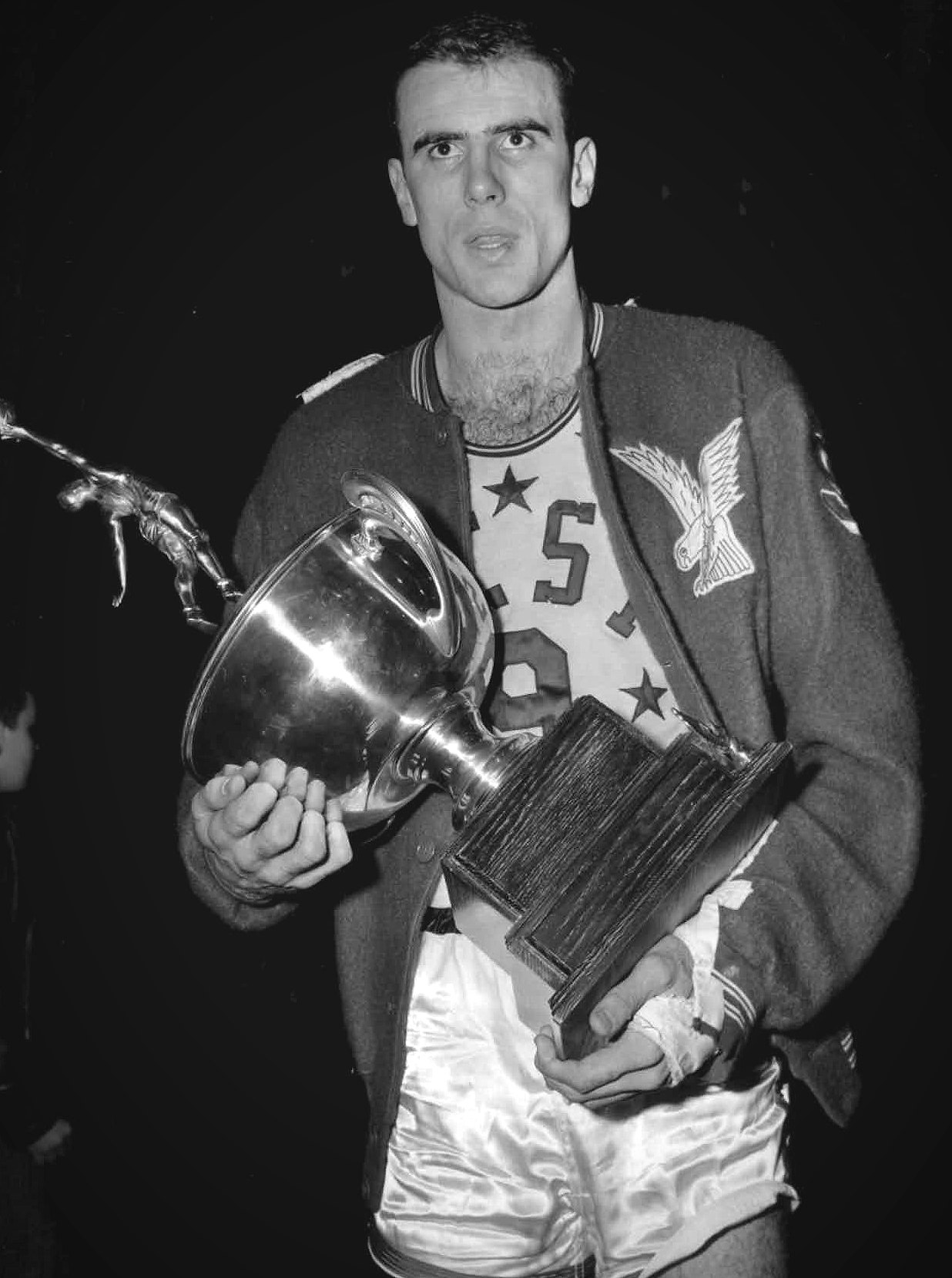
Bob Pettit is the player who broke the Celtics dynasty exactly once. From 1959 through 1966 the Boston Celtics won eight straight NBA championships. The single year in that stretch they did not win was 1958, when Bob Pettit’s St. Louis Hawks beat them in six games in the Finals, with Pettit himself scoring 50 points in the closing Game 6 (including 19 of his team’s final 21). He is the first NBA Most Valuable Player. The award was created in 1956 specifically because the league recognized he was the best player in basketball. He won it twice. He averaged 26.4 points and 16.2 rebounds per game across eleven seasons, all with the Hawks franchise (Milwaukee, then St. Louis). He retired at 32, walked into a New Orleans banking job, and never returned to professional basketball in any role. He is, in 2026, 93 years old and the oldest living NBA Most Valuable Player after Bob Cousy.
Baton Rouge
Robert E. Lee Pettit Jr. was born December 12, 1932 in Baton Rouge, Louisiana. His father, R. E. Lee Pettit Sr., was the East Baton Rouge Parish sheriff for 28 years (1936-1964) and one of the most prominent civic figures in the city. The Pettit family had means. Bob grew up in a four-bedroom house on Park Boulevard with a regulation-height basketball goal his father built into the side of the garage in 1944.
He was cut from the Baton Rouge High School basketball team as a freshman. He was 5’9” then, slow, and could not finish a layup with his left hand. He spent that summer and the next two practicing four hours a day in the driveway. By his sophomore year he had grown to 6’2” and made varsity as a reserve. By his senior year (1949-50) he was 6’7” and the dominant high-school player in Louisiana. He led Baton Rouge to the 1950 Louisiana state championship.
Shop Bob Pettit jersey
As an Amazon Associate we earn from qualifying purchases.
LSU was the obvious college choice. He stayed home and signed with the Tigers in the summer of 1950.
LSU
Pettit played three varsity years at LSU (1951-54). The team’s coach, Harry Rabenhorst, ran a drive-and-pass offense built around Pettit at the high post. LSU went 17-7, 22-6, and 21-5 across his three years. The Tigers won SEC championships in 1953 and 1954. Pettit was a three-time All-American.
The 1953 NCAA Tournament was the high point. LSU reached the Final Four in Kansas City. They lost in the national semifinals to Indiana, with Pettit scoring 17 in the loss. The 1953 Final Four was the first time the LSU basketball program had been on a national stage. Pettit graduated in May 1954 as the leading scorer in LSU history at the time.
The 1954 draft and the Milwaukee Hawks
The Milwaukee Hawks took Pettit second overall in the 1954 NBA Draft. The first overall pick that year was Frank Selvy out of Furman, taken by the Baltimore Bullets. The Hawks were a struggling franchise that had finished 21-51 the previous year and was losing money on attendance in Milwaukee. The team’s owner, Ben Kerner, had publicly considered relocation as early as 1953.
Pettit’s rookie year (1954-55) he averaged 20.4 points and 13.8 rebounds and was named NBA Rookie of the Year. The Hawks finished 26-46. Kerner moved the franchise to St. Louis that summer.
The 1956 MVP
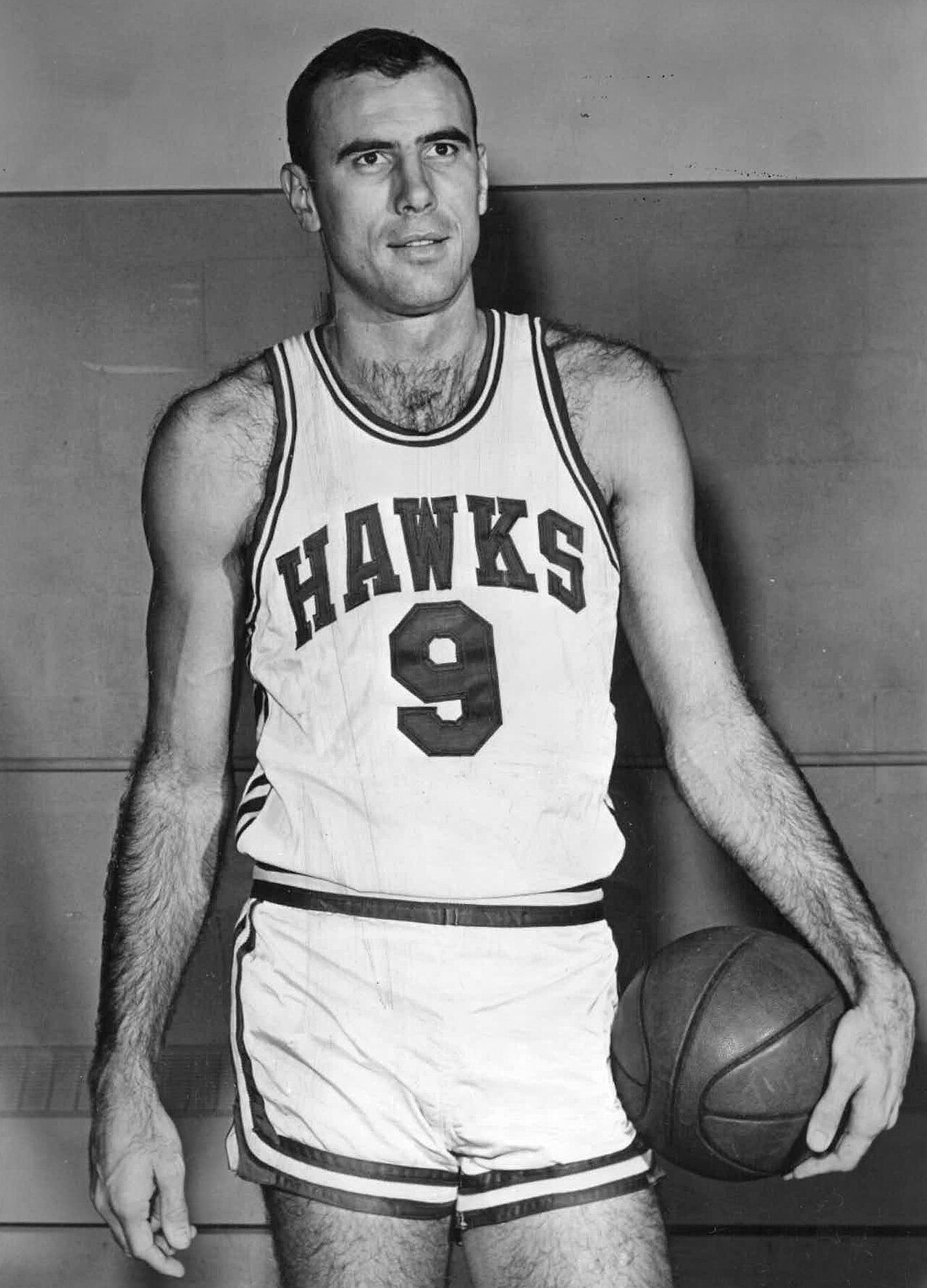
The 1955-56 St. Louis Hawks finished 33-39. Pettit averaged 25.7 points and led the league in rebounding at 16.2. The NBA’s owners, in March 1956, voted to create a Most Valuable Player award. The first vote was a runaway. Pettit won it almost unanimously. He was 23 years old.
The 1956 MVP is, by the structural design of the award itself, the answer to one of the more underdiscussed trivia questions in basketball history: who is the first NBA Most Valuable Player? It is Bob Pettit. The award was added to the NBA’s annual honors specifically to recognize that he was the player the league wanted on its broadcasts and on its program covers. Bill Russell would not enter the league for another six months. Wilt Chamberlain was still at the University of Kansas. The 1956 NBA was, more or less, a Bob Pettit league.
Game 6, April 12, 1958
The single greatest performance of his career came in the Boston Garden in Game 6 of the 1958 NBA Finals. The St. Louis Hawks were up 3-2 in the series. Bill Russell, the Celtics’ second-year center, had injured an ankle in Game 3 and was playing limited minutes. The Hawks sensed an opening. Pettit took it.
He scored 50 points in Game 6, including 19 of the Hawks’ final 21 points across the last 5:32 of the fourth quarter. He shot 19-of-34 from the field and 12-of-19 from the line. The Hawks won 110-109. They won the only NBA championship in St. Louis Hawks history (the franchise has since moved to Atlanta). It is the only championship the Boston Celtics lost between 1957 and 1969 in any season Russell played a healthy role.
Pettit’s 50 in Game 6 is, by many basketball historians’ rankings, in the conversation for the greatest single performance in NBA Finals history. It was a forty-eight-minute performance of pure post offense (turnaround jumpers, hook shots, follow-up rebounds) without anything that would look modern in 2026 highlight terms. He never dunked.
The 1958 Hawks championship is also the structural evidence behind a common counterfactual in basketball-historical writing: had Russell not been injured for parts of that series, the Celtics would likely have won. The dynasty’s eight-straight run from 1959 onward, in that framing, would have been a nine-straight run with 1958 included. Pettit himself has said in interviews that the Russell injury was a factor.
He won his second MVP the following year (1959). He averaged 29.2 points per game and led the league. He played in eleven straight All-Star games (1955-1965), was All-Star Game MVP four times, and was named first-team All-NBA every year of his career except his last (when he made second team).
Retirement at 32
He played his final game on April 25, 1965, a Game 5 playoff loss to the Lakers in the Western Division Finals. He scored 22 points. He retired the following October at age 32. He had averaged 22.5 points and 12.4 rebounds his final season, both well above league average. He was, in any structural sense, still a top-five player in the NBA.
He left the game on his own terms. He has said in multiple interviews that the decision was about avoiding the deterioration he had seen in Bob Cousy’s final two seasons. He did not want to be the great player who hung on. His 1966 memoir, Bob Pettit: The Drive Within Me (Prentice-Hall), is the fullest first-person account of his career and his decision to retire at 32.
Banking, and the quiet years
He returned to Louisiana, finished a banking-management training program, and joined the Bank of New Orleans (later First Commerce, later Bank One) as an executive. He spent his entire post-basketball career in commercial banking, primarily in commercial real-estate finance. He retired from banking in 1995 at age 62.
He has avoided basketball publicity through almost all of the half-century since his playing career. He has appeared at NBA All-Star weekends a small number of times, at Hall of Fame inductions of friends and former opponents, and at the LSU statue dedication in 2002 (the school placed a statue of him outside the Pete Maravich Assembly Center, the same building where the Pete Maravich statue stands a hundred feet away). Beyond those appearances, he has lived quietly with his wife Wanda in Metairie, a New Orleans suburb.

The legacy
He was inducted into the Basketball Hall of Fame in 1970, his first year of eligibility. The Hawks retired his number 9 in 1965. The franchise’s move from Milwaukee to St. Louis to Atlanta means his number is currently retired by the Atlanta franchise, though he never played a game in Georgia. The NBA named him to its 25th, 35th, 50th, and 75th Anniversary Teams.
Career counting numbers: 26.4 points, 16.2 rebounds, and 3.0 assists per game across 792 regular-season games. His career rebound average is among the top ten all time. He is one of only two NBA MVPs from before 1957 (the other being Bob Cousy) who is still living, and his run of ten consecutive first-team All-NBA selections (1955-1964) is one of the longest in NBA history.
Bob Pettit turned 93 on December 12, 2025. He outlived every other 1950s NBA All-Star except Bob Cousy. He has not given a major print interview since approximately 2017.
Gear
Read how Simmons ranked him in The Book of Basketball.
Sources
- Basketball-Reference: Bob Pettit.
- Bob Pettit and Bob Wolff, Bob Pettit: The Drive Within Me (Prentice-Hall, 1966).
- Sports Illustrated, Roy Terrell, “The Quiet Star” (March 1959).
- St. Louis Post-Dispatch archive coverage of Game 6 of the 1958 NBA Finals (April 13, 1958).
- LSU Athletics Department records on the 1953 NCAA Final Four and the 2002 Pettit statue dedication.
Shop Jerseys & Fan Gear at Fanatics
As a Fanatics affiliate, we may earn a commission from qualifying purchases.
Shop on Amazon
As an Amazon Associate, we earn from qualifying purchases.
Shop Sneakers & Gear at JD Sports
We may earn a commission from qualifying purchases on JD Sports.
Sources
- Basketball-Reference: Bob Pettit
- Bob Pettit and Bob Wolff, Bob Pettit: The Drive Within Me (Prentice-Hall, 1966)
- Sports Illustrated: Roy Terrell, "The Quiet Star" (March 1959)
- St. Louis Post-Dispatch archive coverage of Game 6 of the 1958 NBA Finals (April 13, 1958)
- LSU Athletics Department on the 1953 NCAA Final Four and the 2002 statue dedication