The Basketball Hall of Fame Class of 2026
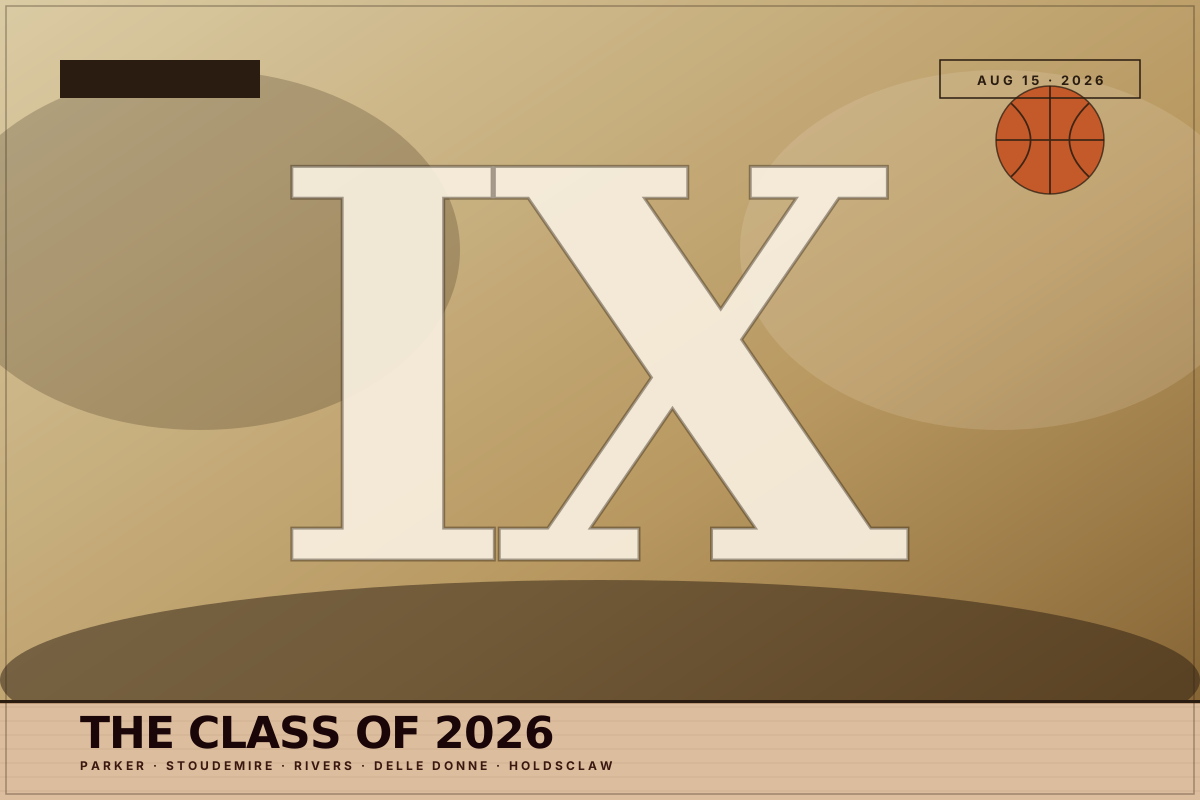
Nine members enter the Naismith Memorial Basketball Hall of Fame this weekend: Candace Parker, Elena Delle Donne, Chamique Holdsclaw, the 1996 United States Women’s National Team, Amar’e Stoudemire, Doc Rivers, Mark Few, Joey Crawford and Mike D’Antoni. The class was announced on April 4, 2026 in Indianapolis, during the NCAA Men’s Final Four, and the enshrinement runs across August 14 and 15, with the ceremony at Symphony Hall in Springfield, Massachusetts.
It is an unusually coherent group. Four of the nine are there for changing how the game is played or officiated rather than for scoring, and four of the nine come from the Women’s Committee, including a full national team.

The class, by committee
| Committee | Inductee | Category |
|---|---|---|
| North American | Joey Crawford | Referee |
| North American | Mark Few | Coach |
| North American | Doc Rivers | Coach |
| North American | Amar’e Stoudemire | Player |
| Women’s | 1996 United States Women’s National Team | Team |
| Women’s | Elena Delle Donne | Player |
| Women’s | Chamique Holdsclaw | Player |
| Women’s | Candace Parker | Player |
| Contributors | Mike D’Antoni | Contributor |
The women’s class is the story
Candace Parker is the most decorated player in the group and one of a very small number of players in either league to have won a championship with three different franchises. She won Rookie of the Year and MVP in the same season, in 2008, and she was the first woman to dunk in an NCAA tournament game. Each of those was a first.
Shop Class of 2026 memorabilia
As an Amazon Associate we earn from qualifying purchases.
Chamique Holdsclaw is the induction that took longest and matters most to people who watched college basketball in the late nineties. She won three consecutive NCAA titles at Tennessee under Pat Summitt, went first overall in 1999, and was compared to Michael Jordan by people who did not make that comparison lightly. Her professional career was shortened and complicated by clinical depression, which she has since written and spoken about at length, and the Hall inducting her is partly an acknowledgment that the standard for a career should not be uninterrupted availability.
Elena Delle Donne shot 50 percent from the field, 40 percent from three and 90 percent from the line across a full season, which almost nobody in either professional league has done, and she did it while managing Lyme disease. She is the rare player whose statistical case and whose difficulty case are equally strong.
The 1996 United States Women’s National Team is the one that changed the structure of the sport rather than a record book. That team toured for a year before the Atlanta Olympics, went undefeated, won gold, and the visibility it generated is the direct reason the WNBA launched in 1997. John L. Doleva, the Hall’s president and chief executive, framed it at the announcement as a team that “helped launch an entire league,” which is not promotional language in this case.
Amar’e Stoudemire
The only NBA player in the class. Stoudemire went straight from Cypress Creek High School in Orlando to the Phoenix Suns in 2002, won Rookie of the Year, and became the finishing half of the most influential offense of the 2000s. He is in the Hall largely because of what he did with D’Antoni, which is why both being in the same class is a nice piece of scheduling.
He also has one of the more instructive injury histories in the modern game: microfracture surgery on his knee in 2005 at the age of 22, an era when that procedure ended careers, and a return to All-NBA level afterward.
Doc Rivers, Mark Few and Joey Crawford
Doc Rivers won the 2008 championship in Boston with a team assembled that summer, was Coach of the Year in 2000 with Orlando, and has coached in the league across four decades. His Hall case is longevity plus a title plus a reputation, held by nearly every player who worked for him, as the best communicator of his coaching generation.
Mark Few built Gonzaga from a regional curiosity into a program that made two national championship games, and did it in a conference nobody scouted, without ever taking one of the jobs that kept opening. That is the entire case and it is enough.
Joey Crawford refereed in the NBA for roughly four decades and worked a long run of Finals. Officials do not usually get in. He did, partly because he was very good and partly because he was the most recognisable referee in the sport, which are related facts and not the same one.

Mike D’Antoni, and the argument he won
D’Antoni goes in on the Contributors Committee, not as a coach, which is the correct and slightly odd classification. He never won a championship. His best team, the 2004-07 Phoenix Suns, lost in the conference finals twice.
He is in because the league now plays his way.
The Seven Seconds or Less Suns ran a spread pick-and-roll offense with a shooting big, four players who could shoot, and an instruction to attack before the defense set. At the time it was treated as a gimmick that could not win in the playoffs. Twenty years later, most offenses in the league are some version of it, and the arguments against it, that you cannot win shooting that many threes, that you have to slow down in May, have been settled decisively in his favour.
Stoudemire was the roll man in that offense. Both of them enter the Hall in the same class, which is the kind of coincidence that reads as design.
Related reading
Sources
Full class list by committee, the April 4, 2026 announcement in Indianapolis and its ESPN2 broadcast, John L. Doleva’s quote, and the August 14-15 enshrinement dates from the Naismith Basketball Hall of Fame’s official release and NBA.com’s coverage of it. Ceremony venue (Symphony Hall, Springfield) and weekend structure from the Hall’s enshrinement page. Individual career details for each inductee are drawn from their Hall of Fame profiles.
Refresh trigger: update after the ceremony with speech detail, and again when the Class of 2027 finalists are announced.
Shop NBA Gear at Fanatics
As a Fanatics affiliate, we may earn a commission from qualifying purchases.
Shop on Amazon
As an Amazon Associate, we earn from qualifying purchases.
Shop Sneakers & Apparel at JD Sports
We may earn a commission from qualifying purchases on JD Sports.