Phil Jackson: 11 NBA championships, two franchises, three superstars
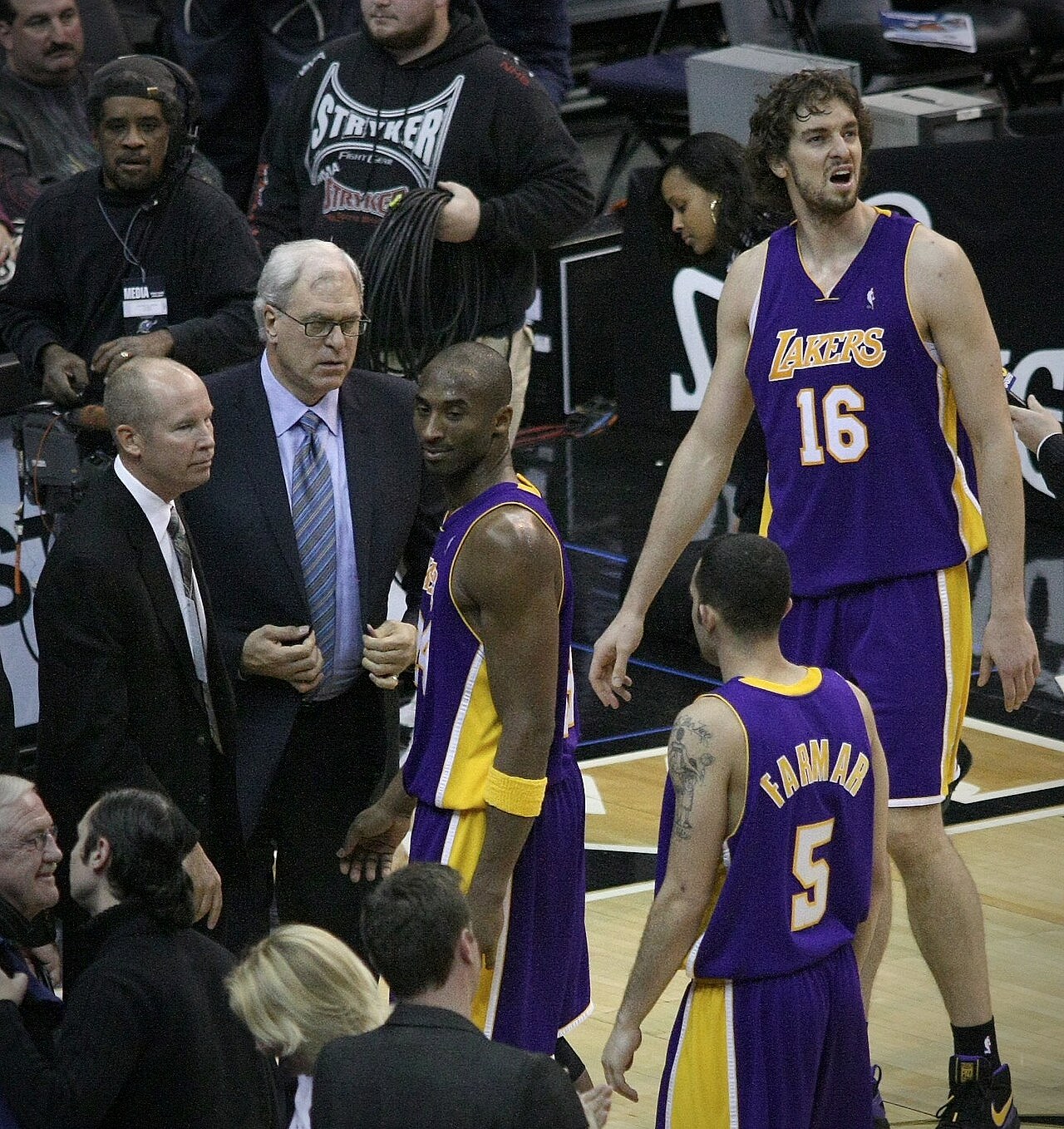
Phil Jackson is, by every standard counting metric, the most successful head coach in NBA history. He won 11 NBA championships across his 20 years as a head coach (1989-2011), a record by a wide margin. Red Auerbach won 9. Pat Riley won 5. Gregg Popovich won 5. No one else has more than 4. Jackson also holds the highest career regular-season winning percentage in NBA coaching history (.704, 1,155 wins against 485 losses) and the highest career playoff winning percentage (.688, 229 wins against 104 losses). He is the only NBA coach to have been to the Finals 13 times.
He did all of this with two franchises (the Bulls and the Lakers) and three superstars (Michael Jordan, Kobe Bryant, Shaquille O’Neal). He is, by basketball-historical convention, both the greatest beneficiary of generational talent in coaching history and the greatest manager of generational talent in coaching history.
Deer Lodge, Williston, and the Pentecostal church
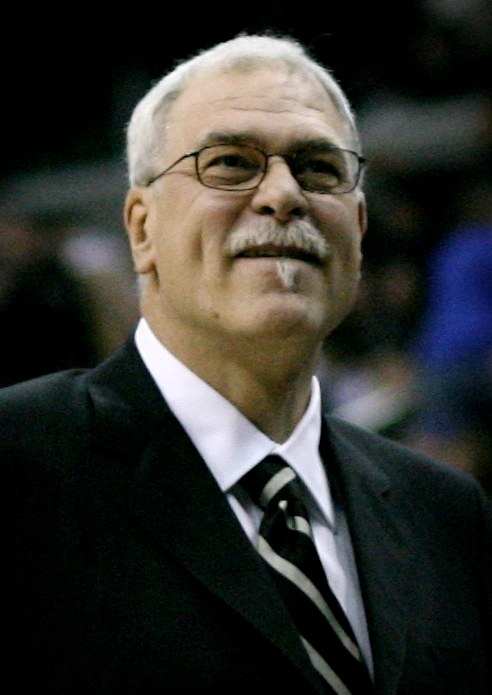
Philip Douglas Jackson was born September 17, 1945 in Deer Lodge, Montana. His parents, Charles and Elisabeth Jackson, were both Pentecostal Assemblies of God ministers. The family moved to Williston, North Dakota when Phil was four. He grew up in a strict religious household where dancing, secular music, and competitive sports beyond the school day were all discouraged. Basketball became the one outlet his parents allowed because Williston High School treated the sport as a community-civic activity rather than entertainment.
Shop Phil Jackson memorabilia
As an Amazon Associate we earn from qualifying purchases.
He was 6’8” by his sophomore year. He led Williston High School to the 1963 North Dakota state championship. The University of North Dakota recruited him for head coach Bill Fitch (who would later coach the Boston Celtics to the 1981 NBA championship). Phil played four years at North Dakota (1963-67), was a two-time NCAA Division II All-American, and led the Fighting Sioux to the NCAA Division II Final Four in 1967.
The New York Knicks took him 17th overall in the 1967 NBA Draft.
The Knicks years (1967-78) and the two championships
Phil played 13 NBA seasons. His best years were as a long, defensively useful reserve forward on the Red Holzman Knicks of the early 1970s. He averaged 6.7 points and 4.3 rebounds per game across his career. He was on the floor for the New York Knicks’ 1973 NBA championship (he had been injured for the 1970 title and watched from the bench in a back brace). He played his final two seasons with the New Jersey Nets (1978-80).
The single most important relationship of his coaching career was formed during these years. Phil idolized Knicks head coach Red Holzman. Holzman’s coaching philosophy (defense-first, distributed offense, treat the team as a group rather than a star plus role players) became the template Phil would later apply in Chicago and Los Angeles. He has said in multiple interviews, including his 1995 book Sacred Hoops, that everything he learned about being an NBA head coach came from Holzman and from his Pentecostal religious upbringing combined.
He retired as a player in 1980 at age 35.
The CBA, then the Bulls
Phil spent five years out of professional basketball after his playing career ended. He worked in real estate in Montana. He published a 1975 book about his Knicks years (Maverick: More Than a Game, co-written with Charley Rosen). He coached the Albany Patroons of the Continental Basketball Association from 1982 through 1987, winning the 1984 CBA championship and the 1985 CBA Coach of the Year award.
Bulls head coach Doug Collins hired him as an assistant in 1987. The 1987-88 Chicago Bulls were Jordan’s fourth NBA season, the year Jordan averaged 35 points per game and won the league’s MVP and Defensive Player of the Year awards in the same season. The Bulls reached the 1988 Eastern Conference Semifinals and lost to Detroit. Collins was fired after the 1988-89 season for failing to advance further. The Bulls’ general manager, Jerry Krause, promoted Phil from assistant to head coach on July 10, 1989.
Chicago (1989-98) and the six rings
Phil’s Bulls won six NBA championships across his nine head-coaching seasons in Chicago: 1991, 1992, and 1993 (the first three-peat) and 1996, 1997, and 1998 (the second three-peat, separated by Jordan’s two-year baseball retirement in 1993-95). The Bulls went 545-193 (.738) in regular-season games under Phil, including the 72-10 record in 1995-96 (then the NBA single-season wins record, broken by the 73-9 Warriors in 2015-16).
The two foundational systems Phil built in Chicago:
The triangle offense, adapted from Bulls assistant coach Tex Winter (who had developed it as the head coach at Kansas State in the 1950s). The triangle is a positionless half-court read-and-react offense that emphasizes ball movement, spacing, and cutting over isolation play. Jordan resisted it at first; he had been built up as an isolation scorer under Doug Collins. By the 1991 playoffs, Jordan had bought in completely. The triangle is the offense Phil ran for the entirety of his coaching career, in both Chicago and Los Angeles.
Mindfulness and Eastern philosophy, drawn from Phil’s interest in Zen Buddhism, Lakota Native American spirituality, and the writings of Friedrich Nietzsche and Carl Jung. Phil ran his Bulls and Lakers practices with extended periods of silent meditation, group breathing exercises, and team-building activities that were unusual in 1990s NBA coaching. He gave players books to read (Nietzsche, Jung, Pema Chödrön, the Bhagavad Gita). The “Zen Master” nickname came from Bulls beat reporter Sam Smith in a 1994 Chicago Tribune feature; Phil neither embraced nor rejected it, and it became permanent.
The 1997-98 Bulls were Phil’s last in Chicago. He left after the 1998 championship (the famous Last Dance season chronicled in the 2020 ESPN documentary). The relationship with Jerry Krause had deteriorated past repair; Krause had reportedly told Phil that the 1997-98 season would be his last in Chicago regardless of the team’s results. Phil took a one-year sabbatical in 1998-99.
Los Angeles (1999-2004 and 2005-2011) and the five rings
Lakers owner Jerry Buss hired Phil in June 1999 specifically to coach Shaquille O’Neal and Kobe Bryant, who had been together since 1996 but had not yet won a championship. Phil’s first three Lakers seasons produced the second three-peat of his career (2000, 2001, 2002). The 2000-01 Lakers went 15-1 in the playoffs, the best playoff record in NBA history at the time.
Phil left the Lakers after the 2003-04 season following a falling-out with Kobe Bryant and a Finals loss to the Detroit Pistons. The team’s official statement was that Phil’s contract would not be renewed; the unofficial story, told in detail in his 2005 book The Last Season: A Team in Search of Its Soul, was that Kobe had told Buss directly that he would not return to the Lakers if Phil did. Phil sat out the 2004-05 season.
Buss rehired him in June 2005. Kobe and Phil reconciled. The 2007-08 Lakers reached the Finals (lost to the Boston Celtics in six). The 2008-09 and 2009-10 Lakers won back-to-back championships, with Pau Gasol acquired from the Memphis Grizzlies in February 2008 as the second star alongside Kobe. The 2009-10 Finals went seven against the Celtics. Kobe was Finals MVP both years.
Phil retired after the 2010-11 season, following a second-round playoff loss to the Dallas Mavericks. He was 65 years old. His final career regular-season record: 1,155 wins, 485 losses (.704). His final playoff record: 229 wins, 104 losses (.688). Both numbers are NBA records. He had won 11 of the 13 NBA Finals he had coached in.
The Knicks executive years (2014-2017)
The single misstep on Phil’s basketball résumé came after his coaching career. The Knicks hired him as president in March 2014 with a five-year, $60 million contract, the largest executive contract in NBA history at the time. The Knicks went 80-166 (.325) under his front-office leadership across three seasons. He hand-picked Derek Fisher as head coach; Fisher was fired in February 2016, eighteen months in. He drafted Kristaps Porziņģis fourth overall in 2015 (a good pick) and Frank Ntilikina eighth overall in 2017 (not a good pick). He publicly feuded with Carmelo Anthony for two seasons.
The Knicks and Phil mutually parted ways on June 28, 2017. He has not held a basketball-operations role since.
The legacy
Phil Jackson is the only NBA head coach to win 11 championships. The next-closest is Red Auerbach with 9. The full top of the NBA championship-by-coach list: Jackson 11, Auerbach 9, Pat Riley 5, Popovich 5, John Kundla 5 (Mikan-era Lakers), Steve Kerr 4.
He was inducted into the Basketball Hall of Fame as a coach in 2007. His five published books (Maverick, Sacred Hoops, More Than a Game with Charley Rosen, The Last Season, and Eleven Rings) are, collectively, the most widely cited coaching-philosophy library by any NBA head coach.
Phil Jackson is, in 2026, 80 years old. He lives at his ranch in Flathead County, Montana, with his longtime partner (and former Lakers president) Jeanie Buss. He gives interviews sparingly. He has not, in seven years since the Knicks departure, returned to professional basketball.
The triangle offense, his foundational on-court system, has been entirely abandoned in the modern NBA. No team runs it as a primary half-court set in 2026. Spacing-and-shooting concepts have replaced post-up cutting as the league’s offensive default. The mindfulness elements of Phil’s coaching, however, are now standard. Roughly 40% of NBA franchises in 2026 employ a full-time mindfulness or sports-psychology consultant. The line between Phil’s 1990s Bulls practice rooms and the modern NBA’s wellness departments is direct.
Gear
Read Jackson’s full account of all eleven championships in 11 Rings.
Sources
- Basketball-Reference: Phil Jackson coaching record.
- Phil Jackson with Hugh Delehanty, Sacred Hoops: Spiritual Lessons of a Hardwood Warrior (Hyperion, 1995).
- Phil Jackson with Hugh Delehanty, Eleven Rings: The Soul of Success (Penguin Press, 2013).
- Phil Jackson with Charley Rosen, More Than a Game (Seven Stories Press, 2001).
- Phil Jackson, The Last Season: A Team in Search of Its Soul (Penguin Press, 2005).
- Roland Lazenby, Mindgames: Phil Jackson’s Long Strange Journey (NTC Contemporary, 2001).
Shop NBA Gear at Fanatics
As a Fanatics affiliate, we may earn a commission from qualifying purchases.
Shop on Amazon
As an Amazon Associate, we earn from qualifying purchases.
Shop Sneakers & Apparel at JD Sports
We may earn a commission from qualifying purchases on JD Sports.
Sources
- Basketball-Reference: Phil Jackson coaching record
- Phil Jackson with Hugh Delehanty, Sacred Hoops: Spiritual Lessons of a Hardwood Warrior (Hyperion, 1995)
- Phil Jackson with Hugh Delehanty, Eleven Rings: The Soul of Success (Penguin Press, 2013)
- Phil Jackson, The Last Season: A Team in Search of Its Soul (Penguin Press, 2005)
- Roland Lazenby, Mindgames: Phil Jackson's Long Strange Journey (NTC Contemporary, 2001)