Magic Johnson
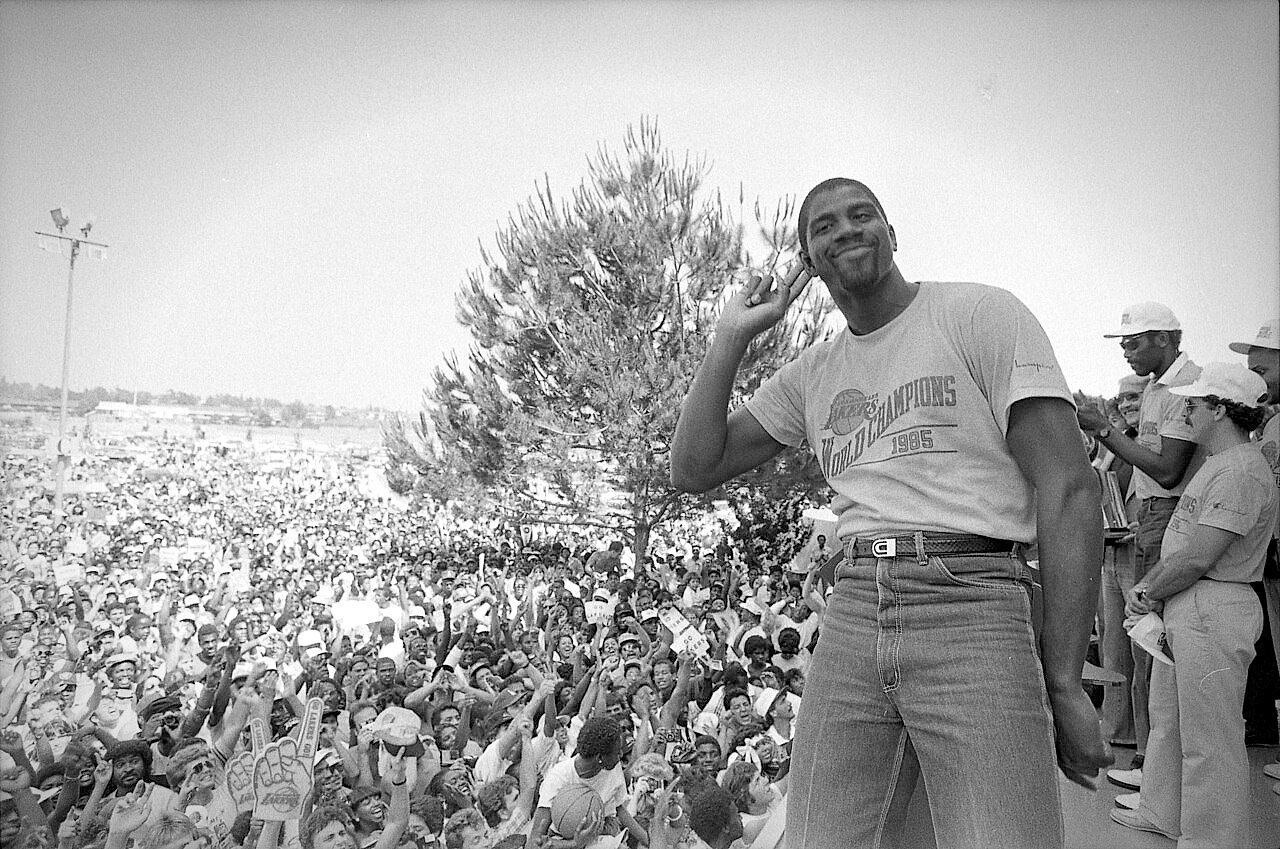
Earvin “Magic” Johnson Jr. was the first dominant six-foot-nine point guard the NBA had ever seen. Across thirteen seasons with the Los Angeles Lakers he won five NBA championships, three regular-season Most Valuable Player awards, three Finals MVPs, and, in an era before the league tracked them, enough assists to have retired as the career leader in assists per game, a mark Steve Nash later broke. He is also, in fairness, the reason the NBA survived the early 1980s in recognizable form. What the league did after 1979 with Johnson in it and Larry Bird opposite him is still the most economically important single thing that has happened to the sport of professional basketball in this country.
Lansing, and the nickname that almost did not stick
He was born August 14, 1959 in Lansing, Michigan, the fourth of seven children. His father, Earvin Sr., worked two shifts at a General Motors plant and picked up a weekend garbage-collection route; his mother, Christine, was a school custodian. The household was, by every on-the-record account, disciplined and close. Earvin Jr. learned the game on a Main Street court in west Lansing, walked the ball to school dribbling left-handed one day and right-handed the next, and by his junior year at Everett High School was averaging 29 and 17 on a team that went 27–1 in the regular season and won the Michigan Class A state championship.
The nickname came from Fred Stabley Jr., a Lansing State Journal sportswriter who in a 1974 game story referred to the fifteen-year-old Earvin as “Magic” after a triple-double in a regular-season home game. The name stuck almost immediately. Earvin’s mother, a church-going woman, was privately uncomfortable with the implication, she preferred his given name, and the family continued to call him Earvin in the house for years after the rest of the country had stopped.
Shop Magic Johnson jersey
As an Amazon Associate we earn from qualifying purchases.
Michigan State and the 1979 NCAA championship
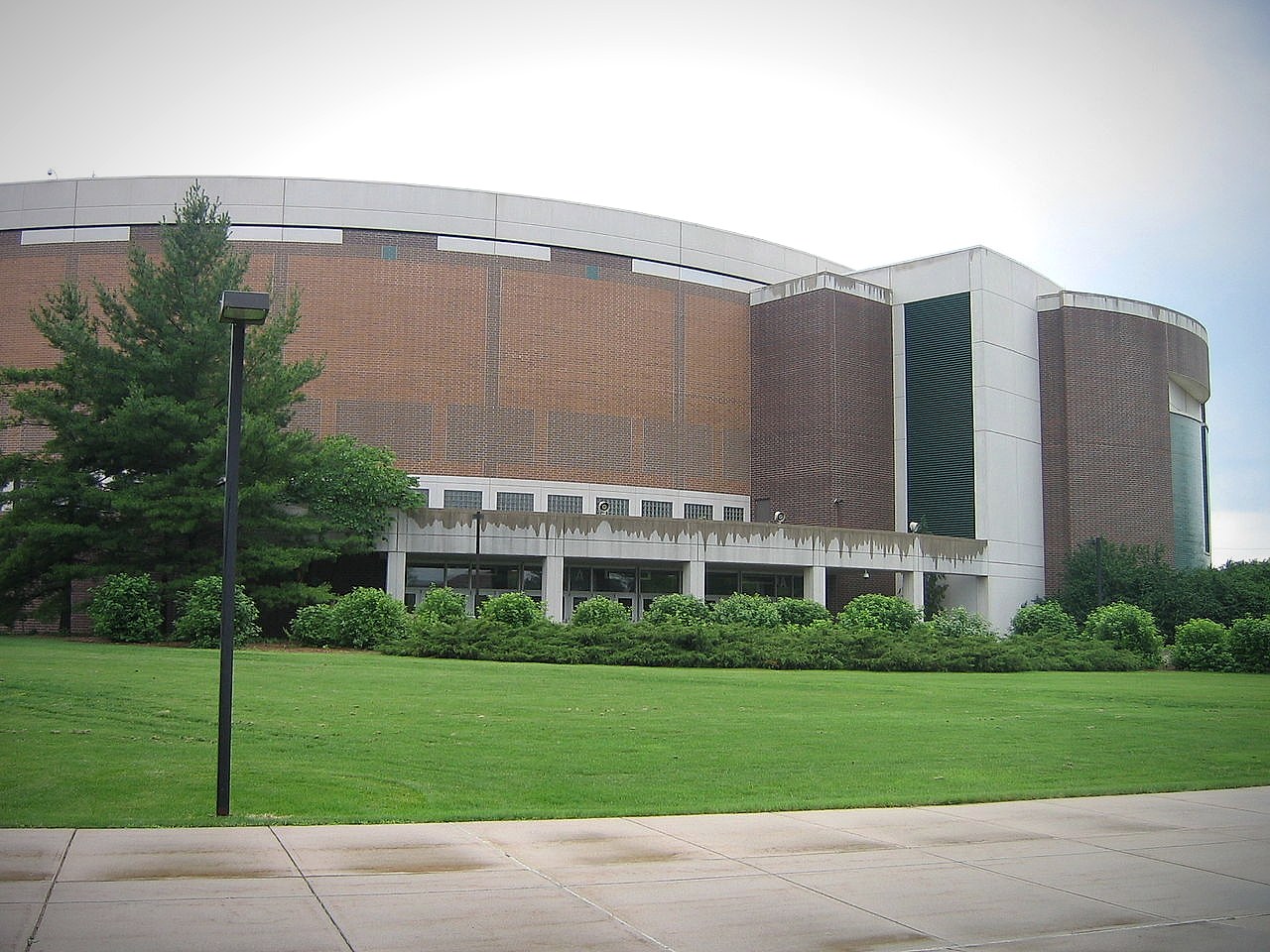
He stayed local for college, Michigan State, in East Lansing, a bus ride from the high-school gym, and played two seasons under head coach Jud Heathcote. In 1978–79 he led the Spartans to the NCAA championship game against Indiana State, a 33–0 team built around senior forward Larry Bird. The two programs had circled each other through the NCAA tournament and the bracket aligned exactly the way the television industry had hoped it would. NBC broadcast the March 26, 1979 final. The Nielsen rating was 24.1. It is still the highest college basketball broadcast in American television history and, a separate and maybe more important fact, the moment the NBA’s incoming marketing apparatus understood what it had. Michigan State won 75–64. Johnson was named the Most Outstanding Player of the tournament and declared for the NBA Draft the following week.
The Lakers pick him first, and the rookie Finals
The Los Angeles Lakers, who owned the first overall pick in the 1979 draft as a result of a 1976 trade with the New Orleans Jazz, selected Johnson on June 25, 1979. The team already had Kareem Abdul-Jabbar in his prime and Norm Nixon at point guard. Johnson’s nominal position was guarded by Nixon, which is why his rookie year was the most positionally creative season of the era, head coach Paul Westhead played Johnson at three different positions on any given night, with Nixon’s minutes and his overlapping.
The 1979–80 season ended with the Lakers back in the Finals. Abdul-Jabbar sprained his ankle in Game 5 against Philadelphia and was ruled out for the deciding Game 6 in the Spectrum. Johnson, a twenty-year-old rookie guard, started at center. He went for 42 points, 15 rebounds, 7 assists, 3 steals, and a block in 47 minutes of play, one of those stat lines that looks, in retrospect, like a typographical error, and the Lakers closed out the series. He was named Finals MVP. He remains the only rookie in NBA history to receive the award.
Showtime (1980–1991)
Across the 1980s the Lakers reached the NBA Finals nine times and won five: 1980, 1982, 1985, 1987, and 1988. Johnson’s partnership with Kareem Abdul-Jabbar, James Worthy, and, from 1981 onward, head coach Pat Riley produced what the league’s marketing department eventually formalized as the “Showtime” brand. The offense was, in schematic terms, a transition-heavy system in which Johnson’s rebounding at six-foot-nine allowed him to push the ball himself after almost every defensive possession, a configuration no previous NBA team had run because no previous NBA team had a six-foot-nine point guard available to run it.
Johnson won three regular-season MVPs (1987, 1989, 1990) and three Finals MVPs (1980, 1982, 1987). The three Finals against Bird’s Celtics, 1984 (Boston won), 1985 (Lakers won), and 1987 (Lakers won), are the competitive spine of the decade and the part of the era the television industry most specifically cashed in on. NBA Finals ratings more than doubled between 1979 and 1987.
November 7, 1991
On the morning of November 7, 1991, Johnson held a press conference at the Forum and announced that he had tested positive for HIV. He retired before the regular season began. The announcement is still, by most media-history accountings, the single largest shift in public understanding of HIV and AIDS to happen in the United States during the epidemic, a significantly larger cultural inflection than any single advocacy campaign, any governmental statement, or the 1985 death of Rock Hudson, which had itself substantially moved the needle. Johnson was thirty-two years old. He had been the biggest star in the NBA for twelve seasons.
He returned briefly for the 1992 NBA All-Star Game in Orlando, where, against a lineup that included Michael Jordan, Clyde Drexler, and several teammates who had publicly said they were uncomfortable sharing the floor with him, he was named MVP on a last-minute three-pointer at the top of the key, with every player on the floor hugging him at the buzzer. He joined the Dream Team in Barcelona that summer. A full attempted comeback during the 1995–96 regular season lasted thirty-two games before he retired for the final time at age thirty-six. Sixteen teams, at that point, still had an unspoken policy against traveling with a player on antiretroviral therapy; by the 1997–98 season, none did. The policy change is the quiet part of the HIV announcement’s legacy that American sports media has never quite finished crediting him for.
The business years
The post-playing career is the part of Johnson’s life that the next generation of American business schools will probably teach. His 1992 memoir My Life (Random House) covers the HIV announcement and the Showtime years in his own words. Between 1994 and roughly 2020 he built one of the largest and most deliberate Black-American ownership portfolios in the country, organized around a simple thesis: urban-market services underserved by major chains. The specific investments:
- Magic Johnson Theaters, a chain of movie theaters placed in urban-core neighborhoods (Los Angeles, Harlem, Atlanta, Houston) that the national chains had abandoned in the 1970s. Sold to AMC in 2008.
- Starbucks, via the “Urban Coffee Opportunities” joint venture, in which Johnson opened more than 125 Starbucks locations in under-served neighborhoods starting in 1998. Divested back to Starbucks corporate in 2010.
- Guggenheim Baseball Management, the ownership group that purchased the Los Angeles Dodgers for $2.15 billion in 2012. Johnson was the public face and a minority equity partner; the group’s principal capital came from Mark Walter and Guggenheim Partners.
- Magic Johnson Enterprises, the holding company through which he eventually acquired stakes in the Los Angeles Sparks (WNBA), the Los Angeles FC (MLS), and, in 2023, the Washington Commanders of the NFL, as part of the Josh Harris-led ownership group.
A brief and not-successful detour as the Lakers’ president of basketball operations occupied 2017 through the spring of 2019; Johnson resigned that April in a press conference he had not informed the franchise’s front office about in advance, a detail that has gotten him teased for six years and that he has, to his credit, not tried to re-narrate.
Hall of Fame
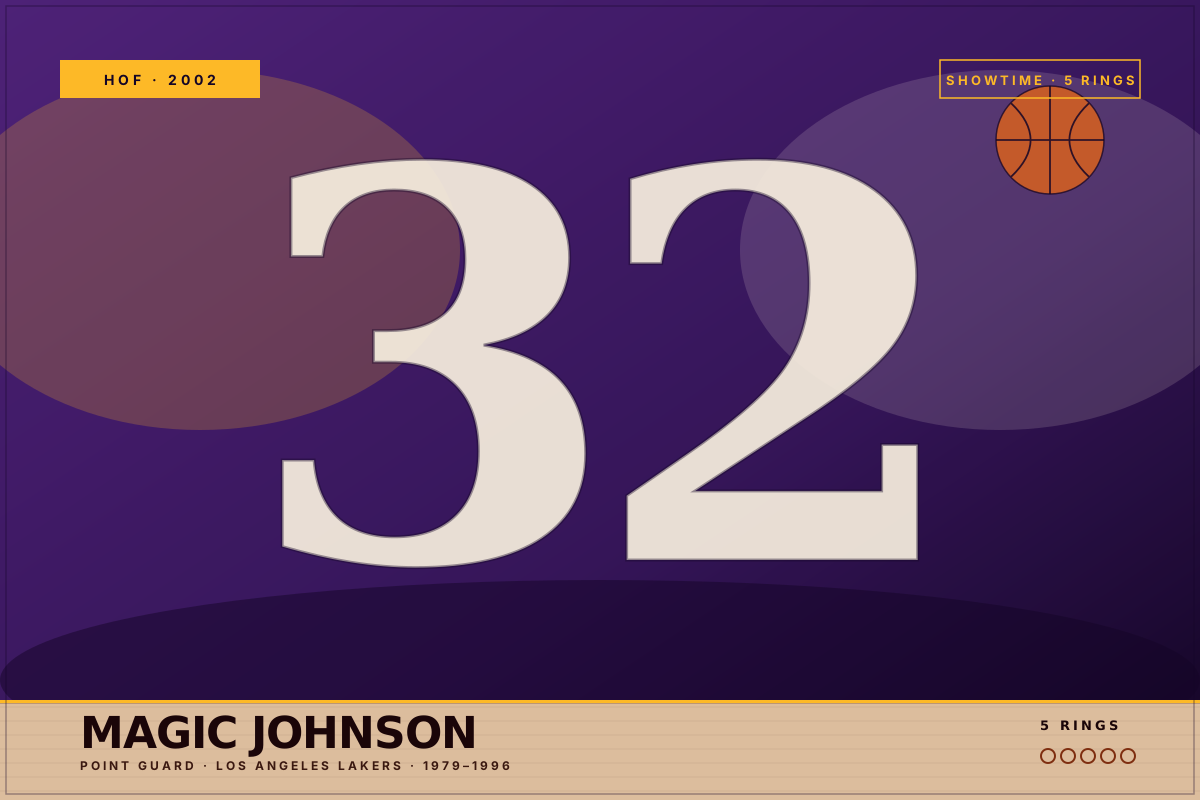
Johnson was inducted into the Naismith Memorial Basketball Hall of Fame in 2002 and inducted a second time, as a member of the 1992 Dream Team, in 2010. The Lakers retired his number 32 in a February 1992 ceremony that took place three months after the HIV announcement; Kareem Abdul-Jabbar’s 33 was retired the same night. The two jerseys hang together today at Crypto.com Arena.
Legacy, and the version of the 1980s he authored
It is fair to say, as the record books do, that Johnson was the first NBA point guard who looked like a modern NBA point guard, that the LeBron James / Luka Dončić / Nikola Jokić six-foot-nine-primary-playmaker archetype is downstream of him, not of anyone else. It is also fair to say something the record books do not, which is that the specific marketing and economic version of the NBA that emerged in the 1980s was a Johnson product at least as much as it was a league-office product. The smile on the magazine covers, the charisma on the network pregame shows, the very particular Midwestern politeness that translated to any audience, all of those are Johnson’s. The league ran on them for a decade. They also, not coincidentally, were the thing that made the second act possible. A lot of retired Hall of Fame players try to become business figures after they retire. The ones who succeed tend to have been charismatic on the court too. Johnson is the canonical example.
Gear
Read When the Game Was Ours, his joint memoir with Larry Bird.
Shop Jerseys & Fan Gear at Fanatics
As a Fanatics affiliate, we may earn a commission from qualifying purchases.
Shop on Amazon
As an Amazon Associate, we earn from qualifying purchases.
Shop Sneakers & Gear at JD Sports
We may earn a commission from qualifying purchases on JD Sports.